A quadratic formula calculator gives you the solutions of any equation written as ax² + bx + c = 0 in seconds. Knowing how the formula works lets you check the result, spot input mistakes and understand what the answer means. This guide explains the formula, walks through the manual method and shows worked examples with real numbers. It also covers how to read the results when the roots are real, repeated or complex.
What is the quadratic formula and what is it used for?
The quadratic formula solves any quadratic equation, meaning an equation where the highest power of the unknown is 2. Its standard form is:
ax² + bx + c = 0, where a, b and c are numbers and a is not zero.
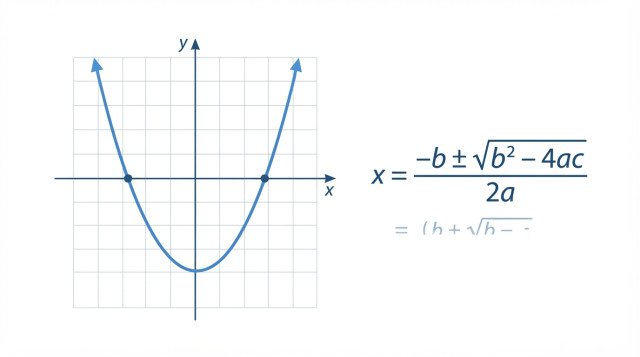
The solutions are called roots or zeros. Graphically, they are the points where the parabola y = ax² + bx + c crosses the horizontal axis. Quadratics appear in many everyday situations:
- Finding when a thrown object hits the ground.
- Working out the dimensions of a rectangle from its area.
- Estimating break-even points when revenue and cost follow a curve.
- Solving exam problems in algebra, physics and engineering.
Quadratic formula: the exact expression to memorize
The formula is:
x = (−b ± √(b² − 4ac)) / (2a)
The ± sign means you calculate two values: one using plus and one using minus. Each value is a root of the equation.
What each letter means
- a: the number multiplying x².
- b: the number multiplying x, including its sign.
- c: the constant term with no x.
If a term is missing, its coefficient is zero. In x² − 9 = 0, for example, a = 1, b = 0 and c = −9.
How to solve a quadratic equation step by step with the formula
Follow the same five steps every time. They work for any quadratic equation.
- Write the equation in standard form. Move every term to one side so the other side is zero.
- Identify a, b and c. Keep the signs. A subtraction means a negative coefficient.
- Calculate the discriminant. D = b² − 4ac.
- Take the square root of D. The sign of D tells you what kind of roots to expect.
- Substitute into the formula. Compute x₁ = (−b + √D) / 2a and x₂ = (−b − √D) / 2a.
What the discriminant tells you before you finish the calculation
The expression under the square root, D = b² − 4ac, is the discriminant. It tells you how many solutions exist and what type they are.
| Discriminant (D) | Number of roots | Type of roots | Parabola |
|---|---|---|---|
| D > 0 | Two | Real and different | Crosses the x-axis twice |
| D = 0 | One (repeated) | Real and equal | Touches the x-axis once |
| D < 0 | Two | Complex conjugates | Never touches the x-axis |
Checking D first is a fast way to catch errors. If a problem describes an object that must reach the ground, a negative discriminant would signal a mistake in your setup.
Quadratic formula examples with real numbers
Example 1: two different real roots
Solve x² − 5x + 6 = 0.
- a = 1, b = −5, c = 6
- D = (−5)² − 4(1)(6) = 25 − 24 = 1
- x = (5 ± √1) / 2 = (5 ± 1) / 2
- x₁ = 6 / 2 = 3 and x₂ = 4 / 2 = 2
Check: 3² − 5(3) + 6 = 9 − 15 + 6 = 0. It works.
Example 2: leading coefficient different from 1
Solve 2x² + 4x − 6 = 0.
- a = 2, b = 4, c = −6
- D = 4² − 4(2)(−6) = 16 + 48 = 64
- x = (−4 ± 8) / 4
- x₁ = 4 / 4 = 1 and x₂ = −12 / 4 = −3
Notice that 2a = 4 divides the whole numerator, not just the square root.
Example 3: one repeated root
Solve x² + 6x + 9 = 0.
- a = 1, b = 6, c = 9
- D = 36 − 36 = 0
- x = −6 / 2 = −3
The only solution is x = −3. The expression is a perfect square: (x + 3)² = 0.
Example 4: no real solutions
Solve x² + 2x + 5 = 0.
- a = 1, b = 2, c = 5
- D = 4 − 20 = −16
- √(−16) = 4i, where i is the imaginary unit
- x = (−2 ± 4i) / 2 = −1 ± 2i
The roots are complex numbers. In a real-world problem, this usually means the situation described never happens.
Example 5: decimal answers
Solve 3x² − 2x − 4 = 0.
- a = 3, b = −2, c = −4
- D = (−2)² − 4(3)(−4) = 4 + 48 = 52
- √52 ≈ 7.2111
- x₁ = (2 + 7.2111) / 6 ≈ 1.5352
- x₂ = (2 − 7.2111) / 6 ≈ −0.8685
When D is not a perfect square, the roots are irrational. Round only at the end to keep the result accurate.
Real-life problems solved with the quadratic formula
When does a ball hit the ground?
A ball is thrown upward from a height of 1 meter. Its height in meters after t seconds is approximately h = −5t² + 20t + 1. To find when it lands, set h = 0.
- a = −5, b = 20, c = 1
- D = 20² − 4(−5)(1) = 400 + 20 = 420
- √420 ≈ 20.494
- t = (−20 ± 20.494) / (−10)
- t ≈ −0.049 or t ≈ 4.049
Time cannot be negative here, so the ball lands after about 4.05 seconds. Discarding roots that make no physical sense is part of interpreting the result.
Finding the sides of a rectangle
A rectangular garden has an area of 40 m², and its length is 3 m longer than its width. Let w be the width.
- w(w + 3) = 40, so w² + 3w − 40 = 0
- a = 1, b = 3, c = −40
- D = 9 + 160 = 169, and √169 = 13
- w = (−3 ± 13) / 2, which gives w = 5 or w = −8
A width cannot be negative, so the garden is 5 m wide and 8 m long. Check: 5 × 8 = 40.
How to use a quadratic formula calculator correctly
An online tool saves time, especially with decimals or large coefficients. To get a reliable answer, follow this routine:
- Rearrange your equation so one side equals zero.
- Enter a, b and c exactly as they appear, including negative signs.
- Review the discriminant if the tool shows it.
- Read both roots, not just the first one.
- Substitute at least one root back into the original equation to confirm it.
You can find more tools for algebra, percentages and unit conversions on Calculatorr. If your work involves related math topics, the site also has calculators for proportions, averages and number theory that pair well with equation solving.
How to interpret the roots of a quadratic equation
The roots are only the starting point. Three related values help you understand the whole curve:
- Sum of roots: x₁ + x₂ = −b / a. In Example 1, 3 + 2 = 5, which equals −(−5) / 1.
- Product of roots: x₁ × x₂ = c / a. In Example 1, 3 × 2 = 6, which equals c / a.
- Vertex: the turning point is at x = −b / (2a). For Example 1, x = 2.5, and the minimum value is 2.5² − 5(2.5) + 6 = −0.25.
If a is positive, the parabola opens upward and the vertex is a minimum. If a is negative, it opens downward and the vertex is a maximum, as in the ball example. These relationships also give you a quick check: if the sum and product of your roots do not match −b / a and c / a, something went wrong.
Common mistakes when using the quadratic formula
- Forgetting to set the equation to zero. The formula only works from ax² + bx + c = 0. An equation like x² + 3x = 10 must become x² + 3x − 10 = 0 first.
- Losing the sign of b. When b is negative, −b becomes positive. In Example 1, −b = 5, not −5.
- Squaring a negative incorrectly. (−5)² is 25, not −25. Use parentheses.
- Dividing only part of the numerator. The entire expression −b ± √D is divided by 2a.
- Using a = 0. If a is zero, the equation is linear and the formula does not apply. Solve it as x = −c / b.
- Rounding too early. Keep the square root unrounded until the final step.
- Ignoring context. A negative time, length or quantity may be a valid root mathematically but not a valid answer to the problem.
Other ways to solve a quadratic equation and when to use them
Factoring
If the equation factors easily, it is the quickest route. For x² − 5x + 6, you look for two numbers that multiply to 6 and add to −5, which are −2 and −3. That gives (x − 2)(x − 3) = 0.
Completing the square
This method rewrites the equation as (x + p)² = q. It is useful for finding the vertex and is how the quadratic formula is derived.
Graphing
Plotting the parabola gives a visual estimate of the roots. It is helpful for checking, but the formula gives exact values.
When factoring is not obvious, the quadratic formula always works. That reliability is why it is the standard method in classrooms and in most calculators.
Quick reference for solving any quadratic equation
| Step | Action | Example (x² − 5x + 6 = 0) |
|---|---|---|
| 1 | Standard form | x² − 5x + 6 = 0 |
| 2 | Identify a, b, c | 1, −5, 6 |
| 3 | Discriminant | 25 − 24 = 1 |
| 4 | Apply formula | (5 ± 1) / 2 |
| 5 | Roots | 3 and 2 |
| 6 | Verify | Substitute back: 0 = 0 |
With this routine, you can solve any quadratic by hand or confirm the result from an online tool. Browse the rest of the Calculatorr collection to keep practicing with related math calculators and step-by-step guides.