Knowing how to calculate cloud base height lets you estimate how high the clouds will sit above the ground using only two readings: air temperature and dew point. It is a quick, reliable method used by pilots, hikers, photographers, drone operators and weather enthusiasts. You need no instruments beyond a weather app, and the arithmetic takes a few seconds.
This guide covers the formula in metric and imperial units, the manual steps, worked examples, how to read the result and the mistakes that most often skew it. For other quick tools, browse the full collection at Calculatorr.

What is cloud base height and why does it matter?
Cloud base height is the distance from the ground to the lowest part of a cloud layer. Meteorologists often call the lowest broken or overcast layer the ceiling.
It matters for several practical reasons:
- Pilots use it to judge visibility and whether visual flight is possible.
- Drone operators need to keep aircraft below and clear of cloud.
- Hikers and climbers can tell whether a summit will sit inside cloud.
- Photographers and stargazers can anticipate low overcast or fog.
- Anyone can read the sky better, since a low base means damp, gloomy conditions and a high base means clearer air.
Cloud base height formula: temperature minus dew point
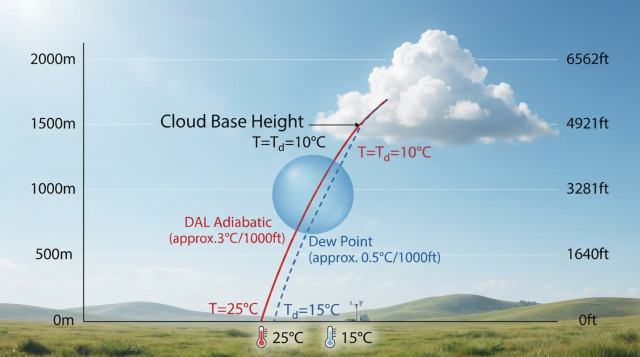
The method works because rising air cools as it expands. Dry air cools at about 9.8 °C per kilometer. The dew point also falls as the air rises, but more slowly, at about 1.8 °C per kilometer. The two values converge at roughly 8 °C per kilometer. When they meet, the air is saturated and a cloud forms.
That convergence rate gives the simplest version of the formula:
Metric version
Cloud base (meters above ground) = (Temperature − Dew point) × 125
Temperature and dew point are in degrees Celsius. The difference between them is called the dew point spread.
Imperial version
Cloud base (feet above ground) = (Temperature − Dew point) ÷ 4.4 × 1,000
Here both values are in degrees Fahrenheit. A common shortcut for Celsius inputs is to multiply the spread by about 400 feet per °C. It is slightly rounded, so it gives results about 2 percent lower than the exact conversion of the metric formula.
Quick reference table
| Spread (°C) | Cloud base (m) | Cloud base (ft) |
|---|---|---|
| 1 | 125 | 410 |
| 2 | 250 | 820 |
| 4 | 500 | 1,640 |
| 6 | 750 | 2,460 |
| 8 | 1,000 | 3,280 |
| 10 | 1,250 | 4,100 |
| 15 | 1,875 | 6,150 |
| 20 | 2,500 | 8,200 |
How to calculate cloud base height step by step
Follow these steps to do it by hand:
- Get the current temperature. Use a local station report or a thermometer in the shade.
- Get the dew point. Weather apps and airport reports list it. If you only have relative humidity, see the estimation tip below.
- Subtract the dew point from the temperature. This is the spread. It can never be negative in a valid reading.
- Multiply the spread by 125 for meters, or divide by 4.4 and multiply by 1,000 for feet when working in Fahrenheit.
- Add station elevation if you want height above sea level. The formula gives height above ground level, not above sea level.
What if you only know relative humidity?
For relative humidity above 50 percent, a good approximation is:
Dew point ≈ Temperature − (100 − RH) ÷ 5
With a temperature of 24 °C and 60 percent humidity, the dew point is about 24 − (40 ÷ 5) = 16 °C. The spread is 8 °C, so the cloud base is about 1,000 meters. If you want a precise dew point instead, see the guide on calculating dew point from temperature and humidity.
Cloud base height examples with real numbers
Example 1: A warm afternoon in Celsius
Temperature is 28 °C and dew point is 16 °C.
- Spread: 28 − 16 = 12 °C
- Cloud base: 12 × 125 = 1,500 m above ground
- In feet: about 4,900 ft
This is a typical height for fair-weather cumulus clouds on a summer day.
Example 2: Using Fahrenheit
Temperature is 77 °F and dew point is 59 °F.
- Spread: 77 − 59 = 18 °F
- Cloud base: 18 ÷ 4.4 × 1,000 = about 4,090 ft
These are the same conditions as 25 °C and 15 °C. The metric formula gives 10 × 125 = 1,250 m, which is about 4,100 ft, so both methods agree.
Example 3: A cool, damp morning
Temperature is 10 °C and dew point is 8 °C.
- Spread: 2 °C
- Cloud base: 2 × 125 = 250 m, or about 820 ft
Expect low, thick cloud or mist hugging hills.
Example 4: Adding elevation
A mountain village sits at 800 m above sea level. The spread is 12 °C, so the base is 1,500 m above ground.
- Cloud base above sea level: 800 + 1,500 = 2,300 m
A hiker planning a ridge at 2,600 m should expect to be inside cloud at the top.
Example 5: Dry climate
Temperature is 35 °C and dew point is 5 °C.
- Spread: 30 °C
- Cloud base: 30 × 125 = 3,750 m
Any clouds that form will be very high, and the sky is often clear. At this height the formula becomes less dependable, because few clouds actually build from surface air in such dry conditions.

How to interpret your cloud base result
The number tells you more when you match it to what you can expect to see and do.
| Cloud base above ground | What it usually means |
|---|---|
| 0 to 150 m (0 to 500 ft) | Fog or very low stratus, poor visibility |
| 150 to 300 m (500 to 1,000 ft) | Low overcast, drizzle possible |
| 300 to 900 m (1,000 to 3,000 ft) | Marginal conditions, hills may be in cloud |
| Above 900 m (3,000 ft) | Generally good visibility under the cloud layer |
A small spread signals moist air close to saturation. A spread of 0 to 2 °C often means fog, mist or imminent rain. A wide spread points to dry air and a high cloud base, or no cloud at all.
Watch the trend as well. If the spread shrinks through the evening, the base is dropping and fog may form overnight. If it widens through the morning, clouds are likely to lift and break.
How to use an online cloud base calculator
An online tool saves you from converting units by hand. The process is simple:
- Enter the air temperature and choose Celsius or Fahrenheit.
- Enter the dew point in the same unit, or enter relative humidity if the tool offers it.
- Add your elevation if you want height above sea level.
- Read the cloud base in meters and feet.
Use the same station for both readings. You can check unit conversions with the other tools on Calculatorr, such as the Celsius and Fahrenheit converter, when your weather source uses a different scale.
Common mistakes when estimating cloud base height
- Mixing units. Using a Celsius temperature with a Fahrenheit dew point produces nonsense. Keep both in the same scale.
- Confusing dew point with relative humidity. Humidity is a percentage. Dew point is a temperature.
- Forgetting the result is above ground level. Add station elevation for a sea-level height, especially in mountains.
- Applying it to every cloud type. The formula suits clouds formed by rising surface air, such as cumulus. It does not describe high cirrus or clouds produced by fronts, which can sit at any height.
- Using stale or distant data. Temperature and dew point change quickly. Use a reading from the last hour and from a nearby station.
- Treating the result as exact. It is an estimate, usually accurate within a few hundred feet for convective clouds, so leave a safety margin for decisions like flying or climbing.
When the formula works best and when to use other tools
The estimate is most accurate on sunny afternoons when the ground heats the air and builds cumulus clouds. It is less reliable at night, in strong wind shear, in rain, and near fronts. For aviation or any safety-critical plan, rely on official observations such as airport reports and the ceiling they list, and use your own calculation only as a cross-check or for general planning.
If you enjoy reading the weather from a few numbers, pair this method with a frost risk estimate or a heat index check to understand overall conditions for the day.