Learning how to calculate sleep debt turns a vague feeling of being tired into a number you can act on. Sleep debt is the gap between the hours of sleep your body needs and the hours you actually get, added up over several days. Once you know that number, you can decide how much extra rest to schedule and how fast to pay it back.
The math is simple addition and subtraction. The hard part is choosing the right inputs and reading the result sensibly. This guide covers the formula, two worked examples, how to read your total and a realistic recovery plan.
How to calculate sleep debt: the basic formula
Sleep debt compares two things: your personal sleep need and your real sleep time. Calculate it per night, then add the nights together.
Sleep debt formula
Sleep debt = (Sleep need × number of nights) − total hours actually slept
You can also work night by night:
Nightly shortfall = Sleep need − hours slept
Add the nightly shortfalls over the period you want to measure. Most people use the last 7 days. Fourteen days gives a fuller picture if your schedule changes a lot.
How many hours of sleep do you need?
Your sleep need is the most important number in the formula. General guidance from sleep medicine groups looks like this:
- Adults (18–64 years): 7 to 9 hours per night
- Older adults (65+): 7 to 8 hours per night
- Teenagers (14–17 years): 8 to 10 hours per night
- School-age children (6–13 years): 9 to 12 hours per night
These are ranges, not personal targets. To estimate your own need, look at how much you sleep on several consecutive days without an alarm, such as during a holiday. After the first few days of catching up, your sleep usually settles near your natural need. Use that figure, for example 7.5 or 8 hours, as the input.
Step-by-step: how to calculate your sleep debt over a week
- Set your sleep need. Pick a realistic number, such as 8 hours.
- Record actual sleep for each night. Count time asleep, not time in bed.
- Subtract each night from your need. A positive result is a deficit. A negative result is a surplus.
- Add the results. The total is your sleep debt in hours.
- Divide by the number of nights. This gives your average nightly shortfall, which is useful for planning.
Time in bed vs. time asleep
Many people overestimate their sleep because they count the whole time in bed. If you were in bed from 11:00 pm to 6:30 am, that is 7.5 hours. If you took about 20 minutes to fall asleep and were awake for another 25 minutes during the night, your sleep time is 7.5 − 0.75 = 6.75 hours. Use 6.75 in the formula.
A wearable or sleep app can give a rough estimate, but a short manual log works too. Write down bedtime, wake time and an honest guess of how long you were awake.
Example 1: a regular work week
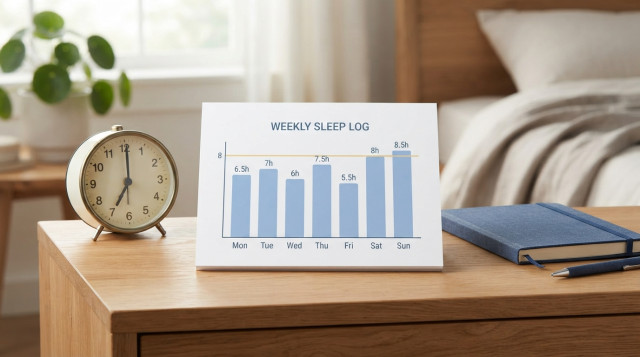
Maria needs 8 hours of sleep. Her week looks like this:
| Day | Hours slept | Need | Difference |
|---|---|---|---|
| Monday | 6.5 | 8 | −1.5 |
| Tuesday | 7 | 8 | −1 |
| Wednesday | 6 | 8 | −2 |
| Thursday | 6.5 | 8 | −1.5 |
| Friday | 7 | 8 | −1 |
| Saturday | 9 | 8 | +1 |
| Sunday | 8.5 | 8 | +0.5 |
Total sleep: 6.5 + 7 + 6 + 6.5 + 7 + 9 + 8.5 = 50.5 hours.
Total need: 8 × 7 = 56 hours.
Sleep debt: 56 − 50.5 = 5.5 hours.
Her average nightly shortfall is 5.5 ÷ 7 ≈ 0.79 hours, or about 47 minutes per night.
Example 2: short weeknights and a recovery weekend
Daniel needs 7.5 hours. He sleeps 5.5 hours for five nights and 8 hours for two nights.
- Total sleep: (5.5 × 5) + (8 × 2) = 27.5 + 16 = 43.5 hours
- Total need: 7.5 × 7 = 52.5 hours
- Sleep debt: 52.5 − 43.5 = 9 hours
- Average sleep: 43.5 ÷ 7 ≈ 6.2 hours per night
Daniel looks fine on paper if he only counts his two good nights. The weekly total shows that his weekend rest did not come close to covering the weekday deficit.
Net method vs. deficit-only method
There are two common ways to treat nights when you sleep more than you need.
- Net method: extra hours cancel out earlier deficits. Maria's debt is 5.5 hours.
- Deficit-only method: only the short nights count, and long nights are ignored. Maria's debt is 1.5 + 1 + 2 + 1.5 + 1 = 7 hours.
The net method is simpler and works well for a quick check. The deficit-only method is stricter and better if you suspect that one long night does not fully undo several short ones. Pick one and use it consistently so your numbers are comparable from week to week.
How to interpret your sleep debt result
A single number only helps if you know what it means. These ranges are practical guidelines for a 7-day period, not medical thresholds.
| Weekly sleep debt | What it usually means | Suggested action |
|---|---|---|
| 0 to 3 hours | Minor shortfall, easy to recover | Go to bed 20 to 30 minutes earlier for a few nights |
| 4 to 7 hours | Moderate debt, often noticeable in focus and mood | Add 45 to 60 minutes of sleep per night for about a week |
| 8 to 14 hours | Significant debt, likely daytime sleepiness | Protect sleep time for two weeks and limit late commitments |
| More than 14 hours | Chronic pattern, not just a rough week | Rework your schedule and consider talking to a health professional |
Typical signs of accumulated sleep debt include difficulty concentrating, irritability, needing more caffeine than usual and falling asleep within minutes of lying down. Falling asleep almost instantly is often read as a sign of good sleep, but it can also mean you are very sleep deprived.
If you sleep your full need for several nights and still feel exhausted, or if you snore loudly, stop breathing during sleep or wake unrefreshed, the issue may not be debt. Conditions such as sleep apnea or insomnia need a professional evaluation, and no calculation can replace one.
Suggested image 1 (place here): a simple weekly chart comparing hours slept with the target sleep need for each day.
How to use a sleep debt calculator online
A calculator removes the manual arithmetic and reduces mistakes, especially over 14 days. The inputs are the same as in the formula:
- Your daily sleep need in hours
- The hours you slept each night, ideally excluding time awake in bed
- The period to evaluate, usually 7 or 14 days
Enter the numbers, then read the total debt and the average nightly shortfall. Check the result against your own estimate. If it looks off, a decimal conversion is the usual cause: 6 hours 45 minutes is 6.75 hours, not 6.45.
Planning your recovery also involves time math, such as working out a new bedtime from a fixed wake-up time. You can find related tools and guides at Calculatorr.com to cover those steps.
How to pay back sleep debt without wrecking your schedule
Sleep debt is not repaid in a single night. A better approach is to add a modest amount of extra sleep over several nights.
Spread the extra sleep across nights
Divide your debt by the number of nights you want to recover over. If Daniel has 9 hours of debt and wants to clear it in 9 nights, he needs 1 extra hour each night, so he should aim for 8.5 hours instead of 7.5. If he wants to recover in 6 nights, he needs 1.5 extra hours per night, which is harder to fit in. A longer plan is usually easier to keep.
| Debt | Recovery period | Extra sleep per night |
|---|---|---|
| 3 hours | 5 nights | 36 minutes |
| 5.5 hours | 7 nights | 47 minutes |
| 9 hours | 9 nights | 60 minutes |
| 12 hours | 12 nights | 60 minutes |
Keep your wake-up time steady
Sleeping in until noon on Sunday feels like a fix, but it shifts your body clock and makes Sunday night harder. Try to keep your wake time within about one hour of your weekday schedule, and move your bedtime earlier instead.
Use short naps carefully
A nap of 20 to 30 minutes in the early afternoon can reduce sleepiness without cutting into nighttime sleep. Long or late naps can make it harder to fall asleep. Count a nap in your log, but do not rely on naps as the main way to repay debt.
Re-measure after one week
After a week of extended sleep, run the calculation again. If your debt falls, your plan works. If it stays flat, something is blocking your sleep: late screens, caffeine, irregular schedules or a bedroom that is too warm or too bright.
Suggested image 2 (place here): an infographic of a 7-night recovery plan with extra sleep minutes added each night.
Common mistakes when calculating sleep debt
- Using time in bed instead of time asleep. This understates your debt, sometimes by an hour or more per night.
- Setting the need too low. If you pick 6 hours because that is what you get, the formula will always show no debt. Use your natural need instead.
- Mixing minutes and decimals. Convert minutes by dividing by 60. Thirty minutes is 0.5 hours, and 15 minutes is 0.25 hours.
- Counting one long night as a full reset. One night of 10 hours rarely cancels a week of short sleep. This is why the deficit-only method can be more realistic.
- Ignoring older debt. If you have been short on sleep for months, a 7-day window understates the problem. Track a few weeks in a row to see the trend.
- Expecting precision. Sleep need changes with age, stress, illness, training load and season. Treat your result as a useful estimate rather than an exact measurement.
How to make a sleep debt calculation part of your routine
Once a week, take five minutes on Sunday evening to log your last seven nights. Write your need, your actual sleep and your total debt. If the number stays under 3 hours for several weeks, your routine is sustainable. If it keeps growing, change something specific: a fixed bedtime alarm, a cutoff time for work messages or an earlier last coffee.
Small, steady changes beat dramatic catch-up weekends. A habit of tracking sleep with a simple formula makes it easier to see which changes actually improve your rest.