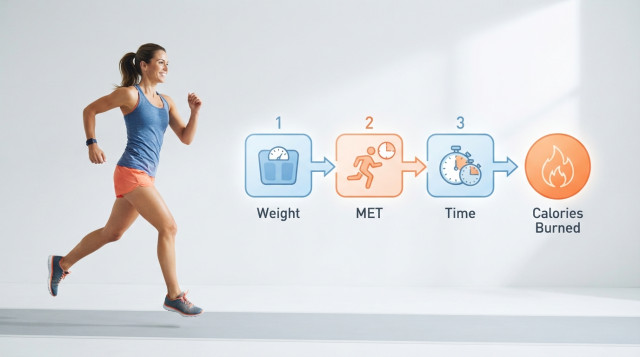
The MET formula to estimate calories burned is the most practical way to turn any activity into a realistic energy number. It needs only three inputs: your body weight, the intensity of the activity and the time you spent doing it. No heart rate monitor or lab test is required. This guide shows how the formula works, how to apply it by hand and how to read the result so you can plan your training with more confidence.
What is a MET and why it helps estimate calories burned
MET stands for metabolic equivalent of task. One MET is the energy your body uses at complete rest, roughly 1 kcal per kilogram of body weight per hour. An activity rated at 6 METs therefore burns about six times the energy you use sitting still.
This makes METs a universal scale. Walking, cycling, swimming, dancing and lifting all have assigned MET values based on large activity compendiums used in exercise science. Instead of guessing, you pick the value that matches your activity and plug it into a formula.
What MET values do and do not tell you
A MET value is an average for a typical person doing that activity at a defined intensity. It does not capture your fitness level, technique, terrain, temperature or body composition. Treat the result as a solid estimate, not an exact measurement. Two people of the same weight can differ by 10 to 15 percent in real energy use for the same session.
MET calorie formula: how to calculate calories burned per minute
The standard formula is:
Calories per minute = MET × 3.5 × body weight in kg ÷ 200
The number 3.5 is the resting oxygen consumption in millilitres per kilogram per minute. Dividing by 200 converts oxygen use into kilocalories, assuming about 5 kcal per litre of oxygen. Multiply the per-minute figure by the minutes you trained to get the session total.
Total calories = MET × 3.5 × weight (kg) ÷ 200 × minutes
Quick shortcut for calories per hour
A simpler version is calories per hour = MET × weight in kg. It runs about 5 percent lower than the full formula because it rounds the resting rate down to exactly 1 kcal/kg/h. It is handy for mental math, but use the full formula when you want more precision.
Typical MET values for common activities
The table below lists approximate values taken from standard activity compendiums. Use them as a starting point and choose the row closest to your real effort.
| Activity | Approximate MET | Intensity |
|---|---|---|
| Stretching or gentle yoga | 2.5 | Light |
| Walking 4.8 km/h (3 mph) | 3.5 | Moderate |
| Brisk walking 5.6 km/h (3.5 mph) | 4.3 | Moderate |
| Weight training, general | 3.5 | Moderate |
| Leisure cycling, under 16 km/h | 4.0 | Moderate |
| Swimming laps, light to moderate | 5.8 | Moderate to vigorous |
| Weight training, vigorous | 6.0 | Vigorous |
| Running 8 km/h (5 mph) | 8.3 | Vigorous |
| Cycling 19 to 22 km/h | 8.0 | Vigorous |
| Running 9.7 km/h (6 mph) | 9.8 | Vigorous |
As a general guide, activities below 3 METs are light, from 3 to 5.9 are moderate and 6 or more are vigorous.
How to estimate calories burned with METs step by step
Follow this process every time and the numbers will stay consistent.
- Convert your weight to kilograms. If you know pounds, divide by 2.2046. A person weighing 180 lb weighs about 81.6 kg.
- Choose the MET value that best matches your activity and effort.
- Multiply MET × 3.5 × weight in kg, then divide by 200 to get calories per minute.
- Multiply by the number of minutes you were active, excluding long rests.
- Round the result to the nearest 5 or 10 kcal. More precision is false accuracy.
Worked examples of the MET formula
Example 1: running for 30 minutes
A person weighing 70 kg runs at 8 km/h (MET 8.3) for 30 minutes.
- 3.5 × 70 = 245
- 245 ÷ 200 = 1.225
- 1.225 × 8.3 = 10.17 kcal per minute
- 10.17 × 30 = about 305 kcal
Example 2: brisk walking for 45 minutes
A person weighing 85 kg walks at 5.6 km/h (MET 4.3) for 45 minutes.
- 3.5 × 85 = 297.5
- 297.5 ÷ 200 = 1.4875
- 1.4875 × 4.3 = 6.40 kcal per minute
- 6.40 × 45 = about 288 kcal
Example 3: cycling for one hour with the shortcut
A person weighing 60 kg cycles at a vigorous pace (MET 8) for 60 minutes.
- Shortcut: 8 × 60 = 480 kcal
- Full formula: 8 × 3.5 × 60 ÷ 200 = 8.4 kcal per minute, so 8.4 × 60 = 504 kcal
The gap of 24 kcal shows why the shortcut is fine for quick planning but slightly low.
Gross vs net calories: what the MET result includes
The result of the formula is gross energy expenditure. It includes the calories your body would have burned anyway if you had stayed on the couch. If you want to know the extra energy caused by the workout, use net calories by subtracting 1 MET.
Net calories = (MET − 1) × 3.5 × weight (kg) ÷ 200 × minutes
For the 70 kg runner in Example 1: (8.3 − 1) = 7.3, then 7.3 × 1.225 = 8.94 kcal per minute, and 8.94 × 30 = about 268 kcal. That is roughly 37 kcal less than the gross figure.
Use net calories if you are building a calorie deficit or surplus and already count your resting needs separately. Use gross calories when comparing against fitness trackers, which usually report total expenditure. To see how a session fits into a bigger plan, pair it with the tools on Calculatorr for daily energy and nutrition targets.
How to use an online calories burned calculator based on METs
An online calculator removes the arithmetic and lets you compare activities in seconds. The workflow is simple:
- Enter your weight and select kilograms or pounds.
- Pick the activity and intensity from the list.
- Enter the duration in minutes.
- Read the estimated calories, and check whether it shows gross or net values.
Even when you use a tool, knowing the formula helps you spot mistakes. If a result looks far too high for a casual walk, the wrong activity or the wrong unit was probably selected. You can find more practical tools for fitness and everyday numbers on calculatorr.com.
How to interpret your calorie estimate and MET minutes
A single number only becomes useful when you put it in context. Here are three practical ways to read it.
Compare activities by efficiency
If you have 30 minutes, the MET value shows which activity gives more energy use. For a 70 kg person, 30 minutes of brisk walking at 4.3 METs burns about 158 kcal, while 30 minutes of running at 8.3 METs burns about 305 kcal. Walking can still be the better choice if it is more sustainable or easier on your joints.
Track weekly MET minutes
MET minutes are MET value × minutes. Thirty minutes of a 4.3 MET walk equals about 129 MET minutes. Many public health guidelines point to roughly 500 to 1,000 MET minutes per week as a healthy activity range. Five brisk walks of 30 minutes give about 645 MET minutes.
Connect it to weight goals
A common planning rule is that about 7,700 kcal corresponds to 1 kg of body fat. If you burn an extra 300 kcal on four days a week, that is 1,200 kcal weekly, or roughly 0.15 kg of fat in theory. Real results vary because appetite, metabolism and daily movement adapt. Use the estimate for planning, then adjust based on what the scale and your energy levels do over several weeks.
Common mistakes when estimating calories burned with METs
- Using pounds instead of kilograms. This inflates the result by more than double. Always convert first.
- Counting rest time. A one-hour gym visit with 25 minutes of actual lifting should be calculated on the active minutes, or with a lower average MET.
- Picking the highest MET value. People tend to choose a vigorous label for moderate effort. Be honest about pace and breathing.
- Mixing gross and net values. Compare like with like, especially when subtracting from a daily calorie target.
- Ignoring the margin of error. A result of 305 kcal really means somewhere between about 260 and 350 kcal.
- Eating back every calorie. Overestimates are common, so rewarding yourself with the full number can erase a planned deficit.
How to make your MET estimate more accurate
You can tighten the estimate with a few habits. Measure your actual speed or power instead of guessing the intensity. Use a stopwatch for active time only. Weigh yourself regularly so the formula uses your current weight, and compare the estimate with a heart rate based reading if you wear a tracker. When both land within 10 percent of each other, you can trust the number for planning.
Once you master this method, you can estimate the energy cost of any session in under a minute and decide whether it supports your goal, whether that is more endurance, a steady calorie deficit or simply a more active week. Explore the rest of the tools at Calculatorr to turn each of these numbers into a clear plan.