percentage of a number: what it is and when to use it
Percentage of a number is a way to express a portion of a quantity relative to 100. You use it when you want to know proportions such as discounts, tax amounts, markups, exam scores, or parts of a population. The concept is straightforward and appears in finance, shopping, statistics and everyday decisions.
how to find the percentage of a number (formula)
The basic formula to get the percentage of a number is:
percentage value = (percentage ÷ 100) × total
Where "percentage" is the percent rate (for example, 20 for 20%) and "total" is the whole quantity you are taking the percentage from.
alternative forms of the same formula
- To get the percent rate from a part and the total: percentage = (part ÷ total) × 100
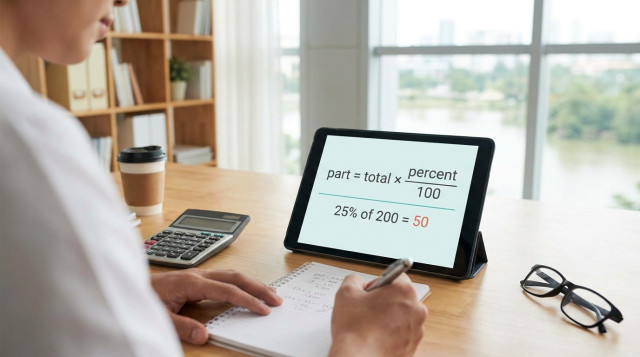
- To find the part when you know percent and total: part = total × (percentage ÷ 100)
step-by-step method to compute a percentage manually
- Write the percentage as a decimal by dividing by 100. Example: 25% → 0.25.
- Multiply that decimal by the total value. Example: 0.25 × 200 = 50.
- If you need the percent rate from two numbers, divide the part by the total and multiply by 100. Example: 50 ÷ 200 × 100 = 25%.
practical examples with real numbers
example 1 — discount in a store
Suppose an item costs $120 and the store gives a 15% discount. To find the discount amount:
discount = 120 × (15 ÷ 100) = 120 × 0.15 = $18.
The sale price = 120 − 18 = $102.
example 2 — tax added at checkout
If a service costs $250 and sales tax is 8.5%, the tax amount is:
tax = 250 × 0.085 = $21.25.
Total to pay = 250 + 21.25 = $271.25.
example 3 — finding percent from two values
A student scored 72 points out of 90 on an exam. To find the percentage score:
percentage = (72 ÷ 90) × 100 = 0.8 × 100 = 80%.
example 4 — changing percentages between totals
If a population of 12,000 grows by 6% in a year, new population = 12,000 × 1.06 = 12,720. The increase amount = 720 people.
how to use an online percentage calculator
Online tools speed up these ops and reduce manual mistakes. To use a percentage calculator on Calculatorr:
- Open the percentage calculator page at Calculatorr.
- Choose the mode: find percentage of a number, find percent rate, or find the part given percent and total.
- Enter the numbers in the form fields (for example, percentage and total).
- Press the compute button to get the result instantly, with optional step breakdown.
Online calculators often show intermediate steps and let you switch units or format results for easy copying.
interpreting results: what the number tells you
The percentage value shows a proportion of the whole. A result of 25% means the part equals one quarter of the total. Percent values below 100% indicate a fraction; above 100% indicate a multiple (for example, 150% = 1.5 times the total).
When working with money, round sensibly (usually to two decimal places for currencies). For statistical measures, choose the precision that makes sense for the dataset.
common errors and how to avoid them
- Mixing up percent and decimal. Remember 20% = 0.20, not 20.
- Using the wrong base. Always check whether the "total" is the original price, discounted price or tax-exclusive amount—this changes the result.
- Confusing increase and decrease. To increase by p%, multiply by (1 + p/100); to decrease, multiply by (1 − p/100).
- Rounding too early. Keep full precision during calculation and round the final result.
quick mental tricks for common percentages
- 10% of a number = move decimal one place left (10% of 350 = 35).
- 5% = half of 10% (5% of 350 = 17.5).
- 1% = move decimal two places left (1% of 350 = 3.5).
- 25% = a quarter, divide by 4 (25% of 200 = 50).
- 50% = half (50% of 200 = 100).
examples of applied percentage calculations
pricing and retail
Retail managers use percentages for markdowns, gross margin and markup. Markup uses base cost: markup percent = (selling price − cost) ÷ cost × 100. Gross margin uses selling price: margin percent = (selling price − cost) ÷ selling price × 100. Mixing the two causes pricing errors.
finance and interest
Annual interest rates use percentages to express growth per year. For simple interest: interest = principal × rate × time. For percentage-based returns, convert the rate to decimal first.
statistics and reporting
When reporting percentages, specify the denominator. Saying "20% increase" without the base value is ambiguous. Context makes the number meaningful.
conversion checklist before reporting percentages
- Confirm the base (what the percent refers to).
- Decide precision and rounding rules (currency vs. percent points).
- Clarify if change is relative or absolute (percent points vs percent change).
- Double-check with an online calculator for safety: visit Calculatorr for tools and worked examples.
ready-to-use examples for practice
Try these to master the method:
- Find 18% of $375.
- If the final price after a 12% discount is $198, what was the original price?
- Convert a score of 43 out of 50 into percent.
Answers: 1) 375 × 0.18 = $67.50. 2) original = 198 ÷ 0.88 ≈ $225. 3) (43 ÷ 50) × 100 = 86%.
Understanding how to work with percentages makes everyday numbers clearer—pricing, taxes, performance metrics and reporting become easier to interpret and act upon.