
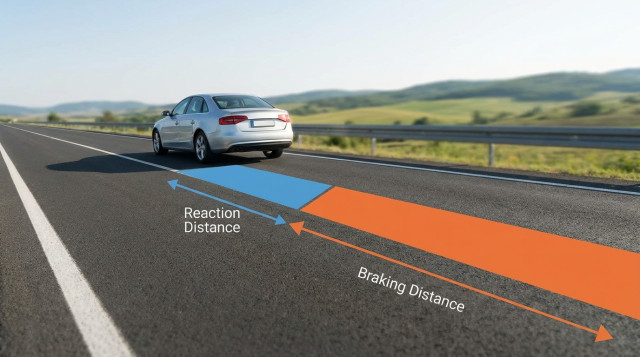
The stopping distance formula tells you how far a vehicle travels from the moment the driver sees a hazard until it comes to a complete stop. It adds two separate parts: the distance covered while the driver reacts, and the distance covered while the brakes do their work. Knowing both numbers helps you choose a safer speed, leave a proper gap and understand why a small increase in speed makes such a large difference.
This guide explains the formula, shows how to work it out by hand in metric and imperial units, and gives real numbers for dry, wet and snowy roads. If you prefer a quick result, you can check your figures against the tools at Calculatorr.
What is stopping distance and why does it matter?
Stopping distance is the total length of road a vehicle needs to stop after a driver perceives danger. It is not a single event. It is made of two phases that behave very differently.
- Reaction phase: the driver notices the hazard, decides to brake and moves a foot to the pedal. The car keeps moving at full speed during this time.
- Braking phase: the brakes are applied and friction between tires and road slows the car down until it stops.
Most people underestimate the second phase because braking distance grows with the square of speed. Double your speed and the braking distance becomes four times longer.
Stopping distance formula: reaction distance plus braking distance
The general formula is:
Stopping distance = reaction distance + braking distance
Reaction distance formula
Reaction distance is simple: speed multiplied by reaction time.
dreaction = v × t
- v = speed in meters per second (m/s)
- t = reaction time in seconds
A typical alert driver needs about 1 to 1.5 seconds. Fatigue, distraction, alcohol or medication can push that to 2 seconds or more.
Braking distance formula
On a flat road, braking distance depends on speed and the friction between tires and pavement:
dbraking = v² / (2 × μ × g)
- v = speed in m/s
- μ = coefficient of friction between tires and road surface
- g = gravitational acceleration, 9.81 m/s²
To convert km/h to m/s, divide by 3.6. To convert mph to m/s, multiply by 0.447.
Stopping distance formula in mph and feet
If you work in miles per hour and feet, a practical version of the braking formula is:
dbraking (ft) = v² / (30 × f)
Here v is in mph and f is the friction coefficient. For reaction distance in feet, convert speed first: mph × 1.467 gives feet per second, then multiply by reaction time.
How to calculate stopping distance step by step
- Convert the speed to m/s. Divide km/h by 3.6.
- Choose a reaction time. Use 1.5 seconds as a realistic default for an attentive driver.
- Calculate reaction distance. Multiply speed (m/s) by reaction time.
- Pick a friction coefficient. Use the surface table below.
- Calculate braking distance. Square the speed and divide by 2 × μ × 9.81.
- Add both distances. The sum is your total stopping distance.
Stopping distance at 50 km/h and 100 km/h: worked cases
City driving at 50 km/h on dry asphalt
Assume a reaction time of 1.5 s and μ = 0.7.
- Speed: 50 ÷ 3.6 = 13.89 m/s
- Reaction distance: 13.89 × 1.5 = 20.83 m
- Braking distance: 13.89² ÷ (2 × 0.7 × 9.81) = 192.90 ÷ 13.734 = 14.04 m
- Total stopping distance: 20.83 + 14.04 = 34.87 m
That is roughly the length of eight to nine parked cars.
Highway driving at 100 km/h on dry asphalt
- Speed: 100 ÷ 3.6 = 27.78 m/s
- Reaction distance: 27.78 × 1.5 = 41.67 m
- Braking distance: 27.78² ÷ 13.734 = 771.60 ÷ 13.734 = 56.18 m
- Total stopping distance: 41.67 + 56.18 = 97.85 m
Doubling the speed from 50 to 100 km/h raised the total stopping distance from about 35 m to about 98 m, almost three times longer.
Imperial example at 60 mph
With a reaction time of 1.5 s and f = 0.7:
- Speed: 60 × 1.467 = 88 ft/s
- Reaction distance: 88 × 1.5 = 132 ft
- Braking distance: 60² ÷ (30 × 0.7) = 3,600 ÷ 21 = 171.4 ft
- Total: 132 + 171.4 = 303.4 ft
Stopping distance table by speed
The values below assume a 1.5 s reaction time, dry asphalt (μ = 0.7) and a flat road. Totals are calculated before rounding.
| Speed (km/h) | Reaction distance (m) | Braking distance (m) | Total (m) |
|---|---|---|---|
| 30 | 12.5 | 5.1 | 17.6 |
| 50 | 20.8 | 14.0 | 34.9 |
| 80 | 33.3 | 36.0 | 69.3 |
| 100 | 41.7 | 56.2 | 97.9 |
| 120 | 50.0 | 80.9 | 130.9 |
Notice how reaction distance grows steadily with speed, while braking distance accelerates. At 120 km/h, braking alone takes more than 80 meters.
How road surface changes braking distance
The friction coefficient is the variable that changes most from one day to the next. These are approximate values for standard passenger car tires in good condition:
| Road condition | Typical μ |
|---|---|
| Dry asphalt | 0.7 to 0.8 |
| Wet asphalt | 0.4 to 0.5 |
| Loose gravel | 0.35 to 0.5 |
| Packed snow | 0.2 to 0.3 |
| Ice | 0.05 to 0.15 |
Here is the same 50 km/h trip (13.89 m/s, reaction distance 20.83 m) on different surfaces:
- Dry, μ = 0.7: braking 14.04 m, total 34.9 m
- Wet, μ = 0.4: braking 192.90 ÷ 7.848 = 24.58 m, total 45.4 m
- Packed snow, μ = 0.25: braking 192.90 ÷ 4.905 = 39.33 m, total 60.2 m
On the highway the effect is larger. At 100 km/h on a wet road (μ = 0.4), braking takes 771.60 ÷ 7.848 = 98.32 m, and the total stopping distance reaches about 140 m.
How slope affects braking distance
On a hill, gravity helps or hurts the brakes. Add the road grade (as a decimal) to the formula:
dbraking = v² / (2 × g × (μ ± G))
Use a plus sign uphill and a minus sign downhill. A 6% grade means G = 0.06.
For 50 km/h downhill on dry asphalt: 192.90 ÷ (2 × 9.81 × (0.7 − 0.06)) = 192.90 ÷ 12.557 = 15.36 m, compared with 14.04 m on flat ground. The difference grows quickly with speed and with heavier vehicles that fade their brakes.
How to use a stopping distance calculator
An online calculator removes unit conversions and arithmetic slips. The process is the same one you did by hand:
- Enter your speed and select the unit (km/h or mph).
- Set the reaction time. Use 1.5 s unless you want a more cautious estimate.
- Choose the road condition or enter a friction coefficient.
- Add the slope if the road is not flat.
- Read the reaction, braking and total distances.
You can also verify any manual calculation with the other conversion and math tools on Calculatorr.com, which is useful when you need to switch between km/h, mph and m/s.
What is a safe following distance?
The stopping distance formula explains why gap rules exist. A time-based rule is easier to apply than memorizing distances: pick a fixed object, watch the car ahead pass it and count the seconds until you reach the same spot.
- 2 seconds: a minimum for dry roads and good visibility
- 3 to 4 seconds: better for highways, heavy traffic or larger vehicles
- 6 seconds or more: rain, snow, fog or when driving tired
At 100 km/h, you cover 27.78 m every second. A 3-second gap is therefore about 83 m. That gap mainly protects your reaction time and gives you room to brake gently, but it does not equal your full stopping distance of nearly 98 m. If the car ahead hits a stationary obstacle, you need the full stopping distance, so increase the gap when you can.
Common mistakes when calculating stopping distance
- Using km/h directly in the formula. The equations need m/s. Forgetting to divide by 3.6 gives wildly wrong results.
- Ignoring reaction time. Many people only calculate braking distance and underestimate the real stop by 40% or more.
- Assuming dry-road friction in the rain. Wet pavement can increase braking distance by roughly 75%.
- Thinking the relationship is linear. Braking distance depends on speed squared, so 20% more speed means about 44% more braking distance.
- Overlooking vehicle condition. Worn tires, low tire pressure or faded brakes lower the effective friction below standard values.
- Forgetting the slope. Downhill stretches lengthen the stop even when the surface is dry.
How to interpret your stopping distance result
Compare the total with the space you actually have. If your calculated stopping distance at the current speed is longer than the visible road ahead, you are driving too fast for the conditions. This is the logic behind advisory speed signs in curves and reduced limits near schools.
Treat the numbers as best-case estimates. The formula assumes full braking on a uniform surface with a steady reaction time. Real emergencies involve surprise, steering inputs and changing grip, so leave a margin of at least 20% to 30% beyond the calculated figure. When in doubt, slow down: halving your speed cuts braking distance to a quarter and gives you far more room for error.