Knowing how to calculate running pace is the fastest way to turn a vague goal like 'run a good 10K' into a concrete plan. Pace tells you how long each kilometer or mile takes, and from that single number you can work out finish times, split targets and the effort a race will demand. The math is simple division and multiplication, and once you understand it, you can check any result from a watch, a treadmill or a calculator online.
How to calculate running pace: what it is and why it matters
Running pace is the time you take to cover one unit of distance, usually expressed as minutes per kilometer (min/km) or minutes per mile (min/mi). A pace of 5:30 min/km means each kilometer takes five minutes and thirty seconds.
Pace is more useful than average speed for training and racing because it maps directly to how effort feels and to the splits on your watch. Speed in km/h is more common on treadmills and bikes, so it helps to move comfortably between the two.
Pace helps you to:
- Set a realistic goal time for a 5K, 10K, half marathon or marathon.
- Avoid starting too fast and fading in the second half.
- Structure intervals, tempo runs and easy days.
- Compare performances across different distances.
Running pace formula: minutes per kilometer or mile
Pace formula
The core formula is:
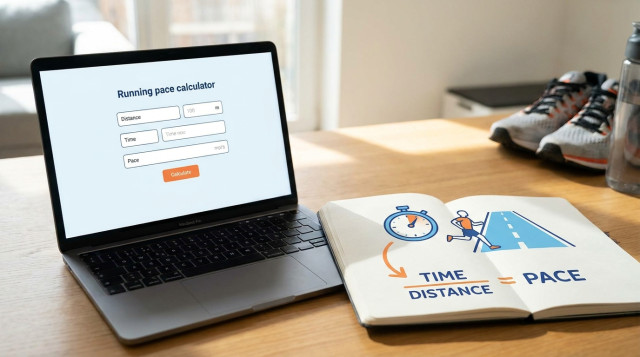
Pace = Total time / Distance
If time is in minutes and distance in kilometers, the result is minutes per kilometer. If distance is in miles, you get minutes per mile.
Speed formula
Speed is the inverse of pace:
Speed (km/h) = Distance (km) / Time (hours)
You can also go straight from pace to speed:
Speed (km/h) = 60 / Pace (min/km)
And from speed to pace:
Pace (min/km) = 60 / Speed (km/h)
How to calculate running pace step by step
Follow these steps with any run or race:
- Convert the total time to minutes. Multiply hours by 60, add the minutes, and convert seconds by dividing by 60. For example, 52:30 is 52 + 30/60 = 52.5 minutes.
- Divide by the distance. 52.5 minutes divided by 10 km equals 5.25 min/km.
- Convert the decimal part to seconds. Multiply 0.25 by 60 to get 15 seconds. The pace is 5:15 min/km.
The third step is where most manual errors happen. A decimal such as 5.25 does not mean 5 minutes and 25 seconds. The decimal is a fraction of a minute, so it must be multiplied by 60.
Example: calculating pace for a 10K run
Suppose you finish a 10K in 52 minutes and 30 seconds.
- Total time: 52.5 minutes
- Pace per kilometer: 52.5 / 10 = 5.25 min/km, which is 5:15 min/km
- Average speed: 10 / (52.5 / 60) = 10 / 0.875 = 11.43 km/h
- Pace per mile: 5.25 × 1.609344 = 8.449 min/mi, which is about 8:27 min/mi
The same run can therefore be described as 5:15 per kilometer, 8:27 per mile or 11.4 km/h. All three numbers describe identical performance.
How to convert running pace between kilometers and miles
One mile equals 1.609344 kilometers. Use these rules:
- From min/km to min/mi: multiply by 1.609344.
- From min/mi to min/km: divide by 1.609344.
Example: a pace of 6:00 min/km equals 6 × 1.609344 = 9.656 min/mi. Convert 0.656 minutes to seconds (0.656 × 60 = 39.4) and you get roughly 9:39 min/mi.
In the other direction, 8:00 min/mi equals 8 / 1.609344 = 4.971 min/km, or about 4:58 min/km.
Running pace and speed conversion table
This table gives quick reference values for common training paces.
| Pace (min/km) | Speed (km/h) | Approx. pace (min/mi) |
|---|---|---|
| 4:00 | 15.00 | 6:26 |
| 4:30 | 13.33 | 7:14 |
| 5:00 | 12.00 | 8:03 |
| 5:30 | 10.91 | 8:51 |
| 6:00 | 10.00 | 9:39 |
| 6:30 | 9.23 | 10:28 |
| 7:00 | 8.57 | 11:16 |
| 7:30 | 8.00 | 12:04 |
Treadmill users can read the speed column directly. If the console shows 10 km/h, your pace is 6:00 min/km.
How to calculate finish time from your pace
To predict a finish time, rearrange the formula:
Finish time = Pace × Distance
Take a runner holding 5:30 min/km. Standard race distances give these results:
| Race | Distance | Finish time at 5:30 min/km |
|---|---|---|
| 5K | 5 km | 27:30 |
| 10K | 10 km | 55:00 |
| Half marathon | 21.0975 km | 1:56:02 |
| Marathon | 42.195 km | 3:52:04 |
Here is the half marathon calculation in detail: 5.5 × 21.0975 = 116.036 minutes. That is 116 minutes plus 0.036 × 60 = 2 seconds, so 1 hour, 56 minutes and 2 seconds.
How to calculate the pace you need for a goal time
When you have a target, divide the goal time by the distance. Imagine you want to run a marathon in 4 hours.
- Convert 4:00:00 to minutes: 240.
- Divide by 42.195 km: 240 / 42.195 = 5.688 min/km.
- Convert 0.688 to seconds: 0.688 × 60 = 41 seconds.
You need to average about 5:41 min/km, which is roughly 9:09 min/mi. In practice, set your watch to alert you if you drift more than a few seconds from this number in the early kilometers.
Splits for a track or short intervals
Pace also tells you lap times. At 5:00 min/km, one kilometer takes 300 seconds, so 400 meters takes 300 × 0.4 = 120 seconds, or 2:00. At 4:30 min/km, a 400 m lap takes 270 × 0.4 = 108 seconds, or 1:48.
How to predict race time from another distance
If you have a recent result at one distance, you can estimate another using the Riegel formula:
T2 = T1 × (D2 / D1)^1.06
Say you ran a 10K in 50:00 and want a half marathon estimate.
- D2 / D1 = 21.0975 / 10 = 2.10975
- 2.10975 raised to the power 1.06 is about 2.206
- T2 = 50 × 2.206 = 110.3 minutes, roughly 1:50:20
Treat this as an optimistic ceiling. It assumes you have trained enough for the longer distance. If your weekly mileage is low, add a few minutes to the prediction, especially for the marathon.
How to use a running pace calculator online
A running pace calculator removes the manual conversions and lets you test scenarios quickly. On Calculatorr, the process is straightforward:
- Enter your distance and choose kilometers or miles.
- Enter your time in hours, minutes and seconds if you want pace, or enter your pace if you want a finish time.
- Review the output: pace per kilometer, pace per mile, speed and projected race times.
- Adjust the inputs to compare goals, such as 5:20 versus 5:30 per kilometer.
Use the calculator to verify your manual work, then check other tools at Calculatorr.com for related fitness, conversion and time calculations.
How to interpret your pace results
A pace number is only useful when you connect it to context. Here are practical ways to read it:
- Easy runs: you should be able to hold a conversation. This is often 60 to 90 seconds per kilometer slower than your 10K race pace.
- Tempo runs: comfortably hard, close to the pace you could hold for about an hour.
- Intervals: faster than 5K pace, with recovery between repetitions.
- Race pace: the average you plan to hold from start to finish, ideally with even or slightly negative splits.
A gap of just 10 seconds per kilometer adds up. Over a marathon, 10 seconds per kilometer equals about 7 minutes. That is why a small pacing error early in a race has a large effect on the finish time.
Remember that pace depends on conditions. Heat, hills, wind and fatigue raise the effort needed for the same pace. If your pace is slower on a hot day but your heart rate and perceived effort match a normal run, you are not losing fitness.
Common mistakes when calculating running pace
- Treating decimals as seconds. 5.5 min/km is 5:30, not 5:50.
- Mixing units. Dividing minutes by miles and calling the result min/km gives a wrong pace by a factor of 1.609.
- Using rounded distances. A half marathon is 21.0975 km, not 21 km, and a marathon is 42.195 km. Rounding down makes your target pace too easy.
- Ignoring GPS error. Watches can overestimate distance in cities or under trees, which makes your pace look faster or slower than reality. Use race markers as the reference.
- Judging a run by average pace alone. Hills, stops and traffic lights distort the average. Look at moving pace and per-kilometer splits.
- Setting a goal with no recent data. A target should come from a recent race or time trial, not from hope.
Quick method to calculate pace without a calculator
For a rough estimate during a run, use the speed shortcut. If you know your treadmill speed, divide 60 by it. At 11 km/h, 60 / 11 = 5.45 min/km, which is about 5:27. If you ran 8 km in 44 minutes, divide 44 by 8 to get 5.5 min/km, or 5:30.
For quick mental checks, remember that 12 km/h is exactly 5:00 per kilometer, and 10 km/h is exactly 6:00. Adjust from there: each extra 1 km/h near these speeds shaves roughly 25 to 30 seconds from the pace.
Once these formulas feel natural, you can plan training blocks, check race predictions and pace yourself with confidence. Whenever you want to confirm a figure, the tools at Calculatorr give you accurate results in seconds.