Shoe size conversion is the process of translating a size from one system to another, such as US to EU or UK to US, so you can buy the right pair from any brand or country. It sounds simple, but each system uses a different unit and a different starting point, which is why a size 9 in one store can be a 42 or a 43 in another. With a clear formula and a reliable foot measurement, you can convert sizes in under a minute and avoid costly returns.
What is shoe size conversion and why do sizes differ between countries?
A shoe size is not a measurement of your foot. It is a measurement of the shoe's last, the mold the shoe is built around, which is always a little longer than your foot to leave room for movement. Each region defines that length with its own unit and numbering.
The main sizing systems explained
- EU (Paris points): one Paris point equals 2/3 of a centimeter, so the size is roughly 1.5 times the last length in centimeters. Sizes are usually whole or half numbers.
- UK: based on the barleycorn, which equals 1/3 of an inch. Each full size adds one barleycorn of length.
- US: also barleycorn-based, but starts from a different point and uses separate scales for men, women and children.
- Mondopoint (CM): simply the foot length in centimeters or millimeters. It is common on ski boots, hiking boots and some sports footwear.
Because the starting points differ, converting between systems needs an offset as well as a unit change.
Shoe size conversion formula: how to calculate your size from foot length
The most reliable method is to start from your foot length and add a small allowance for comfort. The allowance is usually between 1 and 2 cm; this guide uses 1.5 cm, a common middle value for everyday shoes.
Formulas for adult sizes
Let L be your foot length in centimeters and last length = L + 1.5.
- EU size = 1.5 × (L + 1.5)
- UK size = 3 × (last length in inches) − 25, where last length in inches = (L + 1.5) ÷ 2.54
- US men's size = UK size + 1
- US women's size = US men's size + 1.5
These produce a good estimate, but brands round and grade sizes differently, so treat the result as a starting point.
Converting directly between systems
If you already know one size and want another, use these quick relationships for adult shoes:
- UK to US men's: add 1
- UK to US women's: add 2 (using women's UK sizing)
- US men's to US women's: add 1.5
- US women's to US men's: subtract 1.5
- UK to EU: EU ≈ 1.27 × (UK + 25)
- EU to UK: UK ≈ (EU ÷ 1.27) − 25
The UK to EU shortcut comes from combining the barleycorn and Paris point definitions with the 1.5 cm allowance. It is accurate enough for most shopping decisions.
How to measure your foot at home for the right size
Every conversion depends on this number, so measure carefully.
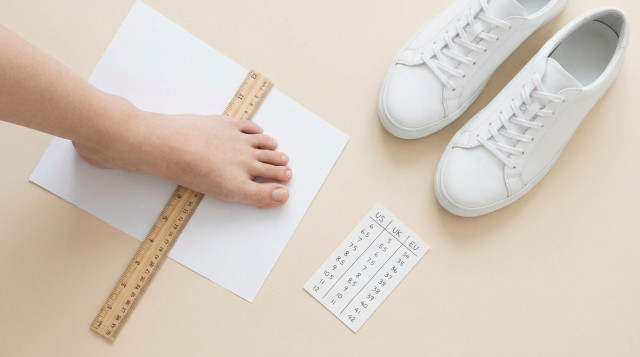
- Place a sheet of paper on a hard floor with one edge against a wall.
- Stand on the paper with your heel touching the wall. Wear the type of socks you plan to use with the shoes.
- Mark the tip of your longest toe. This is not always the big toe.
- Measure the distance from the wall to the mark in centimeters.
- Repeat with the other foot and use the larger value.
Measure in the late afternoon or evening, when feet are slightly larger after a day of walking. This avoids buying shoes that feel tight later.
How to convert shoe sizes step by step with real examples
Example 1: from foot length to US, UK and EU
Your foot measures 26 cm.
- Last length = 26 + 1.5 = 27.5 cm.
- EU size = 1.5 × 27.5 = 41.25, which rounds to 41.
- Last length in inches = 27.5 ÷ 2.54 = 10.83 in.
- UK size = 3 × 10.83 − 25 = 7.48, which rounds to 7.5.
- US men's size = 7.5 + 1 = 8.5.
- US women's size = 8.5 + 1.5 = 10.
So a 26 cm foot corresponds to roughly EU 41, UK 7.5, US men's 8.5 and US women's 10.
Example 2: from UK size to EU and US
You wear a UK 9 and are shopping on a European site.
- EU size ≈ 1.27 × (9 + 25) = 1.27 × 34 = 43.18, so EU 43.
- US men's size = 9 + 1 = 10.
You should look for EU 43 or US men's 10.
Example 3: from US women's to US men's
A US women's size 8.5 becomes 8.5 − 1.5 = 7 in US men's sizing. This is useful when a style is only listed in men's sizes.
Shoe size conversion chart for adults
The table below applies the formulas above with a 1.5 cm allowance. Values are rounded to the nearest half size, or to the nearest whole number for EU.
| Foot length (cm) | EU | UK | US men's | US women's |
|---|---|---|---|---|
| 23 | 37 | 4 | 5 | 6.5 |
| 24 | 38 | 5 | 6 | 7.5 |
| 25 | 40 | 6.5 | 7.5 | 9 |
| 26 | 41 | 7.5 | 8.5 | 10 |
| 27 | 43 | 8.5 | 9.5 | 11 |
| 28 | 44 | 10 | 11 | 12.5 |
Printed charts from brands may differ by half a size or one EU size. When a brand offers its own chart, always prefer it over a generic one.
How to use an online shoe size calculator
A calculator removes the rounding work and lets you compare systems instantly. On Calculatorr, you can find conversion and measurement tools that follow the same logic as the formulas in this guide.
- Enter your foot length in centimeters or inches, or enter a size you already know.
- Select the source system (EU, UK, US men's, US women's).
- Choose the target system.
- Review the converted size and the nearest half-size options.
If you only have your foot length in inches, you can convert it first with a unit converter from Calculatorr by multiplying inches by 2.54 to get centimeters.
How to interpret your converted shoe size
The number you get is a target, not a guarantee. Here is how to read it.
- Between two sizes: if the result falls between sizes, such as EU 41.25, choose the larger one for shoes you wear with thick socks and the smaller one for snug, athletic fits.
- Width matters: two people with the same length can need different widths. If a shoe pinches at the sides, go up half a size or look for a wide version.
- Different feet: a difference of up to half a size between feet is common. Buy for the larger foot.
- Purpose of the shoe: running shoes usually need an allowance close to 1.5 to 2 cm so toes do not hit the front. Dress shoes can be closer to 1 cm.
Common mistakes when converting shoe sizes
- Mixing men's and women's scales. A US 8 in men's is not a US 8 in women's. The gap is about 1.5 sizes.
- Assuming all brands fit the same. Two pairs labeled EU 42 can differ by several millimeters.
- Measuring only one foot. Always measure both and use the larger value.
- Forgetting the allowance. Matching your exact foot length to the shoe length leaves no room and causes discomfort.
- Using adult formulas for children. Kids' sizes restart their numbering, so the UK subtraction constant is different. Use a children's chart or a dedicated calculator instead.
- Rounding too early. Keep decimals until the last step, then round once.
When should you use a different method to find your shoe size?
Some footwear needs more precision than a general conversion offers. Ski boots and cycling shoes often use Mondopoint, where the size is your foot length itself, so you can skip the conversion and match your measurement directly. For orthopedic needs or very wide feet, a fitting in a store with a Brannock device or a foot scanner provides better accuracy than any formula.
For everyday purchases, though, the combination of a careful measurement, the formulas above and a quick check of the brand's size guide gives results you can trust. Save your foot length and your sizes in each system, and you will be able to convert any size in seconds the next time you shop online or abroad.