
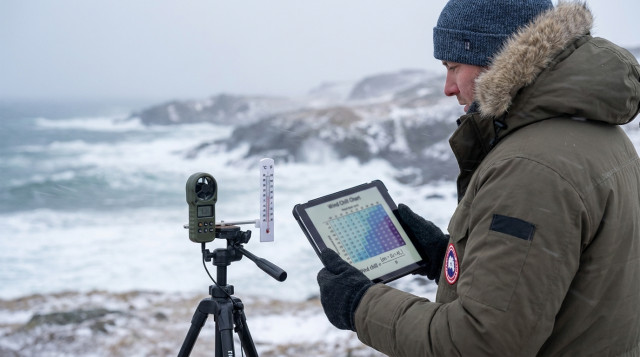
how to calculate wind chill and what it means
How to calculate wind chill measures the apparent temperature felt on exposed skin when air temperature and wind speed combine. Knowing wind chill helps you judge cold exposure risk, dress appropriately and plan outdoor activities. Below you’ll find the standard formulas, step-by-step manual calculations, practical examples, guidance to use an online calculator and common mistakes to avoid.
what is wind chill and when to use the calculation
Wind chill is not an actual air temperature but an index that estimates how cold the body feels due to heat loss from exposed skin when wind is present. Use the wind chill calculation when air temperature is low (typically at or below 10°C / 50°F) and there is measurable wind. The formula is valid only within specific temperature and wind ranges—apply it only under those conditions (details below).
how to calculate wind chill: the formulas
There are two commonly used wind chill formulas depending on units:
- Metric (°C and km/h): Wind chill temperature (°C) = 13.12 + 0.6215 × T_a − 11.37 × v^0.16 + 0.3965 × T_a × v^0.16
Where T_a is air temperature in °C and v is wind speed in km/h. Valid for T_a ≤ 10°C and v > 4.8 km/h. - Imperial (°F and mph): Wind chill temperature (°F) = 35.74 + 0.6215 × T_a − 35.75 × v^0.16 + 0.4275 × T_a × v^0.16
Where T_a is air temperature in °F and v is wind speed in mph. Valid for T_a ≤ 50°F and v > 3.0 mph.
These formulas are the official North American/Canadian wind chill equations adopted for public weather services and widely used for practical decisions.
step-by-step: calculate wind chill manually (metric example)
Example: Air temperature T_a = −8°C, wind speed v = 30 km/h. Calculate wind chill (°C).
- Identify inputs: T_a = −8, v = 30.
- Compute v^0.16: 30^0.16. Using a scientific calculator, 30^0.16 ≈ 1.668.
- Multiply constants:
- 0.6215 × T_a = 0.6215 × (−8) = −4.972
- 11.37 × v^0.16 = 11.37 × 1.668 ≈ 18.96
- 0.3965 × T_a × v^0.16 = 0.3965 × (−8) × 1.668 ≈ −5.294
- Plug into formula: 13.12 + (−4.972) − 18.96 + (−5.294) = 13.12 − 4.972 − 18.96 − 5.294.
- Sum terms: 13.12 − 4.972 = 8.148. Then 8.148 − 18.96 = −10.812. Then −10.812 − 5.294 ≈ −16.106.
- Result: wind chill ≈ −16.1°C.
Interpretation: Although the thermometer reads −8°C, the combined effect of wind makes it feel like −16.1°C on exposed skin.
step-by-step: calculate wind chill manually (imperial example)
Example: Air temperature T_a = 20°F, wind speed v = 20 mph. Calculate wind chill (°F).
- Inputs: T_a = 20, v = 20.
- Compute v^0.16: 20^0.16 ≈ 1.515.
- Multiply constants:
- 0.6215 × T_a = 0.6215 × 20 = 12.43
- 35.75 × v^0.16 = 35.75 × 1.515 ≈ 54.17
- 0.4275 × T_a × v^0.16 = 0.4275 × 20 × 1.515 ≈ 12.96
- Plug into formula: 35.74 + 12.43 − 54.17 + 12.96 = 6.96 (approximately).
- Result: wind chill ≈ 7°F.
Interpretation: A 20°F air temperature with 20 mph wind feels like about 7°F to exposed skin.
how to use an online wind chill calculator
Using an online calculator saves time and avoids manual errors when computing v^0.16 or combining terms. To use an online wind chill calculator on Calculatorr or another reliable tool:
- Enter the air temperature in the units required (°C or °F).
- Enter wind speed in km/h or mph matching the formula choice.
- Ensure the inputs fall within the formula’s valid range (T ≤ 10°C / 50°F and wind speed above the minimum threshold).
- Click calculate to get the wind chill value and a short interpretation.
Online tools typically handle unit conversions, so if you have wind in m/s or temperature in Kelvin, pick a calculator that supports conversion or convert inputs first.
valid ranges and limitations of the wind chill formula
- The standard formulas are valid for temperatures at or below 10°C (50°F).
- Wind speed must be above roughly 4.8 km/h (3.0 mph); at very low wind speeds the cooling effect is negligible and formulas may not apply.
- Wind chill applies to exposed skin—insulated conditions (clothing, shelter) significantly change perceived cold.
- Wind chill does not account for humidity, solar radiation, or long-term cold stress (hypothermia risk depends on more factors).
how to interpret wind chill values
Wind chill provides a guide for deciding on protective measures:
- 0 to −9°C (32 to 16°F feeling): skin can be uncomfortable, but risk of frostbite is low.
- −10 to −27°C (14 to −17°F feeling): exposed skin can develop frostnip or mild frostbite after prolonged exposure; wear insulated clothing and limit time outside.
- ≤ −28°C (≤ −18°F feeling): rapid frostbite is possible, and hypothermia risk increases; avoid exposed skin and minimize outdoor time.
These bands are general. Local guidance from weather services often provides specific exposure time estimates related to wind chill values.
common errors when calculating wind chill
- Using the formula outside its valid temperature or wind ranges leads to incorrect results.
- Mixing units (entering °C with mph or °F with km/h) without converting causes large errors.
- Rounding intermediate values too early (especially v^0.16) introduces small but avoidable inaccuracies. Keep at least four significant digits during calculation.
- Interpreting wind chill as an actual air temperature rather than an index for heat loss.
practical tips for everyday use
- Check wind chill when planning outdoor activities, especially for children, elderly and outdoor workers.
- Layer clothing, cover exposed skin, and be aware that wet skin cools faster than dry skin.
- Use local weather warnings—if wind chill crosses hazardous thresholds, follow recommended precautions.
- When in doubt, use an online calculator like the one on Calculatorr to get a quick, reliable reading.

example table: selected wind chill results (metric)
| Air temp (°C) | Wind (km/h) | Wind chill (°C) |
|---|---|---|
| 0 | 10 | −4 |
| −5 | 20 | −13 |
| −15 | 40 | −31 |

additional considerations and related calculations
Wind chill is one part of cold-weather planning. Consider also:
- Frostbite and hypothermia risk charts from local authorities.
- Heat loss models for exposed skin if working in extreme conditions.
- Conversion tools if you need to switch units before calculating—Calculatorr offers converters that simplify unit handling.
quick checklist before calculating wind chill
- Confirm temperature units and wind units match the chosen formula.
- Ensure temperature is ≤ 10°C (50°F) and wind speed exceeds minimum threshold.
- Use a reliable calculator or keep sufficient precision in manual calculations.
- Interpret results as apparent temperature for exposed skin, not the actual air temperature.
Use the wind chill formula to make safer choices outdoors and combine it with local weather guidance. For a fast result, try the wind chill calculator at Calculatorr and follow the dressing and exposure advice for the wind chill value you obtain.