
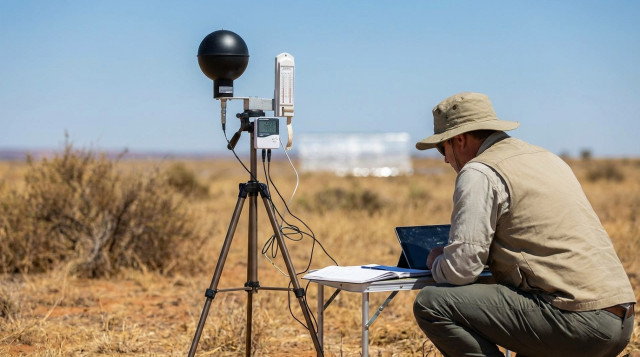
wet bulb globe temperature (WBGT) is a widely used index to assess heat stress risk in outdoor and indoor occupational settings. It combines air temperature, humidity, wind speed and radiant heat into a single value that helps decide work–rest schedules, hydration needs and safety limits.
what is WBGT and why calculate it
WBGT estimates the effective thermal load on the human body. Organizations use WBGT thresholds to protect workers, athletes and event participants from heat illness. Calculating WBGT gives a measurable criterion to trigger controls such as more frequent breaks, cooling interventions or reduced work intensity.
how to calculate WBGT: formula and variables
There are two common WBGT formulas depending on measurement availability:
1) Outdoor or with solar radiation (direct sun)
WBGT = 0.7 × Twb + 0.2 × Tg + 0.1 × Ta
- Twb = natural wet-bulb temperature (°C)
- Tg = globe temperature measured with a black globe thermometer (°C)
- Ta = dry-bulb (air) temperature (°C)
2) Indoor or shaded environments (no direct solar load)
WBGT = 0.7 × Twb + 0.3 × Tg (Ta may be omitted if Tg is available)
how to measure each input manually
dry-bulb temperature (Ta)
Measure ambient air temperature with a calibrated digital or mercury thermometer shielded from direct sunlight. Record in °C (or convert from °F).
natural wet-bulb temperature (Twb)
Twb is the temperature a wetted thermometer bulb reaches with natural ventilation. Methods to obtain Twb:
- Use a psychrometer with a wet wick and allow adequate ventilation; read the wet-bulb directly.
- If only air temperature and relative humidity are known, approximate Twb using a psychrometric formula or a simple approximation (see calculation example).
- For fast field work, use a modern meter that outputs natural wet-bulb temperature directly.
globe temperature (Tg)
Tg is measured inside a 15 cm (6 in) matte black globe with a thermometer at its center. Place the globe where the worker’s head or torso would be, at breathing zone height, and shield from obstructions that alter radiant exposure. For practical field work, commercially available black-globe thermometers provide Tg in °C.
step-by-step manual calculation (no special instruments)
When you lack a globe thermometer and natural wet-bulb measurement, you can approximate WBGT from common meteorological data: air temperature (Ta) and relative humidity (RH). This method reduces precision but gives a usable estimate.
step 1 — get Ta and RH
Use a reliable thermometer and a hygrometer or obtain local station data (Ta in °C, RH in %).
step 2 — estimate Twb from Ta and RH (approximation)
A simple approximation to convert Ta and RH to Twb (°C):
Twb ≈ Ta × atan(0.151977 × sqrt(RH + 8.313659)) + atan(Ta + RH) - atan(RH - 1.676331) + 0.00391838 × pow(RH, 1.5) × atan(0.023101 × RH) - 4.686035
This empirical formula gives a reasonable Twb estimate for common ambient ranges. For quick mental checks, Twb is roughly Ta minus a humidity-dependent value (e.g., at 30°C and 50% RH, Twb ≈ 24–25°C).
step 3 — estimate Tg if globe thermometer is not available
For outdoor sunny conditions, Tg is typically higher than Ta due to solar radiation. A rough field estimate:
- In full sun: Tg ≈ Ta + 3 to 8 °C (use local solar intensity and surface reflection to choose within range).
- In shade: Tg ≈ Ta ± 1 °C.
step 4 — compute WBGT
Use the outdoor formula if in direct sun or indoor formula if shaded. Plug Twb, Tg and Ta into the formula and calculate WBGT in °C.
calculation example (practical field case)
Scenario: outdoor construction site, measured Ta = 32°C, RH = 55%, no globe thermometer available.
- Estimate Twb using the approximation: Twb ≈ 25.4°C (calculated from the formula above).
- Estimate Tg for full sun: Tg ≈ Ta + 5 = 37°C.
- Apply outdoor formula: WBGT = 0.7×25.4 + 0.2×37 + 0.1×32
- WBGT = 17.78 + 7.4 + 3.2 = 28.38°C
Interpretation: a WBGT ≈ 28.4°C indicates elevated heat stress; many guidelines recommend work–rest cycles, hydration, and monitoring when WBGT exceeds mid-20s °C depending on metabolic workload and clothing.
how to use an online WBGT calculator
Online calculators simplify the process: enter air temperature, relative humidity, globe temperature (if available) and choose sun/shade. Calculatorr offers climate and heat-index tools that can compute WBGT and suggest control measures. Link relevant pages naturally while checking local conditions and measurement units.
how to interpret WBGT results and recommended actions
WBGT values are actionable when paired with activity level and clothing. Typical guidance:
- < 25°C — low to moderate heat stress for light work; monitor hydration.
- 25–28°C — moderate; increase rest breaks and hydration, reduce work intensity for heavy tasks.
- 28–31°C — high; implement frequent rest cycles, cooling, and close medical supervision for strenuous work.
- > 31°C — very high to extreme; limit heavy work, use engineering controls, consider postponing nonessential tasks.
Adjust thresholds if workers wear impermeable or insulated clothing, are unacclimatized, or have medical risk factors.
common errors and how to avoid them
- Using Ta alone: air temperature ignores humidity and radiation—WBGT is more representative.
- Misreading wet-bulb: forced-vent psychrometers give different wet-bulb than natural-wet-bulb; use the correct method or convert carefully.
- Estimating Tg poorly: underestimating radiant load leads to dangerously low WBGT. When in doubt, assume higher Tg in direct sun.
- Applying thresholds without accounting for clothing and work intensity: always match WBGT guidance to metabolic rate and protective clothing.
practical tips for accurate field measurement
- Place instruments at breathing zone height and away from reflective surfaces.
- Allow instruments to equilibrate; record steady readings.
- Calibrate instruments regularly and log time of day, wind conditions and worker activity for context.
- When precise instruments are unavailable, use conservative estimates to protect health.
further use cases and applications
WBGT supports decisions in occupational safety, sports training, event planning and emergency response. It helps define work–rest schedules, hydration protocols, and signals when to deploy cooling interventions or change schedules to cooler hours.
For fast calculations, try Calculatorr’s heat stress tools to compute WBGT from common inputs and receive actionable guidance tailored to work intensity and clothing. Use measured Twb and Tg whenever possible for the most reliable results.