A ladder angle calculator answers one question before you climb: how far from the wall should the base sit? Get it wrong and the ladder can slide out at the bottom or tip backward at the top. Both are common causes of falls from height, and both are easy to prevent with a simple calculation.
The standard answer is the 4-to-1 rule: for every 4 units of working ladder length, place the base 1 unit away from the wall. This guide explains the math behind that rule, shows how to calculate the angle and the ladder length you need, and covers the mistakes that make a correctly angled ladder unsafe anyway.
What is the safe ladder angle and why does it matter?
A leaning (non-self-supporting) ladder stays in place because of friction at the base and the support at the top. The angle decides how those forces balance.
- Too flat (base too far out): the ladder is more likely to slide at the bottom, and it flexes more under your weight.
- Too steep (base too close): the ladder is more likely to tip backward, especially when you reach or push on the wall.
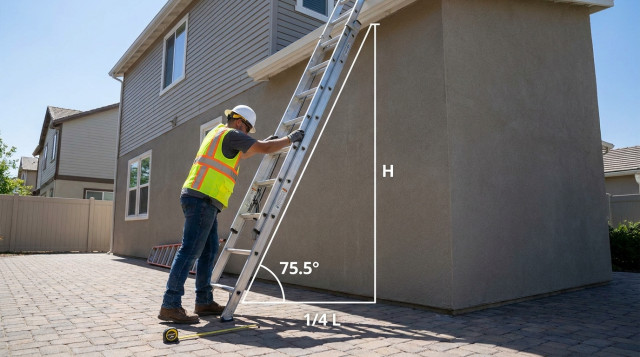
The widely used safe setup is an angle of about 75.5 degrees from the ground. That is the angle you get when the base is one quarter of the working length away from the wall.
What does working length mean?
Working length is the distance along the ladder from the foot to the point where it touches the wall or roof edge. It is not the full length of the ladder if the ladder extends above the support point. This detail matters because the 4-to-1 rule uses the working length, not the total length.
Ladder angle formula: how to calculate base distance and angle
The setup is a right triangle. The ladder is the hypotenuse, the wall is the vertical side and the ground between the wall and the foot is the horizontal side.
Formula for base distance
Base distance = working length ÷ 4
The same result using trigonometry: Base distance = working length × cos(75.5°), and cos(75.5°) is approximately 0.25.
Formula for the height the ladder reaches
Support height = working length × sin(75.5°)
Since sin(75.5°) is approximately 0.968, a correctly set ladder touches the wall at roughly 97% of its working length in height.
Formula for the angle if you already know the setup
Angle = arctan(support height ÷ base distance)
You can also use Angle = arccos(base distance ÷ working length) if you measured along the ladder instead of up the wall.
How to calculate ladder angle step by step
- Measure the height you need to reach. This is the vertical distance from the ground to the roof edge, gutter or landing where the ladder will rest.
- Convert height to working length. Divide the height by 0.968. This gives the length of ladder between the foot and the support point.
- Calculate the base distance. Divide the working length by 4.
- Add the extension above the support point. If you are stepping onto a roof or platform, the ladder must extend at least 3 ft (about 1 m) above it.
- Choose a ladder that covers the total. Total length needed = working length + extension (plus the overlap on extension ladders).
- Set the ladder and check it. Place the foot at the calculated distance and confirm with a quick posture test (described below).
Ladder angle example in feet: reaching a roof edge
You need to reach an eave that is 18 ft above level ground and step onto the roof.
- Working length = 18 ÷ 0.968 = 18.6 ft
- Base distance = 18.6 ÷ 4 = 4.65 ft (about 4 ft 8 in)
- Extension above the eave = 3 ft
- Total ladder length needed = 18.6 + 3 = 21.6 ft
Check the geometry: the base is 4.65 ft and the working length is 18.6 ft, so the height is the square root of (18.6² − 4.65²) = square root of (345.96 − 21.62) = 18.0 ft. The setup matches the height you need.
Why a nominal 24 ft extension ladder may not be enough
Extension ladders are sold by nominal length, which is the sum of the two sections. The sections must overlap when extended, typically around 3 ft for ladders up to 36 ft. A 24 ft ladder therefore reaches a maximum of about 21 ft in length. With 21.6 ft required in this example, you would move up to the next size, such as a 28 ft nominal ladder. Always confirm the maximum working length printed on the ladder label.
Ladder angle example in meters
You need to reach a window frame 5 m above the ground and then climb past it onto a flat roof edge.
- Working length = 5 ÷ 0.968 = 5.17 m
- Base distance = 5.17 ÷ 4 = 1.29 m
- Extension above the support = 1 m
- Total length needed = 5.17 + 1 = 6.17 m
Round up when you choose the ladder, and never plan to use the last rung or the top sections of the ladder as a working position.
Quick reference table: base distance by working length
| Working length | Base distance (1/4 rule) | Approximate support height |
|---|---|---|
| 8 ft | 2 ft | 7.7 ft |
| 12 ft | 3 ft | 11.6 ft |
| 16 ft | 4 ft | 15.5 ft |
| 20 ft | 5 ft | 19.4 ft |
| 24 ft | 6 ft | 23.2 ft |
| 3 m | 0.75 m | 2.9 m |
| 5 m | 1.25 m | 4.84 m |
| 7 m | 1.75 m | 6.78 m |
Notice that the base distance is simply a quarter of the working length. If you only remember one number, remember that.
How to check a ladder angle you already set up
Sometimes the ladder is already in place and you want to verify it. Suppose the foot is 6 ft from the wall and the ladder touches the wall at 18 ft.
- Angle = arctan(18 ÷ 6) = arctan(3) = 71.6°
- Working length = square root of (18² + 6²) = 18.97 ft
- Correct base distance for that length = 18.97 ÷ 4 = 4.74 ft
The ladder is about 1.3 ft too far from the wall. The angle of 71.6 degrees is flatter than the recommended 75.5 degrees, so the base should be moved closer.
The posture test for a quick field check
When you cannot measure, stand at the foot of the ladder with your toes against the side rails and extend your arms straight in front of you. Your palms should reach the rung at shoulder height. If you have to stretch, the ladder is too far out. If your arms bend, it is too steep. Use this as a backup check, not a replacement for the calculation on a tall setup.
How to use a ladder angle calculator online
A ladder calculator removes the manual steps, which helps when you are working on site and comparing several heights. Open Calculatorr and look for the tools that handle right triangle and angle calculations, then follow this routine:
- Enter the vertical height you need to reach.
- Choose the unit (feet or meters) and keep it consistent.
- Read the working length and the base distance in the results.
- Add the extension above the support point to find the minimum ladder size.
If a calculator works with trigonometry, you can also enter the base distance and height to get the angle directly, which is useful for checking an existing setup. For related unit work, such as converting feet to meters before measuring, you can find other tools on Calculatorr.com.
How to interpret the results
| Angle | What it means | Action |
|---|---|---|
| Below about 73° | Too flat. Higher risk of slipping at the base and of the ladder bowing | Move the base closer to the wall |
| About 75° | Recommended range | Secure the ladder and climb |
| Above about 78° | Too steep. Higher risk of tipping backward | Move the base slightly away from the wall |
A small deviation of a few inches in base distance does not make a ladder unsafe by itself, but the error grows with the working length. On a 24 ft working length, a 6 in error in base distance shifts the angle by roughly 1.2 degrees.
Common mistakes when calculating ladder angle
- Using total ladder length instead of working length. The base distance should be based on the length from the foot to the support point. Using the total length places the ladder too far out.
- Forgetting the 3 ft (1 m) extension. A ladder that ends exactly at the roof edge gives you nothing to hold when stepping on or off.
- Ignoring extension ladder overlap. The nominal size is not the usable length.
- Measuring on sloped ground. The base distance is horizontal, and the foot needs level, firm support. Do not stack blocks or bricks under a leg to level it.
- Mixing units. Measuring height in feet and applying a metric ladder length leads to rounding errors that matter at height.
- Judging by eye. Most people set ladders too flat because it feels more stable at the bottom.
Other checks that matter as much as the angle
Load rating
The ladder duty rating must cover your weight plus tools and materials. Common ratings in the US system are Type III at 200 lb, Type II at 225 lb, Type I at 250 lb, Type IA at 300 lb and Type IAA at 375 lb. Add up your body weight, clothing, tools and anything you carry before choosing.
Top and base conditions
- Rest the top against a solid, flat surface, not a window pane or a loose gutter.
- Tie off or secure the top where possible.
- Keep your belt buckle between the side rails and avoid overreaching.
- Maintain three points of contact while climbing.
Environmental risks
Wet ground, wind and nearby power lines change the risk. Fiberglass ladders are preferred near electrical hazards, and no ladder should be raised within a safe distance of overhead lines.
When the 4-to-1 rule does not apply
The rule is for non-self-supporting ladders, meaning ladders that lean on a structure. Stepladders and platform ladders are designed to stand on their own and must be fully opened with spreaders locked. Do not lean a closed stepladder against a wall, and do not use the top step as a standing position. Some specialty ladders, such as roof ladders with hooks, have their own manufacturer instructions that take priority.
For any job where the numbers look borderline, such as a working length near the limit of your ladder or soft ground that cannot be fixed, the safest calculation is the one that leads you to a longer ladder or a different access method such as scaffolding or a platform lift.