
Knowing how to calculate your due date is one of the first practical steps after a positive pregnancy test. The estimate shapes when you book appointments, when you plan leave from work and how you track each week of pregnancy. The math is simple, and you can do it by hand in under a minute or check it with a calculator on Calculatorr.
This guide shows the standard formula, how to adjust it for your cycle length, how to work from a conception date or an IVF transfer, and how to read the result without treating it as a fixed deadline.
What is an estimated due date and how is it calculated?
An estimated due date (EDD) is the day you reach 40 weeks of gestation, which is 280 days counted from the first day of your last menstrual period (LMP). Gestational age is counted from the LMP, not from conception. Conception usually happens about two weeks later, so a pregnancy lasts roughly 38 weeks from fertilization.
The EDD is a statistical midpoint, not a promise. Only about 4 to 5 percent of babies arrive on the exact date. Most are born within a window of about two weeks on either side.
Naegele's rule formula: the classic way to calculate a due date
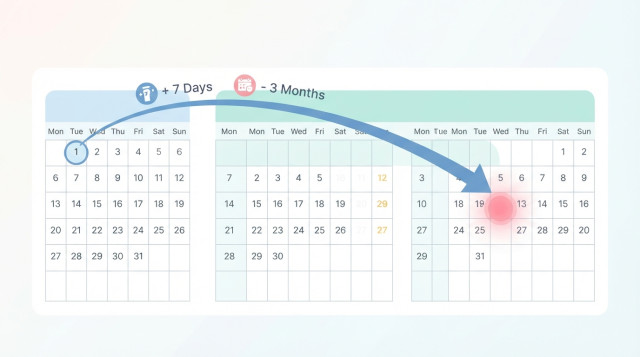
Naegele's rule is the oldest and most widely taught method. It assumes a regular 28-day cycle with ovulation around day 14.
- Take the first day of your last period.
- Add 7 days.
- Subtract 3 months.
- Add 1 year if the result falls in the following calendar year.
In short: EDD = LMP + 7 days - 3 months + 1 year.
The same result can be reached by adding 280 days to the LMP. The two methods can differ by a day or two because calendar months have different lengths, so do not worry if two tools show slightly different dates.
Example 1: due date from the last period using Naegele's rule
Suppose your last period began on 12 March.
- Add 7 days: 19 March.
- Subtract 3 months: 19 December.
Your estimated due date is 19 December. Counting exactly 280 days from 12 March lands on 17 December, so the two approaches differ by two days here. Both are valid estimates, and most online calculators use the 280-day count.
Example 2: a cycle that crosses into the next year
Your last period began on 5 October.
- Add 7 days: 12 October.
- Subtract 3 months: 12 July.
- Move to the next year, because the pregnancy runs past December.
The due date is 12 July of the following year. Counting 280 days from 5 October gives the same date when February has 28 days, or 11 July when it falls in a leap year.
How to adjust your due date for cycle length
Naegele's rule assumes ovulation on day 14, which is only true for a 28-day cycle. If your cycles are consistently longer or shorter, ovulation happens later or earlier, and the due date should move with it.
The adjustment is straightforward:
Adjusted EDD = LMP + 280 days + (your cycle length - 28)
| Average cycle length | Adjustment to the 280-day date |
|---|---|
| 24 days | 4 days earlier |
| 26 days | 2 days earlier |
| 28 days | No change |
| 30 days | 2 days later |
| 32 days | 4 days later |
| 35 days | 7 days later |
Example 3: due date with a 32-day cycle
Your last period started on 20 January and your cycles average 32 days.
- Add 280 days to 20 January: 27 October.
- Cycle difference: 32 - 28 = 4 days.
- Add 4 days: 31 October.
Your adjusted due date is 31 October. Without the adjustment you would be off by four days, which matters when you are following weekly milestones.
How to calculate your due date from the conception date
If you know the date of conception, for example through ovulation tracking, use 266 days instead of 280. That is 38 weeks, the typical length of pregnancy measured from fertilization.
EDD = conception date + 266 days
Example 4: conception on 1 June
Counting 266 days forward from 1 June lands on 22 February of the following year. That date corresponds to 40 weeks counted from the LMP, assuming conception happened on a typical day 14.
Keep in mind that the exact conception day is often uncertain. Sperm can survive for several days, so tracking apps and calculators give an estimate rather than an exact date.
How to calculate your due date after IVF or embryo transfer
With assisted reproduction the timeline is more precise because the transfer date is known. The calculation depends on the age of the embryo at transfer:
- Day 3 embryo transfer: due date = transfer date + 263 days.
- Day 5 embryo transfer: due date = transfer date + 261 days.
Your clinic normally provides the official date, so use these formulas only to double-check it.
How to calculate how many weeks pregnant you are
Once you have your LMP or your due date, you can work out your current gestational age. Count the days since the first day of your last period, then divide by 7. The whole number is the weeks and the remainder is the extra days.
Example 5: weeks and days since the LMP
Your LMP was on 12 March and today is 14 June.
- Days from 12 March to 14 June: 94.
- 94 / 7 = 13 with a remainder of 3.
You are 13 weeks and 3 days pregnant. If you only know the due date, subtract it from today's date to get the days remaining, then subtract that number from 280.
Due date calculator: how to use one correctly
A due date calculator removes arithmetic mistakes and handles leap years automatically. To get a reliable result, follow these steps:
- Choose the method that matches what you know: last period, conception date, IVF transfer or ultrasound.
- Enter the first day of your last period, not the last day of bleeding.
- Add your average cycle length if it differs from 28 days.
- Review the due date, current week and trimester dates.
You can find this type of tool and many others, from health to date calculations, on the Calculatorr home page. If you want to track other health numbers while you plan, tools such as a BMI or daily water intake calculator can also be useful.
What your due date result means: trimesters and term categories
Once you have the due date, you can map the entire pregnancy. These are the standard ranges counted from the LMP:
| Stage | Gestational age |
|---|---|
| First trimester | Week 1 to 13 weeks 6 days |
| Second trimester | 14 weeks 0 days to 27 weeks 6 days |
| Third trimester | 28 weeks 0 days until birth |
Births are also classified by timing:
| Category | Gestational age at birth |
|---|---|
| Early term | 37 weeks 0 days to 38 weeks 6 days |
| Full term | 39 weeks 0 days to 40 weeks 6 days |
| Late term | 41 weeks 0 days to 41 weeks 6 days |
| Post-term | 42 weeks 0 days or later |
Treat the due date as the center of a range. Planning for flexibility between week 37 and week 41 is more realistic than planning around a single day.
When does an ultrasound change the due date?
Many providers confirm the date with an early ultrasound, which measures the embryo from head to rump (crown-rump length). In the first trimester, this measurement is a very accurate way to date a pregnancy.
As a general guide used in clinical practice, the LMP date is usually kept if the ultrasound differs by only a few days. It is commonly revised when the gap is larger than about 5 days before 9 weeks, or larger than about 7 days between 9 and 13 weeks and 6 days. If your cycles are irregular or you are unsure of your LMP, the ultrasound date often becomes the official one.
If your provider gives you a different date than the calculator, follow your provider. Their estimate is based on your examination and measurements.
Common mistakes when calculating a due date
- Using the wrong starting day. The count starts on the first day of full bleeding, not on the day you tested positive or the day of intercourse.
- Ignoring cycle length. Applying Naegele's rule to a 35-day cycle makes the date a week too early.
- Mixing 280 and 266 days. Use 280 days with the LMP and 266 days only with the conception date.
- Forgetting the year. When the result passes December, the due date falls in the next calendar year.
- Treating the date as exact. The EDD is an estimate, and healthy pregnancies often end a week or two before or after it.
- Relying on irregular cycle data. If your periods vary by more than a week, an ultrasound date is more reliable than any formula.
How to use your due date for planning
With a date in hand, a few practical calculations help:
- Write down the start of each trimester and the 20-week mark, when many anatomy scans are scheduled.
- Count back from week 37 to plan parental leave, since many births happen shortly before the due date.
- Use a date calculator to count days or weeks between today and key milestones.
- Share the date, and how it was calculated, with your healthcare provider at the first visit.
This article is for general information and does not replace medical advice. A doctor or midwife can confirm your due date and adjust it based on your history and ultrasound results.