
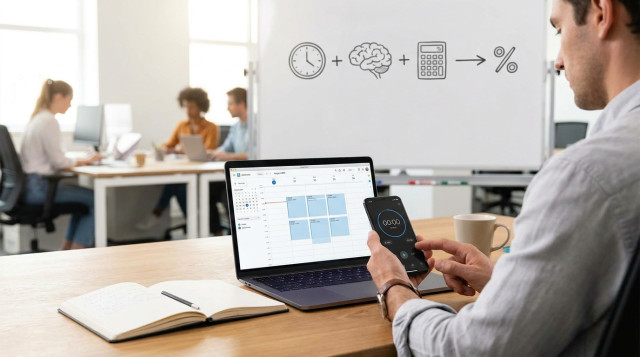
how to calculate focus time percentage: what it is and why it matters
how to calculate focus time percentage measures the share of your working time spent in uninterrupted, high-concentration work (deep work) versus total available work time. This metric helps professionals, knowledge workers and teams quantify productivity, set realistic goals and track improvements over time.
When to use focus time percentage
- Evaluating how much of your day is spent on meaningful work.
- Setting targets to increase deep work and reduce context switching.
- Measuring the impact of schedule changes, meeting reductions or use of productivity techniques.
how to calculate focus time percentage: formula
The basic formula is simple:
Focus time percentage (%) = (Focus time ÷ Total work time) × 100
Where:
- Focus time = total minutes or hours spent in uninterrupted, concentrated work (no meetings, no email, no shallow tasks).
- Total work time = total minutes or hours available for work during the measurement period (workday, week, month), excluding paid time off.
Variations and refinements
You can adapt the formula to your needs:
- Exclude scheduled breaks to get 'productive hours' as denominator.
- Use weighted focus time: multiply blocks by concentration quality (e.g., 1.0 for deep work, 0.5 for semi-focused tasks).
- Calculate at team level by summing focus time across team members and dividing by total team work time.
how to calculate focus time percentage: step-by-step manual method
- Define your measurement period. Typical choices: single workday, typical week, or month.
- Decide what counts as focus time. Example: uninterrupted blocks of at least 25 minutes with no notifications, meetings or shallow admin tasks.
- Track time. Use a manual log, a timer (Pomodoro-style), calendar analysis or a time-tracking app. Record start and end times for each focus block.
- Sum focus time. Add durations of all focus blocks during the period. Convert to consistent units (minutes or hours).
- Measure total work time. Sum your paid working hours in the same period (e.g., 8 hours/day × 5 days = 40 hours/week). Optionally subtract breaks or non-working time.
- Apply the formula. Divide focus time by total work time and multiply by 100 to get the percentage.
how to calculate focus time percentage: worked example (daily)
Maria works 8 hours today (480 minutes). She uses a timer and records four focus blocks: 60 min, 45 min, 90 min and 30 min. Meetings and email time total 155 minutes.
Step-by-step:
- Focus time = 60 + 45 + 90 + 30 = 225 minutes.
- Total work time = 480 minutes.
- Focus time percentage = (225 ÷ 480) × 100 = 46.875% ≈ 46.9%.
Interpretation: Maria spent about 47% of her workday in uninterrupted, high-concentration work.
how to calculate focus time percentage: weekly example with adjustments
Team lead James measures his week. His team member logged these weekly values: Focus time = 12 hours, Total scheduled work time = 40 hours. However, James prefers to exclude lunch (5 hours/week) from denominator to measure productive time.
- Adjusted total work time = 40 - 5 = 35 hours.
- Focus time percentage = (12 ÷ 35) × 100 = 34.29% ≈ 34.3%.
Interpretation: With breaks removed, focused work represents about one-third of available productive hours—useful when comparing productivity across roles or weeks.
how to calculate focus time percentage using an online calculator
To speed up the process, use an online calculator for focus time percentage. Typical steps on the calculator page:
- Enter the total focus time in minutes or hours.
- Enter the total work time in the same units.
- Click 'Calculate' to get the focus time percentage and optionally a recommended target.
Calculatorr offers time and productivity tools that make this quick: visit the site, open a time percentage or productivity calculator and input your values to see instant results and shareable reports.
how to interpret focus time percentage: benchmarks and targets
There are no absolute rules, but practical benchmarks help:
- Below 20%: likely too many interruptions and meetings; consider reducing meetings or blocking protected time.
- 20%–40%: typical for many knowledge workers balancing collaboration and individual work.
- 40%–60%: strong focus culture or successful time-blocking; good for deep work-dependent roles.
- Above 60%: excellent, but check for burnout risk or missed collaboration needs.
Set realistic targets based on role: coders or writers may aim for 50%+, while managers may target 25%–35% and improve gradually.
Use cases for tracking
- Evaluate the effect of 'no meeting' days.
- Measure productivity gains after implementing focus techniques (Pomodoro, time blocking).
- Compare focus time before and after policy changes or new tools.
common errors when measuring focus time percentage
- Counting shallow work as focus. Email triage or quick admin tasks often feel productive but have low cognitive load; exclude or weight them.
- Mixing units. Don’t mix minutes and hours without converting; stick to one unit for numerator and denominator.
- Ignoring context. A low percentage isn’t always bad for meeting-heavy roles; interpret relative to responsibilities.
- Short measurement windows. One day can be an outlier; use a week or month for stable insight.
how to improve focus time percentage: practical tips
- Block focus periods in your calendar and mark them as busy.
- Turn off non-essential notifications and use a 'do not disturb' mode.
- Group meetings into specific days or times to protect longer blocks for deep work.
- Use the Pomodoro technique to create repeatable focus blocks and build momentum.
- Delegate or batch shallow tasks (email, admin) to dedicated times.
Tracking and improvement cycle
Measure baseline focus time percentage, apply one change (e.g., two 'no meeting' afternoons), measure again after one or two weeks and compare. Use the result to iterate—small, measurable changes compound into meaningful gains.
how to calculate focus time percentage: final notes and resources
Focus time percentage is a straightforward, actionable metric that quantifies deep work. Use consistent definitions and measurement methods, track over sufficient periods and combine the metric with qualitative feedback to avoid productivity traps. For quick calculations, use an online calculator or create a simple spreadsheet to log focus blocks and compute the percentage automatically. Explore related tools and calculators at https://calculatorr.com/ to simplify tracking and reporting.