The waist-to-hip ratio is a simple number that shows how your body fat is distributed, and it takes only a tape measure and a calculator to find it. If you want to know how to calculate waist-to-hip ratio correctly, you need two measurements, one division and a clear idea of how to read the result. This guide covers the formula, the exact way to measure, worked examples in centimeters and inches, and the ranges commonly used to judge health risk.
You can also run the numbers instantly with the tools at Calculatorr, but understanding the manual method helps you spot input errors and interpret the result with confidence.
Waist-to-hip ratio calculator: what it measures and why it matters
Waist-to-hip ratio (WHR) compares the circumference of your waist with the circumference of your hips. It does not tell you how much you weigh. It tells you where your body tends to store fat.
Fat stored around the abdomen (often called visceral or central fat) is linked to a higher risk of type 2 diabetes, high blood pressure and cardiovascular problems. Fat stored mainly around the hips and thighs is generally associated with lower risk. Two people with the same weight and the same body mass index can have very different WHR values, which is why many people use it alongside other health checks.
Waist-to-hip ratio formula
The formula is a straightforward division:
WHR = waist circumference ÷ hip circumference
Both measurements must use the same unit, either centimeters or inches. The unit cancels out, so the result is a plain number, usually between 0.6 and 1.1.
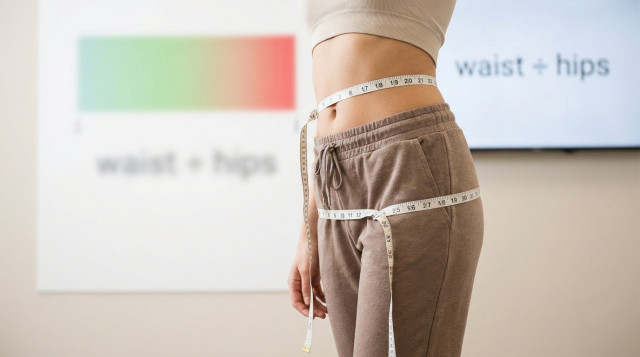
- Waist circumference: the narrowest part of your torso, or the midpoint between your lowest rib and the top of your hip bone.
- Hip circumference: the widest part of your hips and buttocks.
How to measure your waist and hips correctly
The result is only as good as the measurements. A difference of 2 or 3 cm can move you into a different category, so take your time.
How to measure your waist
- Stand upright with your feet together and your arms relaxed at your sides.
- Find the bottom of your lowest rib and the top of your hip bone (the iliac crest). The midpoint between them is your measuring line.
- Wrap the tape around your bare abdomen or over thin clothing, keeping it parallel to the floor.
- Breathe out normally and read the number at the end of a regular exhale. Do not suck in your stomach.
How to measure your hips
- Stay standing with your feet together.
- Wrap the tape around the widest part of your buttocks, usually level with the fullest point of the hips.
- Check in a mirror that the tape is level all the way around.
- Keep it snug but not tight enough to press into the skin.
Tips for consistent readings
- Measure in the morning before eating, since bloating can add centimeters.
- Use a flexible, non-stretch tape, not a metal workshop tape.
- Take each measurement twice and average the two if they differ.
- Always measure at the same landmarks if you want to track progress over time.
How to calculate waist-to-hip ratio step by step
Once you have both measurements, the process takes under a minute.
- Write down your waist measurement.
- Write down your hip measurement in the same unit.
- Divide the waist by the hips.
- Round to two decimal places.
- Compare the result with the reference ranges for your sex.
Example in centimeters
A woman measures a waist of 82 cm and hips of 100 cm.
WHR = 82 ÷ 100 = 0.82
This falls in the moderate band for women, close to the upper end of the lower-risk range.
Example in inches
A man measures a waist of 34 inches and hips of 40 inches.
WHR = 34 ÷ 40 = 0.85
This is below the commonly used 0.90 threshold for men, so it falls in the lower-risk range.
Example with a higher result
A man measures a waist of 96 cm and hips of 102 cm.
WHR = 96 ÷ 102 = 0.94
This is above 0.90, which suggests excess abdominal fat and is worth discussing with a health professional, especially if other risk factors are present.
How to find the waist measurement needed to reach a target ratio
You can rearrange the formula to set a goal: target waist = target WHR × hip circumference.
Suppose a woman has hips of 100 cm and a waist of 88 cm, giving a WHR of 0.88. If her target is 0.80, then the waist she needs is 0.80 × 100 = 80 cm. That means reducing her waist by 8 cm while her hips stay the same.
What is a healthy waist-to-hip ratio?
Health guidelines vary slightly, but the following bands are widely used as a practical reference for adults.
| Risk level | Men | Women |
|---|---|---|
| Lower risk | Below 0.90 | Below 0.80 |
| Moderate risk | 0.90 to 0.99 | 0.80 to 0.84 |
| High risk | 1.00 or higher | 0.85 or higher |
Men and women have different thresholds because women naturally carry more fat around the hips and thighs, which lowers the typical ratio.
How to interpret your result
- Lower risk: your fat distribution is favorable. Maintain your habits and keep monitoring.
- Moderate risk: you are near the threshold. Small changes in activity, sleep and diet can shift the number.
- High risk: a significant share of your fat is stored around the abdomen. Consider a medical check-up that includes blood pressure, blood sugar and cholesterol.
A ratio is a screening signal, not a diagnosis. It points to where attention may be needed.
How to use an online waist-to-hip ratio calculator
An online calculator saves time and removes arithmetic mistakes, which is useful when you track your numbers every few weeks.
- Open a calculator on Calculatorr.com designed for body measurements.
- Choose centimeters or inches and keep that unit for both fields.
- Enter your waist and hip measurements.
- Select your sex if the tool asks, since the thresholds differ.
- Read the ratio and the risk category it returns.
Before you trust the result, do a quick sanity check by hand. If the answer is above 1.2 or below 0.6, you probably swapped the fields or mixed units. Combining this value with other tools on Calculatorr, such as a body mass index or daily calorie calculator, gives a more complete picture than any single number.
Common mistakes when calculating waist-to-hip ratio
- Measuring at the belly button. The navel is not always at the narrowest point or the midpoint between rib and hip bone. Use the anatomical landmarks instead.
- Mixing units. Entering a waist in inches and hips in centimeters produces a meaningless result.
- Pulling the tape too tight. Compressing the skin lowers the waist reading and makes your ratio look better than it is.
- Holding your breath or sucking in. Measure after a relaxed exhale.
- Measuring over thick clothing. Jeans or sweaters add extra centimeters.
- Measuring the hips at the wrong height. The correct spot is the widest point, not the top of the hip bones.
- Comparing readings taken at different times of day. Meals and hydration can change the waist by a couple of centimeters.
Limits of the waist-to-hip ratio and when to use other measures
WHR is useful, but it is not perfect. Keep these limits in mind:
- It is designed for adults. Children and teenagers need growth-based references.
- Pregnancy changes the numbers. The ratio is not reliable during or shortly after pregnancy.
- Body shape and ethnicity matter. Risk thresholds can differ between populations, and some groups develop metabolic risk at lower ratios.
- Very high or very low muscle mass can distort it. Strong gluteal muscles can lower the ratio without reflecting a lower risk in every case.
- It ignores height. Some people prefer waist-to-height ratio, where keeping the waist under half of your height is a common goal.
For a fuller assessment, combine WHR with body mass index, waist circumference alone, blood tests and a conversation with a doctor.
How to improve your waist-to-hip ratio in practice
Spot reduction does not work, so improving your ratio means reducing overall body fat while keeping muscle, especially in the hips and legs.
- Create a moderate calorie deficit. A slow, steady loss is easier to sustain and protects muscle.
- Prioritize protein and fiber. They support fullness and help preserve lean mass.
- Combine cardio and strength training. Squats, lunges and hip thrusts build the lower body, while regular cardio reduces abdominal fat.
- Sleep and manage stress. Poor sleep and chronic stress are associated with more abdominal fat storage.
- Re-measure every four weeks. Use the same time of day, the same landmarks and the same tape.
Track the trend rather than a single reading. A drop of 0.02 to 0.03 over a few months already reflects a meaningful change in fat distribution, and you can log each result with the calculators available on Calculatorr.com.