
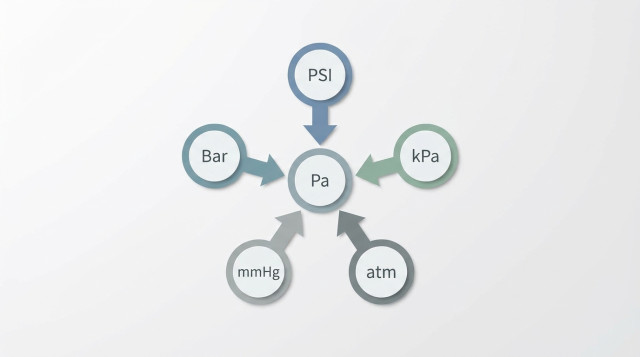
Knowing how to convert pressure units saves time and prevents costly mistakes, whether you are inflating a tire, reading a weather report, checking a blood pressure result or setting up a compressor. A tire gauge may show psi, the car manual may list bar, and a pump may be labeled in kPa. Each unit measures the same physical quantity, so converting between them is a matter of using the right factor.
This guide covers the most common pressure units, the exact conversion factors, a manual method you can repeat anywhere, and the errors that trip up most people. You can also check any result with the tools available at Calculatorr.
What is pressure and which units are used to measure it?
Pressure is force applied over an area. The formula is simple:
Pressure = Force ÷ Area
The official SI unit is the pascal (Pa), defined as one newton per square meter. A pascal is very small, so real-world work usually relies on larger or more practical units.
The most common pressure units
- Pascal (Pa) and kilopascal (kPa): the SI standard. 1 kPa equals 1,000 Pa. Common in engineering, science and many car manuals.
- Bar and millibar (mbar): 1 bar equals 100,000 Pa, or 100 kPa. Used for tires, scuba tanks, industrial equipment and meteorology.
- Hectopascal (hPa): equal to 1 millibar. Used in weather forecasts worldwide.
- PSI (pounds per square inch): common in the United States for tires, pressure washers, air tools and plumbing.
- Standard atmosphere (atm): based on average air pressure at sea level. Used in chemistry and physics.
- mmHg and torr: based on a column of mercury. Used for blood pressure and vacuum measurements.
- inHg (inches of mercury): used in aviation and in some weather reports.
What are the exact pressure conversion factors?
These factors are the foundation of every conversion. Memorize one or two and keep the table nearby for the rest.
| Unit | Equivalent in Pa | Equivalent in other units |
|---|---|---|
| 1 kPa | 1,000 Pa | 0.01 bar, 0.145038 psi |
| 1 bar | 100,000 Pa | 100 kPa, 14.5038 psi, 0.986923 atm |
| 1 psi | 6,894.76 Pa | 6.89476 kPa, 0.0689476 bar |
| 1 atm | 101,325 Pa | 101.325 kPa, 1.01325 bar, 14.6959 psi, 760 mmHg |
| 1 mmHg | 133.322 Pa | 0.133322 kPa, 0.0193368 psi |
| 1 inHg | 3,386.39 Pa | 3.38639 kPa, 0.491154 psi |
Notice that 1 atm is not exactly 1 bar. The difference is about 1.3%, which matters in precise scientific or industrial work but is often ignored in everyday tasks.
How to convert pressure units step by step
You can convert any pressure unit using the same three-step method.
Step 1: identify the starting and target units
Write down what you have and what you need. For example: 32 psi to bar.
Step 2: find the conversion factor
Look up how many target units equal one starting unit. Here, 1 psi equals 0.0689476 bar.
Step 3: multiply
Result = Starting value × Conversion factor
So 32 psi × 0.0689476 = 2.206 bar.
To go in the opposite direction, either divide by the same factor or use the inverse factor. Dividing 2.206 by 0.0689476 returns 32 psi.
Using Pascals as a bridge
If you do not remember a direct factor between two units, convert to pascals first and then to the target unit.
- Convert the starting value to Pa by multiplying by its factor in Pa.
- Divide the result by the target unit's value in Pa.
Example: convert 30 mmHg to psi. First, 30 × 133.322 = 3,999.66 Pa. Then 3,999.66 ÷ 6,894.76 = 0.58 psi.
How to convert PSI to bar, kPa and atm with examples
Example 1: car tire pressure from psi to bar
A tire shows 35 psi and your manual lists bar.
35 × 0.0689476 = 2.413 bar. A reasonable target is about 2.4 bar.
Example 2: bar to psi for a tire pump
The manual recommends 2.4 bar and your gauge reads in psi.
2.4 × 14.5038 = 34.81 psi. Inflate to roughly 35 psi.
Example 3: kPa to psi
A bicycle tire is rated for 350 kPa.
350 × 0.145038 = 50.76 psi.
Example 4: scuba tank from bar to psi
A full tank is filled to 200 bar.
200 × 14.5038 = 2,900.8 psi.
Quick reference for common psi values
| PSI | Bar | kPa |
|---|---|---|
| 15 | 1.03 | 103.4 |
| 30 | 2.07 | 206.8 |
| 35 | 2.41 | 241.3 |
| 40 | 2.76 | 275.8 |
| 60 | 4.14 | 413.7 |
| 100 | 6.89 | 689.5 |
How to convert mmHg and inHg for blood pressure and weather
Blood pressure from mmHg to kPa
Blood pressure is usually reported in mmHg, but some countries use kPa. A reading of 120/80 mmHg converts like this:
- 120 × 0.133322 = 16.0 kPa
- 80 × 0.133322 = 10.67 kPa
So 120/80 mmHg is about 16.0/10.7 kPa.
Atmospheric pressure from hPa to inHg
A weather report gives 1,013 hPa and you need inHg.
- Convert hPa to kPa by dividing by 10: 1,013 ÷ 10 = 101.3 kPa.
- Divide by 3.38639: 101.3 ÷ 3.38639 = 29.91 inHg.
That is very close to standard sea-level pressure of 29.92 inHg.
How to use a pressure conversion calculator online
A calculator removes the risk of arithmetic slips, especially with long decimal factors. The process is quick:
- Enter the value you want to convert.
- Select the starting unit, such as psi.
- Select the target unit, such as bar or kPa.
- Read the result and round it to the precision you need.
Browse the tools on Calculatorr to find related converters for temperature, area, energy and more. It is good practice to do a rough mental check first. If you convert 30 psi to bar and get 20, something is wrong, because a bar is roughly 14.5 psi and the answer should be near 2.
What is the difference between gauge and absolute pressure?
This is the most misunderstood part of pressure unit conversion. Two measurement types exist:
- Gauge pressure (psig, barg): measured relative to the surrounding atmosphere. A flat tire reads 0 psig even though air pressure still surrounds it.
- Absolute pressure (psia, bara): measured relative to a perfect vacuum. It equals gauge pressure plus atmospheric pressure.
Absolute = Gauge + Atmospheric pressure
Example: a tank reads 30 psig at sea level. Absolute pressure is 30 + 14.696 = 44.7 psia.
Unit conversion factors are the same for both types, but you must add or subtract atmospheric pressure when switching between them. Most tire gauges, pressure washers and household tools display gauge pressure. Gas law calculations in chemistry and physics require absolute pressure.
What are the most common mistakes when converting pressure?
- Confusing bar and atm. They are close but not identical. Use 1.01325 bar per atm for precise work.
- Mixing gauge and absolute values. Adding or ignoring atmospheric pressure leads to errors of nearly 15 psi.
- Multiplying when you should divide. Check that your result makes sense. Psi values are always larger than bar values for the same pressure, so converting psi to bar must produce a smaller number.
- Mixing up hPa and kPa. 1 kPa equals 10 hPa. A shift of one decimal place changes the whole result.
- Rounding too early. Keep at least four or five significant digits in the factor and round only the final answer.
- Using kgf/cm² as if it were bar. Older gauges use this unit. 1 kgf/cm² equals 0.980665 bar, so it is close but not identical.
How to interpret pressure conversion results
A converted number is only useful if you know what it means in context. Here are some practical benchmarks:
- Standard atmospheric pressure: 101.325 kPa, 1.01325 bar, 14.696 psi or 760 mmHg.
- Typical passenger car tires: about 30 to 36 psi, or roughly 2.1 to 2.5 bar.
- Road bike tires: often 80 to 110 psi, or about 5.5 to 7.6 bar.
- Underwater: pressure increases by about 1 bar for every 10 meters of seawater, on top of the 1 bar of atmosphere at the surface.
When a result falls far outside these ranges for the situation, double-check the unit and the gauge versus absolute setting before acting on it. Always follow the manufacturer's labeled limits for tires, vessels and equipment, because exceeding them can be dangerous.
How to convert pressure units quickly in your head
For rough estimates you can use these shortcuts:
- Psi to bar: divide by 14.5, or divide by 15 for a fast approximation.
- Bar to psi: multiply by 14.5, or by 15 for an estimate slightly on the high side.
- Bar to kPa: multiply by 100.
- Psi to kPa: multiply by about 7.
- hPa to kPa: divide by 10.
These shortcuts are fine for deciding whether a tire is roughly right, but use the exact factors or a calculator for engineering, medical or safety-critical tasks.