
Understanding the Surface Area of a Cylinder
A cylinder is a three-dimensional geometric solid consisting of two parallel circular bases connected by a curved surface. Calculating its surface area is a fundamental task in geometry, engineering, and various DIY projects. Whether you are trying to determine how much paint you need for a storage tank or how much material is required to manufacture a soda can, knowing the total surface area is essential. The surface area represents the total space occupied by the exterior of the shape, including the top, the bottom, and the side wall.
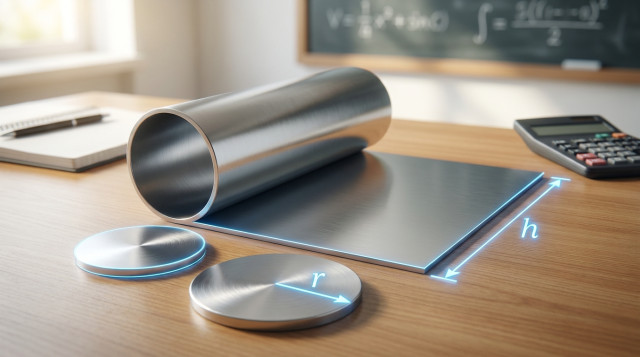
To visualize this, imagine taking a standard soup can and removing the paper label. If you cut the label vertically and lay it flat, it forms a perfect rectangle. The two metal lids at the top and bottom are circles. Therefore, the total surface area of a cylinder is simply the sum of the areas of these three parts: two identical circles and one large rectangle. Understanding this decomposition makes the mathematical formula much easier to remember and apply in real-world scenarios.
The Formula for Calculating the Surface Area of a Cylinder
The mathematical formula for the total surface area of a cylinder is derived from its individual components. To perform the calculation, you need two primary measurements: the radius of the circular base and the height of the cylinder. The radius (r) is the distance from the center of the circle to its edge, while the height (h) is the vertical distance between the two circular bases.
Breaking Down the Mathematical Components
The formula is expressed as: A = 2πrh + 2πr². Let us break this down into its two main parts to understand what each section represents:
- 2πr² (Area of the Bases): This part of the formula calculates the area of the two circular ends. The area of a single circle is πr². Since a cylinder has a top and a bottom base, we multiply by two.
- 2πrh (Lateral Surface Area): This part calculates the area of the curved side (the 'label' of the can). When unrolled, the width of this rectangle is equal to the circumference of the circle (2πr), and its length is the height of the cylinder (h). Multiplying these gives the area of the side wall.
In these equations, π (Pi) is a mathematical constant approximately equal to 3.14159. For most practical applications, using 3.14 is sufficient, but for high-precision engineering, more decimal places may be required. If you prefer to work with the diameter (d) instead of the radius, remember that the radius is exactly half of the diameter (r = d/2).
How to Calculate the Surface Area of a Cylinder Step by Step
Performing this calculation manually is straightforward if you follow a logical sequence. By breaking the process into steps, you reduce the likelihood of making a calculation error. Here is the step-by-step guide to finding the total surface area.
Step 1: Measure the Radius and Height
Before starting the math, ensure you have accurate measurements. Use a ruler or tape measure to find the radius of the base. If it is difficult to find the center of the circle, measure the full diameter across the widest part and divide by two. Next, measure the height of the cylinder from the top base to the bottom base. Ensure both measurements are in the same units (e.g., both in centimeters or both in inches).
Step 2: Calculate the Area of the Circular Bases
Square the radius (multiply the radius by itself) and then multiply the result by π (3.14159). This gives you the area of one circle. Since there are two bases, multiply that final number by two. For example, if the radius is 5 cm, you would calculate 5 * 5 = 25, then 25 * 3.14159 = 78.54, and finally 78.54 * 2 = 157.08 cm².
Step 3: Calculate the Lateral Surface Area
Now, find the area of the curved side. Multiply 2 by π, then by the radius, and finally by the height (2 * π * r * h). Using the same 5 cm radius and assuming a height of 10 cm, the calculation would be: 2 * 3.14159 * 5 * 10 = 314.16 cm².
Step 4: Sum the Results for the Total Surface Area
The final step is to add the area of the bases to the lateral surface area. Using our example: 157.08 (bases) + 314.16 (lateral) = 471.24 cm². This number represents the total exterior surface of the cylinder.
Practical Examples with Real Numbers
To better understand how these formulas apply to daily life, let us look at two distinct examples. These scenarios demonstrate how the dimensions significantly impact the final surface area and how the information is used in practical decision-making.
Example 1: Calculating the Surface Area of a Soda Can
A standard aluminum soda can typically has a radius of approximately 3.25 cm and a height of 12 cm. To find the amount of aluminum needed to create the can, we apply the formula:
- Area of the two bases: 2 * 3.14159 * (3.25)² = 2 * 3.14159 * 10.5625 = 66.37 cm².
- Lateral surface area: 2 * 3.14159 * 3.25 * 12 = 245.04 cm².
- Total surface area: 66.37 + 245.04 = 311.41 cm².
This calculation helps manufacturers determine material costs and the weight of the packaging.
Example 2: Estimating Paint for a Large Industrial Tank
Imagine a large cylindrical water tank with a radius of 2 meters and a height of 5 meters. You need to know the surface area to buy the correct amount of waterproof paint. Note that if the tank is sitting on the ground, you might only need to paint the top and the sides, but for this example, we will calculate the full exterior.
- Area of the two bases: 2 * 3.14159 * (2)² = 2 * 3.14159 * 4 = 25.13 m².
- Lateral surface area: 2 * 3.14159 * 2 * 5 = 62.83 m².
- Total surface area: 25.13 + 62.83 = 87.96 m².
Knowing that the total area is roughly 88 square meters allows you to check the coverage rate on the paint can and purchase exactly what you need, avoiding waste.
Common Errors in Cylinder Calculations
Even with a clear formula, it is easy to make mistakes during the calculation process. Being aware of these common pitfalls can help you ensure accuracy in your projects.
One of the most frequent errors is confusing the radius with the diameter. Many people measure the full width of the cylinder (the diameter) and plug that number directly into the formula as 'r'. This results in a surface area that is significantly larger than the actual value. Always remember to divide the diameter by two before starting your calculations.
Another common mistake involves inconsistent units. If you measure the radius in inches but the height in feet, your final result will be mathematically incorrect. Always convert all measurements to the same unit of measure before applying the formula. Additionally, remember that surface area is always expressed in square units (cm², m², in²), whereas volume is expressed in cubic units. Mixing these up can lead to confusion when ordering materials or interpreting data.
Finally, many users forget to multiply the base area by two. A cylinder has both a top and a bottom. If you only calculate πr², you are missing half of the flat surface area. However, in some practical cases, such as calculating the area of an open bucket, you might intentionally only calculate one base. Always consider the physical reality of the object you are measuring.
Why Knowing the Surface Area of a Cylinder is Useful
The ability to calculate the surface area of a cylinder is a valuable skill across many industries. In the field of logistics and packaging, it allows companies to design labels and determine the amount of plastic or metal required for containers. This directly impacts production costs and environmental sustainability efforts.
In construction and HVAC (Heating, Ventilation, and Air Conditioning), professionals often work with cylindrical pipes and ducts. Calculating the surface area is necessary to determine the amount of insulation required to wrap a pipe or the amount of sealant needed for joints. Similarly, in the chemical industry, engineers must calculate the surface area of cylindrical reactors to understand heat exchange rates, as the surface area directly affects how quickly a substance cools down or heats up.
For homeowners, these calculations are useful for landscaping and home improvement. If you have cylindrical pillars, a circular fire pit, or a round swimming pool, knowing the surface area helps you estimate costs for stone veneers, liners, or protective coatings. It turns a guessing game into a precise planning process.
How to Use a Cylinder Surface Area Calculator Online
While manual calculations are excellent for understanding the underlying principles, they can be time-consuming and prone to human error, especially when dealing with complex decimals. Using a digital tool can provide instant, accurate results for any project. When you need a quick result without manual math, using a tool like the one found at Calculatorr ensures accuracy and saves time.
To use an online calculator, you simply need to input the radius (or diameter) and the height. Most advanced calculators will allow you to select your preferred units and will automatically provide both the lateral surface area and the total surface area. This is particularly helpful when you need to perform multiple calculations for different sizes or when you are working on-site and need an immediate answer. By leveraging these tools, you can focus on the practical application of the results rather than the arithmetic itself.
Whether you are a student solving a geometry problem or a professional planning an industrial project, mastering the cylinder surface area calculation is a practical asset. By understanding the relationship between the circular bases and the rectangular lateral surface, you gain a deeper insight into the spatial properties of the world around you.