
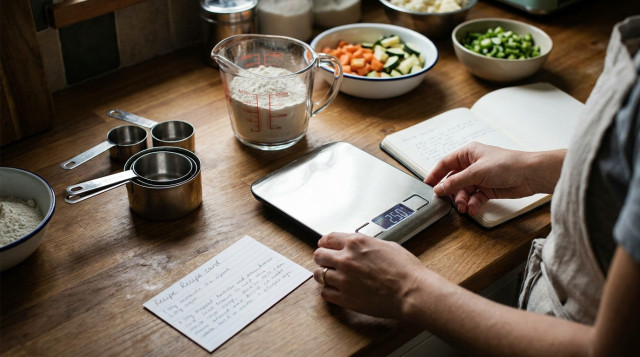
how to scale recipe servings is the core skill when you need to make more or less food than a recipe specifies. This guide explains the simple math, gives formulas, step-by-step examples, and shows how to use an online calculator to resize ingredient lists accurately.
how to scale recipe servings: formula and when to use it
Scaling a recipe changes each ingredient proportionally so the final dish keeps the same taste and texture. Use scaling when you need to:
- Increase servings for guests.
- Reduce servings to avoid leftovers.
- Adjust ingredient amounts to match available cookware or storage.
Basic formula: scaled amount = original amount × (desired servings / original servings)
Why this formula works
Recipes are ratios of ingredients to yield. Multiplying every ingredient by the same factor preserves those ratios. The factor is the ratio of desired servings to the recipe's stated servings.
step-by-step method to scale ingredients manually
- Find the number of servings the original recipe makes (original servings).
- Decide how many servings you want (desired servings).
- Compute the scaling factor: factor = desired servings ÷ original servings.
- Multiply each ingredient amount by the factor to get the scaled amount.
- Round amounts sensibly for practicality (see rounding rules).
- Adjust for cooking vessels, baking pan sizes, and cooking time if needed.
Example 1: doubling a dinner recipe
Original: chili recipe for 4 servings uses 500 g ground beef, 400 g canned tomatoes, and 1 tbsp salt.
- Desired servings = 8
- Factor = 8 ÷ 4 = 2
- Scaled beef = 500 g × 2 = 1000 g (1 kg)
- Scaled tomatoes = 400 g × 2 = 800 g
- Scaled salt = 1 tbsp × 2 = 2 tbsp
Result: use 1 kg beef, 800 g tomatoes, 2 tbsp salt.
Example 2: making half of a cake recipe
Original: cake for 12 slices uses 300 g flour, 200 g sugar, 3 eggs.
- Desired servings = 6
- Factor = 6 ÷ 12 = 0.5
- Scaled flour = 300 g × 0.5 = 150 g
- Scaled sugar = 200 g × 0.5 = 100 g
- Scaled eggs = 3 × 0.5 = 1.5 eggs → practical: 1 large egg + 1 egg white or beat and use 45–50 g of beaten egg
Note on eggs: fractional eggs require conversion to volume weight (one large egg ≈ 50 g). Use beaten egg weight or egg replacers for precision.
practical rounding rules and ingredient-specific tips
- Dry ingredients (flour, sugar): round to the nearest gram or 1/8 teaspoon for small amounts.
- Liquids (milk, oil): round to nearest milliliter or 1/8 teaspoon for small volumes.
- Spices and salt: scale proportionally but taste and adjust—start slightly under and season later.
- Leavening agents (baking powder, yeast): do not always scale linearly for large changes—use slightly less than the factor for very large batches to avoid overproofing.
- Eggs: convert to grams if fractioned (1 large egg ≈ 50 g total; egg white ≈ 30 g; yolk ≈ 20 g) and round to usable quantities.
- Herbs: scale down more aggressively for delicate herbs (e.g., use 75–90% of proportional amount).
how to scale recipe servings with unit conversions
When a recipe mixes metric and US units, convert to one system before scaling for accuracy. Common conversions:
- 1 cup (US) all-purpose flour ≈ 120–125 g
- 1 cup (US) sugar ≈ 200 g
- 1 tablespoon (US) ≈ 15 mL
- 1 teaspoon (US) ≈ 5 mL
Step: convert each ingredient to a consistent unit (grams or milliliters), apply the scaling factor, then convert back to preferred kitchen units if desired.
Example with mixed units
Original: soup for 6 servings uses 2 cups (480 mL) broth, 200 g potatoes, 1 tsp salt. Desired = 10 servings.
- Factor = 10 ÷ 6 ≈ 1.6667
- Broth = 480 mL × 1.6667 ≈ 800 mL (about 3 1/3 cups)
- Potatoes = 200 g × 1.6667 ≈ 333 g
- Salt = 1 tsp × 1.6667 ≈ 1.67 tsp → practical: 1 2/3 tsp
using an online scaling calculator
Online tools speed the process and handle unit conversions automatically. To use a calculator on Calculatorr.com:
- Enter the original number of servings.
- Enter the desired number of servings.
- Type each ingredient amount and its unit (g, mL, cups, tbsp, tsp, etc.).
- Click "scale" to get adjusted ingredient quantities in the same units or choose automatic unit conversion.
The calculator applies the factor = desired ÷ original to each entry, converts units where needed, and returns rounded, kitchen-friendly amounts. Link to more tools and related calculators at https://calculatorr.com/ for conversions and baking-specific helpers.
interpreting scaled results: what the numbers mean
Scaled amounts are new target quantities to use in place of the originals. Interpretation notes:
- If scaled volume exceeds pan capacity, split the batch or use larger cookware.
- Cooking time does not always scale linearly—larger volumes often need longer cook or bake time; check internal temperature and texture.
- For baked goods, oven capacity and heat circulation affect outcomes—avoid overcrowding.
- For sauces and stews, liquids may evaporate differently in larger pots; watch consistency and adjust liquid if needed.
common mistakes when scaling recipes and how to avoid them
- Scaling only some ingredients: always scale all ingredients to keep ratios.
- Scaling leavening agents linearly for very large batches: reduce slightly to prevent over-expansion or off textures.
- Rounding too early: do all calculations first, then round final amounts sensibly.
- Ignoring equipment limits: ensure pots, pans, and oven space match the scaled volume.
- Not adjusting cooking time/temperature: test doneness rather than relying on original times.
quick reference table: scaling factors
| Desired vs Original | Factor | Example (300 g flour) |
|---|---|---|
| Double (8/4) | 2.0 | 600 g |
| One and a half (6/4) | 1.5 | 450 g |
| Half (6/12) | 0.5 | 150 g |
| Third (4/12) | 0.333 | 100 g |
advanced tips for professional scaling
- Test a scaled recipe at small scale before committing to very large batches (catering, events).
- Keep a log of adjustments—time, temperature, and small tweaks—to reproduce success later.
- For commercial baking, use baker's percentages (ingredient mass ÷ flour mass) to maintain precise ratios across batch sizes.
- When scaling for dietary needs, also check per-serving nutrition values after scaling (calories, macros).
Scaling recipes is simple math but requires culinary judgment. Use the formula and examples above, rely on a calculator for speed, and apply the practical tips to keep flavor and texture consistent when resizing any recipe.