
how to calculate macronutrient split from daily calories is a practical skill for anyone planning nutrition—whether your goal is weight loss, muscle gain or general health. This guide shows clear formulas, step-by-step calculations, real examples and how to use an online calculator to get precise macronutrient targets you can follow daily.
what is a macronutrient split and why calculate it?
A macronutrient split defines the percentage or grams of calories that come from carbohydrates, protein and fat in your daily diet. Calculating a macronutrient split helps you:
- Match energy intake to goals (lose fat, build muscle, maintain weight).
- Ensure adequate protein for recovery and muscle retention.
- Manage hunger and performance by balancing carbs and fats.
- Track progress with measurable targets in grams.
how to calculate macronutrient split: the basic formulas
Start with your total daily calories (TDEE or target calories). Then choose macronutrient percentages that fit your goals. Use these energy values per gram:
- Protein: 4 kcal per gram
- Carbohydrate: 4 kcal per gram
- Fat: 9 kcal per gram
Formulas:
- Calories from macro = Total calories × (percentage for that macro)
- Grams of protein = Calories from protein ÷ 4
- Grams of carbs = Calories from carbs ÷ 4
- Grams of fat = Calories from fat ÷ 9
example of the formulas in symbolic form
Let C = total daily calories, P% = protein percent (as decimal), Cb% = carbs percent, F% = fat percent. Then:
- Protein grams = (C × P%) / 4
- Carb grams = (C × Cb%) / 4
- Fat grams = (C × F%) / 9
step-by-step: how to calculate macronutrient split manually
- Determine your target daily calories: use your maintenance calories (TDEE) or a calorie goal (deficit for fat loss, surplus for muscle gain). For example, 2,200 kcal/day.
- Choose a macronutrient ratio: pick percentages that suit your goal. Common splits:
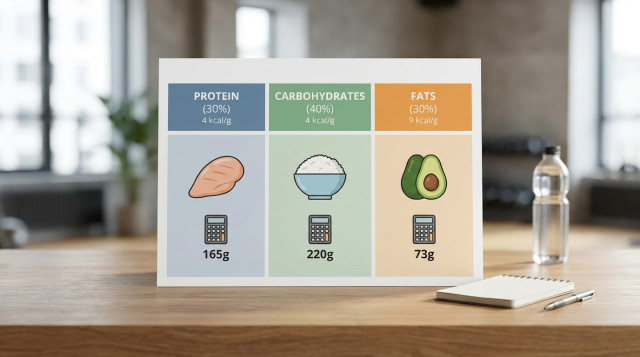
- Balanced: 30% protein / 40% carbs / 30% fat
- Lower-carb for fat loss: 30% protein / 25% carbs / 45% fat
- Higher-carb for performance: 25% protein / 55% carbs / 20% fat
- High-protein for muscle gain: 35% protein / 40% carbs / 25% fat
- Convert percentages to calories: multiply total calories by each percentage (as a decimal).
- Convert calories to grams: divide by energy per gram (4 or 9).
- Round and adjust: round grams to sensible serving sizes and adjust minor mismatches so the totals still equal your calorie target.
practical example 1: maintenance with balanced split
Goal: maintain weight. Total calories: 2,200 kcal. Ratio: 30% protein / 40% carbs / 30% fat.
- Calories from protein = 2,200 × 0.30 = 660 kcal → Protein grams = 660 ÷ 4 = 165 g
- Calories from carbs = 2,200 × 0.40 = 880 kcal → Carb grams = 880 ÷ 4 = 220 g
- Calories from fat = 2,200 × 0.30 = 660 kcal → Fat grams = 660 ÷ 9 ≈ 73.3 g (round to 73 g)
Daily targets: 165 g protein, 220 g carbs, 73 g fat.
practical example 2: fat loss with high fat split
Goal: moderate calorie deficit. Total calories: 1,800 kcal. Ratio: 30% protein / 25% carbs / 45% fat.
- Protein calories = 1,800 × 0.30 = 540 → Protein grams = 540 ÷ 4 = 135 g
- Carb calories = 1,800 × 0.25 = 450 → Carb grams = 450 ÷ 4 = 112.5 g (round 113 g)
- Fat calories = 1,800 × 0.45 = 810 → Fat grams = 810 ÷ 9 = 90 g
Daily targets: 135 g protein, 113 g carbs, 90 g fat.
how to choose the right macronutrient percentages
Consider these factors:
- Goal: higher protein for muscle gain/retention; higher carbs for athletic performance; higher fat for satiety and low-carb approaches.
- Activity level: more active people generally need more carbs.
- Personal preference and dietary restrictions: vegetarian, vegan, keto or cultural patterns affect practicality.
- Medical conditions: adjust per medical advice (diabetes, lipid disorders).
how to use an online macronutrient calculator
An online macronutrient calculator simplifies steps: enter your daily calories and desired split, and it returns grams per macro. To use one on Calculatorr:
- Open the macronutrient calculator on the site or search 'macronutrient calculator' at Calculatorr.
- Enter your target calories in the field labeled 'Total calories' or similar.
- Select or enter percentages for protein, carbs and fat. Some tools offer presets (balanced, low-carb, high-protein).
- Click 'Calculate' to get grams per macro and an energy breakdown.
- Adjust percentages and recalculate until targets match your preferences and needs.
Using an online tool reduces arithmetic errors and offers quick comparisons of different splits.
how to interpret the results
After calculating grams per macro, use these guidelines:
- Protein: aim for at least 1.2–2.2 g/kg body weight depending on activity and goals. If your calculated protein is below this, raise its percentage.
- Carbs: ensure sufficient carbs on training days for performance; reduce on low-activity days if needed.
- Fat: keep fats within a healthy range (around 20–40% of calories) to support hormones and nutrient absorption.
- Calories vs macros: the calorie target remains the main driver of weight change. Macros tune body composition and performance.
common mistakes when calculating macronutrient split
- Using unrealistic percentages: extremely low or high proportions can be unsustainable.
- Ignoring protein needs: underestimating protein risks muscle loss during a deficit.
- Rounding errors: small rounding can shift calories—always check total calories after rounding grams.
- Not adjusting for exercise: failing to increase carbs around high-intensity workouts can hurt performance.
- Following presets blindly: personalize splits to your body, preferences and medical needs.
advanced adjustments and tracking
Once you have your split:
- Track intake for 1–2 weeks and compare weight, energy and performance.
- Adjust calories first if weight change is not as planned (+/- 5–10%). Then tweak macros to improve satiety or recovery.
- Cycle carbs across the week if you have heavy training and rest days: higher on training days, lower on rest days.
example of a 7-day carb cycling approach
- High-intensity training days: 50% carbs / 30% protein / 20% fat
- Moderate days: 40% carbs / 30% protein / 30% fat
- Rest/low-activity days: 25% carbs / 35% protein / 40% fat
final tips to make macronutrient targets practical
- Plan meals around protein portions: aim for 20–40 g protein per meal depending on daily goal.
- Use food scales and nutrition labels to measure consistently.
- Prefer whole foods for micronutrients and fiber; use packaged foods to fill gaps when needed.
- Recalculate when your calorie needs change (weight, activity, age).
If you want to skip manual steps, try the macronutrient calculator at Calculatorr to get instant grams and calorie breakdowns tailored to your targets.
Suggested images:
- Location: near the top of the article. Alt text: 'macronutrient split chart showing percentages of protein carbs and fat - how to calculate macronutrient split'.
- Location: next to practical examples section. Alt text: 'sample daily meal plan with grams of protein carbs and fat - macronutrient split calculation'.