how to convert lux to lumens for a surface: formula and when it matters
Lux and lumens are common lighting measures used in architecture, photography, workplace design and horticulture. This guide explains what each unit means, the formula to convert lux to lumens for a specific surface area, step-by-step manual calculations, practical examples, interpretation of results and how to use an online calculator on Calculatorr to get fast answers.
what are lux and lumens and why convert them?
Lumen (lm) measures luminous flux: the total amount of visible light emitted by a source. Lux (lx) measures illuminance: the luminous flux per unit area that falls on a surface. Converting lux to lumens is useful when you know the desired illuminance for a surface (e.g., office desk needs 500 lx) and must estimate the required light output of fixtures over a given area.
key idea
For a uniform surface, lumens = lux × area. That is, to achieve a given lux level across an area, multiply that lux by the area in square meters to get the total luminous flux that must land on that surface.
formula to convert lux to lumens for a surface
Use this simple formula when illuminance is approximately uniform and light distribution losses are not yet considered:
Lumens (lm) = Illuminance (lux) × Area (m²)
units and conversions
- Illuminance: lux (lx) = lumens per square meter.
- Area: use square meters (m²). If you have square feet, convert: 1 ft² = 0.092903 m².
- Resulting luminous flux is in lumens (lm).
step-by-step: how to do the conversion manually
- Decide the target illuminance in lux for the surface (reference standards: e.g., 300–500 lx for offices, 100–200 lx for corridors, 1000 lx for detailed tasks).
- Measure or compute the surface area in square meters.
- Apply the formula: multiply lux by area to get lumens required on that surface.
- Adjust for real-world factors: room geometry, fixture efficiency, light loss factors, and utilization factor to estimate lamp lumens needed.
step 4 explained: losses and utilization
The formula gives required lumens landing on the surface (delivered lumens). To choose fixtures you must account for:
- Fixture efficiency (luminaire lumens delivered ÷ lamp lumens).
- Room surface reflectances and geometry affecting utilization (utilization factor, U).
- Maintenance factor (MF) for dirt, aging and reduced output over time.
To estimate lamp lumens required from fixtures:
Lamp lumens required ≈ (Lux × Area) / (Number of fixtures × Fixture efficiency × U × MF)
practical example 1 — single room requirement
Scenario: a 5 m × 4 m office (area = 20 m²) needs 500 lx on work surfaces.
- Area = 5 × 4 = 20 m²
- Required illuminance = 500 lx
- Delivered lumens needed = 500 × 20 = 10,000 lm
Interpretation: to achieve 500 lx uniformly across the desk plane, fixtures must collectively deliver 10,000 lumens onto that plane. If using four fixtures and assuming fixture efficiency × utilization × MF combined equals 0.6, then lamp lumens per fixture ≈ 10,000 / (4 × 0.6) ≈ 4,167 lm per fixture.
practical example 2 — converting from square feet
Scenario: a retail counter is 50 ft² and needs 300 lx. Convert area: 50 ft² × 0.092903 = 4.64515 m². Then:
- Lumens = 300 × 4.64515 ≈ 1,393.5 lm
Interpretation: about 1,394 lumens must reach the counter surface. Allow for losses as above before selecting fixtures.
how to use the online calculator on Calculatorr
Calculatorr provides a fast lux-to-lumens converter tailored for surface area input. Steps:
- Enter desired illuminance in lux (e.g., 500).
- Enter surface area in m² or provide dimensions to auto-calc area.
- If available, enter fixture efficiency, utilization factor and maintenance factor to estimate lamp lumens required.
- Click convert to get delivered lumens and adjusted lamp lumens per fixture.
Use this link to open the converter and related tools on Calculatorr: Calculatorr lighting tools. The calculator reduces manual errors and shows intermediate steps so you can verify each value.
common mistakes and how to avoid them
- Using area in ft² without converting to m² — always convert to m² before multiplying by lux.
- Confusing lumens emitted by a lamp with lumens delivered to the surface — account for fixture losses and room factors.
- Assuming uniform illuminance in irregular rooms — measure or model where uniformity is critical.
- Ignoring maintenance factor — lighting dims over time; include MF to avoid under-illumination later.
how to interpret the result and next steps
If delivered lumens are much higher than typical luminaire outputs, options include increasing number of fixtures, using higher efficiency luminaires, improving room reflectances, or lowering target lux where acceptable. For precise design, use photometric data from manufacturers and lighting design software to model distribution and uniformity.
quick reference table: common target lux and what they are used for
| Space | Typical target (lux) |
|---|---|
| Corridors, stairways | 100–200 lx |
| Offices, classrooms | 300–500 lx |
| Detailed inspection, drawing | 750–1500 lx |
| Retail displays | 500–1000 lx |
summary of steps (one-line checklist)
- Choose target lux for the activity.
- Measure area in m² (convert if needed).
- Multiply lux × area to get lumens required on surface.
- Adjust for fixture efficiency, utilization and maintenance to determine lamp lumens.
- Use Calculatorr's online tool to speed up and verify calculations: https://calculatorr.com/
image suggestions
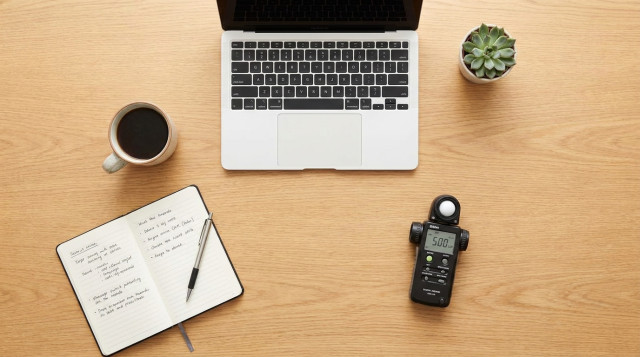
Image 1 (above the first examples): photograph of an office desk lit uniformly with a caption 'convert lux to lumens: target illuminance and area'. Alt text: 'office desk illuminated showing 500 lux target — convert lux to lumens'.
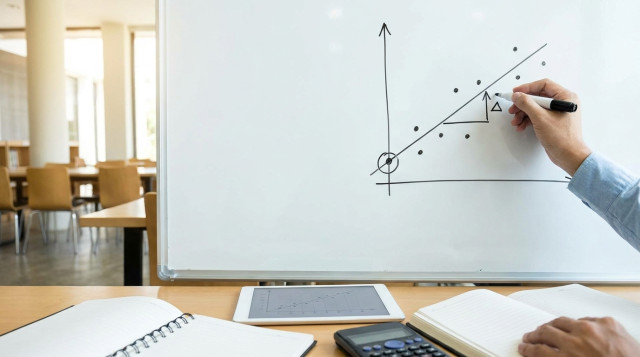
Image 2 (near the utilization section): schematic diagram showing a room plan with fixture positions and arrows indicating luminous flux over an area. Alt text: 'diagram of lumens falling on room surface illustrating lux × area conversion'.