
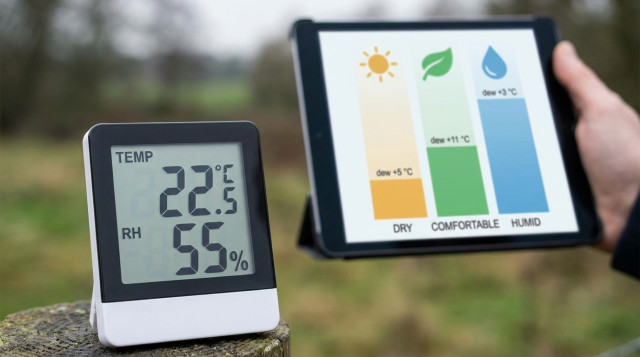
how to calculate dew point from temperature and humidity
The dew point is the temperature at which air becomes saturated and water vapor begins to condense into liquid. Knowing the dew point helps with weather prediction, HVAC control, comfort assessment, and preventing condensation in buildings and equipment.
what the dew point tells you
- A low dew point (e.g., below 10°C / 50°F) indicates dry air and greater evaporative cooling potential.
- A moderate dew point (around 10–16°C / 50–61°F) feels comfortable for most people.
- A high dew point (above 16°C / 61°F) feels humid and muggy; above 20°C / 68°F is oppressive in many climates.
formula (Magnus-Tetens approximation)
One common and accurate approximation to compute dew point from temperature and relative humidity is the Magnus-Tetens formula. Use the constants for water:
alpha(T, RH) = (a * T) / (b + T) + ln(RH/100)
Dew point (Td) = (b * alpha) / (a - alpha)
Where:
- T is the air temperature (°C)
- RH is relative humidity (%)
- a = 17.27
- b = 237.7 (°C)
- ln is the natural logarithm
step-by-step manual calculation
- Ensure temperature T is in °C. If you have °F, convert: T(°C) = (T(°F) - 32) × 5/9.
- Divide RH by 100 to convert percent to fraction for the ln argument.
- Compute alpha = (a * T) / (b + T) + ln(RH/100).
- Compute Td = (b * alpha) / (a - alpha).
- If needed, convert Td back to °F: Td(°F) = Td(°C) × 9/5 + 32.
worked examples
example 1 — typical comfortable day
Given: T = 22°C, RH = 55%
alpha = (17.27 × 22) / (237.7 + 22) + ln(0.55)
alpha = (379.94) / (259.7) + ln(0.55)
alpha ≈ 1.463 + (−0.5978)
alpha ≈ 0.8652
Td = (237.7 × 0.8652) / (17.27 − 0.8652)
Td ≈ 205.67 / 16.4048
Td ≈ 12.54°C
Interpretation: Dew point ≈ 12.5°C (54.5°F). Air is comfortable; some but not excessive humidity.
example 2 — hot and humid
Given: T = 30°C, RH = 70%
alpha = (17.27 × 30) / (237.7 + 30) + ln(0.70)
alpha = 518.1 / 267.7 + (−0.3567)
alpha ≈ 1.935 + (−0.3567) = 1.5783
Td = (237.7 × 1.5783) / (17.27 − 1.5783)
Td ≈ 375.33 / 15.6917
Td ≈ 23.91°C
Interpretation: Dew point ≈ 23.9°C (75.0°F). This indicates very humid air; outdoors will feel sticky and uncomfortable.
example 3 — cold and dry
Given: T = 5°C, RH = 35%
alpha = (17.27 × 5) / (237.7 + 5) + ln(0.35)
alpha = 86.35 / 242.7 + (−1.0498)
alpha ≈ 0.3556 + (−1.0498) = −0.6942
Td = (237.7 × (−0.6942)) / (17.27 − (−0.6942))
Td ≈ (−165.06) / 17.9642
Td ≈ −9.19°C
Interpretation: Dew point ≈ −9.2°C (15.4°F). Very dry air — condensation unlikely unless temperature drops substantially.
how to use an online dew point calculator
Online calculators automate the Magnus-Tetens steps. To use one:
- Enter air temperature and choose °C or °F.
- Enter relative humidity (%) or specific humidity where supported.
- Click calculate to get dew point and often additional metrics (vapor pressure, absolute humidity).
Try a dew point tool at Calculatorr to compute quickly and compare results across units.
conversion notes and alternate inputs
- If you have temperature in °F, convert first as shown above.
- Some tools accept temperature and vapor pressure or mixing ratio instead of RH; those require different formulas.
- For higher precision at extremes, use the full Clausius-Clapeyron relations or specialized formulations; Magnus-Tetens is accurate within about ±0.2–0.5°C for most ambient conditions.
common mistakes and how to avoid them
- Using RH as a number (e.g., 55) instead of a fraction (0.55) inside the natural logarithm. Always divide RH by 100 before ln.
- Forgetting to match units: constants a and b assume T in °C. Convert from °F to °C first.
- Rounding intermediate values too aggressively — keep 3–4 significant digits for alpha to reduce error.
- Applying the formula at very high temperatures (>50°C) or extremely low RH — consider more precise methods then.
practical uses and interpretation tips
- HVAC: Dew point helps set indoor temperature and humidity targets to avoid condensation on windows and ducts.
- Building maintenance: Compare indoor surface temperatures to dew point to prevent mold and corrosion.
- Agriculture: Dew point indicates risk of dew formation, which affects disease pressure on crops.
- Human comfort: Use dew point thresholds to guide clothing, cooling needs, and outdoor activity planning.
summary of quick reference thresholds
| Dew point (°C) | Perception |
|---|---|
| < 10 | Dry, comfortable |
| 10–16 | Comfortable to slightly humid |
| 16–20 | Humid, noticeable |
| > 20 | Very humid, uncomfortable |
Use the Magnus-Tetens formula for fast and practical dew point estimates. For automated calculations and unit conversions, visit Calculatorr to try a dew point calculator and related climate tools.
image suggestions
1) Location: near the top of the article, showing a weather station display with temperature and humidity readings. Alt text: 'dew point calculator inputs temperature and humidity'.
2) Location: next to the examples section, an infographic comparing air at different dew points (dry, comfortable, humid) and associated temperatures. Alt text: 'dew point examples: comfortable vs humid air'.