
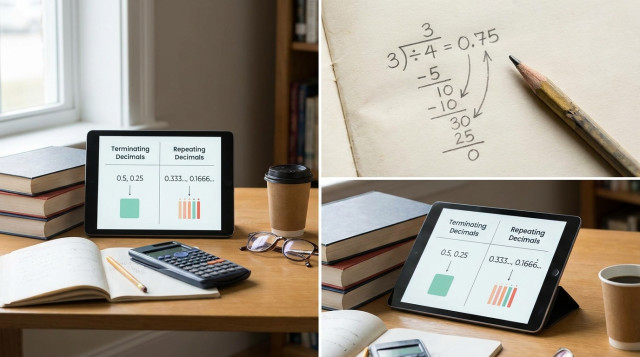
how to convert fractions to decimals — what it means and when to use it
To convert fractions to decimals is to express a ratio written as numerator/denominator (for example 3/4) in base‑10 form (0.75). Converting is useful in finance, measurements, cooking, data entry and when comparing values that are easier to read as decimals.
basic concept: division is the conversion
Every fraction a/b can be converted to a decimal by dividing the numerator a by the denominator b. If the denominator has only factors 2 and/or 5, the decimal terminates; otherwise it may repeat.
formula to convert fractions to decimals
The conversion follows this simple formula:
decimal = numerator ÷ denominator
terminating vs repeating decimals
- Terminating decimal: denominator (in lowest terms) has prime factors only 2 and/or 5 (e.g., 1/8 = 0.125).
- Repeating decimal: denominator has other prime factors (e.g., 1/3 = 0.333...).
step-by-step method to convert fractions to decimals manually
- Reduce the fraction to lowest terms by dividing numerator and denominator by their greatest common divisor (GCD). This simplifies the process and reveals whether the decimal will terminate.
- Divide numerator by denominator using long division. Place the numerator inside the division bracket and the denominator outside.
- If the fraction is improper (numerator ≥ denominator), extract the whole number first: perform integer division and keep the remainder for the fractional part.
- Continue division until remainder becomes zero (decimal terminates) or a remainder repeats (decimal repeats). When a remainder repeats, the digits between repeats form the repeating block.
- Format the result as either a terminating decimal (e.g., 0.75) or with a repeating bar (e.g., 0.0 for 1/3) or write the repeating block in parentheses (0.(3)).
long division quick refresher
When dividing a smaller numerator by a larger denominator, add a decimal point and zeros to the numerator. Each zero gives one decimal digit in the result.
worked examples: convert fractions to decimals step by step
example 1 — 3/4
1) Reduced form: 3/4 (already simplified). 2) Divide 3 by 4 via long division: 3.000 ÷ 4 = 0.75. Result: 0.75 (terminating).
example 2 — 7/8
7 ÷ 8 = 0.875 (terminating because denominator 8 = 2^3).
example 3 — 1/3
1 ÷ 3 = 0.333... Remainder 1 repeats, so the decimal is repeating: 0.(3) or 0.3 with a bar over the 3.
example 4 — 22/7 (improper fraction)
22 ÷ 7 = 3 remainder 1. Continue dividing remainder: 1.000 ÷ 7 = 0.142857 repeating. Result: 3.(142857). This shows a repeating block of six digits.
example 5 — reducing first: 50/200
Reduce: divide numerator and denominator by 50 → 1/4. Then 1 ÷ 4 = 0.25. Reducing first makes the division easier and reveals the terminating nature.
how to convert fractions to decimals using an online calculator
Use an online fraction-to-decimal tool for speed and to avoid long division mistakes. On this site you can input numerator and denominator directly and get precise output, including repeating notation and rounding options. Try the fraction-to-decimal calculator at Calculatorr and paste your fraction or type numbers into the fields.
steps to use the online calculator
- Enter numerator (top number) and denominator (bottom number).
- Choose whether you want exact repeating notation or a rounded decimal (select number of decimal places).
- Click convert to see the result and optional steps (long division trace).
interpreting results: what the decimal tells you
- If the decimal terminates, the fraction corresponds to a finite base‑10 value — useful in currency and measurement where finite decimals are common.
- If the decimal repeats, expect an infinite pattern. Rounding may be required for practical use; specify the number of decimal places needed.
- For improper fractions, the integer part shows how many whole units you have and the decimal shows the fractional remainder.
converting back: decimals to fractions (brief)
To reverse the process, multiply a terminating decimal by a power of 10 to remove the decimal point and simplify the resulting fraction. For repeating decimals, use algebraic methods to identify the repeating block and form an exact fraction.
common mistakes and how to avoid them
- Failing to reduce the fraction first — this can conceal whether the decimal terminates.
- Stopping long division too early — if you stop before a remainder repeats or becomes zero, the result is inaccurate.
- Misreading repeating patterns — write down remainders as you divide to spot repeats reliably.
- Incorrect rounding — choose the number of decimal places based on required precision (money vs engineering vs rough estimates).
useful table: common fractions and their decimals
| Fraction | Decimal | Notes |
|---|---|---|
| 1/2 | 0.5 | terminating |
| 1/3 | 0.(3) | repeating |
| 1/4 | 0.25 | terminating |
| 1/8 | 0.125 | terminating |
| 2/5 | 0.4 | terminating |
| 22/7 | 3.(142857) | repeating long block |
practical tips for different contexts
- Money: round to two decimal places (cents). If you get a repeating decimal, round using correct rounding rules.
- Measurements: match decimal precision to instrument accuracy (e.g., mm vs m).
- Data entry: prefer decimals for columns in spreadsheets; convert fractions before importing to avoid ambiguity.
examples for practice (try these manually or with a calculator)
- 5/16 → ?
- 11/20 → ?
- 13/6 → ?
Answers: 5/16 = 0.3125; 11/20 = 0.55; 13/6 = 2.1666... = 2.(16).
where to go next on Calculatorr
If you need conversions between fractions, percentages and decimals, or want a visual long division trace, use the calculators and guides at Calculatorr. Look for 'fraction to decimal', 'decimal to fraction' and related conversion tools to speed up common tasks.
final checklist before using a decimal result
- Is the fraction fully reduced?
- Does the decimal need rounding for your context?
- Have you identified repeating patterns if present?
- Have you recorded the precision needed for reporting (currency, measurement, data)?