
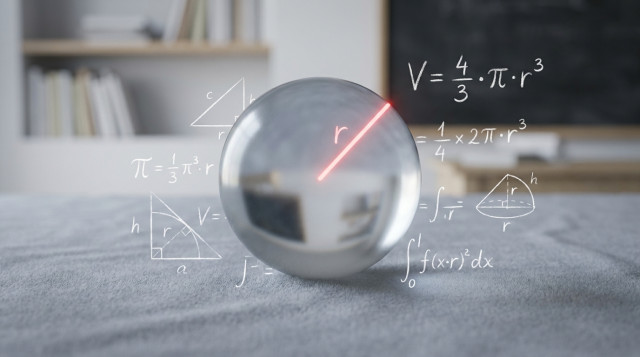
Understanding the Volume of a Sphere
A sphere is a perfectly round geometrical object in three-dimensional space, such as the shape of a round ball. Unlike a circle, which is a two-dimensional flat shape, a sphere has depth and occupies a specific amount of space. This space is what we refer to as volume. Calculating the volume of a sphere is a fundamental skill in geometry, physics, and various engineering fields. Whether you are determining the capacity of a spherical fuel tank or the displacement of a ball bearing, understanding the underlying mathematics is essential.
The volume represents the total number of cubic units that can fit inside the sphere. Because spheres are curved in every direction, we cannot simply multiply length by width by height as we would with a cube. Instead, we rely on a specific formula that accounts for the unique curvature of the object based on its radius. In 2026, while digital tools make these calculations instantaneous, knowing the manual process ensures you can verify results and understand the spatial relationships involved.
The Mathematical Formula for Sphere Volume
The standard formula used to find the volume of a sphere is expressed as:
V = (4/3) × π × r³
To use this formula correctly, it is vital to understand what each symbol represents. Each component plays a specific role in translating a linear measurement (the radius) into a three-dimensional capacity.
Breaking Down the Variables
V (Volume): This is the result you are looking for, typically measured in cubic units such as cubic centimeters (cm³), cubic meters (m³), or cubic inches (in³).
π (Pi): Pi is a mathematical constant approximately equal to 3.14159. It represents the ratio of a circle's circumference to its diameter. In most practical calculations, using 3.14 is sufficient, but for higher precision, using more decimal places or the π button on a calculator is recommended.
r (Radius): The radius is the distance from the exact center of the sphere to any point on its outer surface. This is the most critical measurement. If you only have the diameter (the distance from one side to the other through the center), you must divide it by two to find the radius.
r³ (Radius Cubed): This means multiplying the radius by itself three times (r × r × r). This cubing process is what transforms the linear measurement into a three-dimensional volume measurement.
Step-by-Step Guide to Calculating Sphere Volume Manually
Performing this calculation by hand requires a logical sequence of steps. Following this order prevents common errors and ensures that the units remain consistent throughout the process.
Step 1: Determine the Radius
The first step is to identify the radius of the sphere. If you are measuring a physical object, use a caliper or a ruler to find the diameter and then halve it. For example, if you have a sphere with a diameter of 12 centimeters, your radius (r) is 6 centimeters. Ensure that your measurement is as accurate as possible, as any error in the radius will be magnified when you cube the number.
Step 2: Cube the Radius Value
Once you have the radius, multiply it by itself three times. Using our example of a 6 cm radius:
6 × 6 × 6 = 216.
It is a frequent mistake to multiply the radius by three (6 × 3 = 18) instead of cubing it. Always double-check that you are performing exponential multiplication.
Step 3: Multiply by Pi
Take the result from the previous step and multiply it by π (approximately 3.14159).
216 × 3.14159 = 678.58344.
At this stage, you have the volume of a cylinder that would enclose the sphere, but we still need to apply the spherical constant.
Step 4: Apply the 4/3 Fraction
The final step is to multiply your current total by 4 and then divide by 3 (which is the same as multiplying by 1.3333).
678.58344 × 4 = 2714.33376
2714.33376 / 3 = 904.77792.
Therefore, the volume of a sphere with a 6 cm radius is approximately 904.78 cm³.
Practical Examples with Real Numbers
To better understand how this applies to the real world, let's look at two distinct examples using different units of measurement.
Example 1: Calculating the Volume of a Small Marble
Imagine you have a small glass marble with a radius of 0.5 inches. To find how much glass was used to make it, we apply the formula:
1. Cube the radius: 0.5 × 0.5 × 0.5 = 0.125.
2. Multiply by Pi: 0.125 × 3.14159 = 0.39269.
3. Multiply by 4/3: (0.39269 × 4) / 3 = 0.52359.
The volume of the marble is approximately 0.52 cubic inches.
Example 2: Finding the Volume of a Large Water Tank
Consider a spherical industrial water tank with a diameter of 10 meters. First, we find the radius: 10 / 2 = 5 meters.
1. Cube the radius: 5 × 5 × 5 = 125.
2. Multiply by Pi: 125 × 3.14159 = 392.69875.
3. Multiply by 4/3: (392.69875 × 4) / 3 = 523.5983.
The tank can hold approximately 523.6 cubic meters of water.
Common Errors in Sphere Volume Calculations
Even experienced students and professionals can make mistakes when calculating volume. Being aware of these pitfalls can save time and prevent costly errors in construction or science projects.
- Using Diameter instead of Radius: This is the most common error. Always check if the measurement provided is the full width (diameter) or the half-width (radius).
- Squaring instead of Cubing: Many people accidentally use the surface area logic (r²) instead of the volume logic (r³). Remember that volume is 3D, so the exponent must be 3.
- Incorrect Order of Operations: Ensure you cube the radius before multiplying by 4/3 or Pi. While multiplication is commutative, cubing only applies to the radius variable.
- Unit Inconsistency: If your radius is in inches, your result must be in cubic inches. Do not mix metric and imperial units within the same formula.
Using an Online Sphere Volume Calculator
While manual calculation is excellent for understanding the theory, using a digital tool is often preferred for speed and precision, especially when dealing with long decimals. When you use a calculator at https://calculatorr.com/, the risk of human error in multiplication or division is eliminated.
To use an online calculator, you simply need to enter the radius or diameter. The system automatically applies the high-precision value of Pi and performs the cubing and fractional multiplication instantly. This is particularly useful in 2026 for professionals who need to perform multiple calculations in a fast-paced environment, such as logistics or manufacturing.
Applications of Sphere Volume in Science and Industry
The ability to calculate the volume of a sphere is not just an academic exercise; it has significant real-world implications across various sectors.
Manufacturing and Engineering
In manufacturing, calculating the volume of spherical parts is necessary to determine the amount of raw material (like plastic, metal, or glass) required for production. This helps in cost estimation and waste reduction. Engineers also use these calculations to determine the buoyancy of spherical floats or the pressure capacity of spherical tanks, which distribute stress more evenly than cylindrical ones.
Astronomy and Planetary Science
Astronomers use the sphere volume formula to estimate the size of planets, stars, and moons. Since most celestial bodies are roughly spherical, calculating their volume is the first step in determining their density and mass, which in turn helps scientists understand the gravity and composition of distant worlds.
Medicine and Biology
In the medical field, doctors may calculate the volume of spherical tumors or cysts using imaging data. This helps in tracking the growth or shrinkage of a mass over time, allowing for more accurate treatment plans. Similarly, biologists calculate the volume of cells or microorganisms to understand metabolic rates and nutrient absorption.
Units of Measurement and Conversions
When calculating volume, the units are always cubed. It is important to be able to convert these units if the context requires it. For example, if you calculate the volume of a sphere in cubic meters but need to know how many liters it holds, you should know that 1 cubic meter equals 1,000 liters.
| Radius (Units) | Approximate Volume (Cubic Units) |
|---|---|
| 1 | 4.19 |
| 2 | 33.51 |
| 3 | 113.10 |
| 5 | 523.60 |
| 10 | 4188.79 |
By maintaining a clear understanding of the radius and the consistent application of the 4/3 π r³ formula, you can solve any problem involving spherical volume with confidence. Whether for school, work, or personal curiosity, these mathematical principles remain a cornerstone of our understanding of the physical world.