Understanding the geometric properties of a trapezoid is essential for students, architects, and DIY enthusiasts alike. A trapezoid, known as a trapezium in some regions, is a four-sided flat shape with at least one pair of parallel sides. Calculating its area is a fundamental skill in geometry that applies to land measurement, construction, and various design projects. Whether you are measuring a piece of fabric or calculating the square footage of an irregularly shaped lot, knowing how to find the area of a trapezoid accurately ensures precision in your work. Using tools available at https://calculatorr.com/ can further simplify these tasks, but mastering the manual calculation provides a deeper understanding of spatial relationships.
What is a Trapezoid and Why Calculate Its Area?
A trapezoid is a quadrilateral characterized by having two parallel sides, which are referred to as the bases. The other two sides are called the legs. The perpendicular distance between the two bases is known as the height or altitude. There are several types of trapezoids you might encounter: an isosceles trapezoid has legs of equal length, a right trapezoid contains at least two right angles, and a scalene trapezoid has sides and angles of different measures. Calculating the area of these shapes is necessary whenever you deal with surfaces that are not perfectly rectangular or square. In roofing, for example, many sections of a roof are trapezoidal. In urban planning, plots of land often follow the curves of roads, resulting in trapezoidal boundaries. Being able to calculate the area allows for accurate material estimation and cost projection.
The Formula for the Area of a Trapezoid
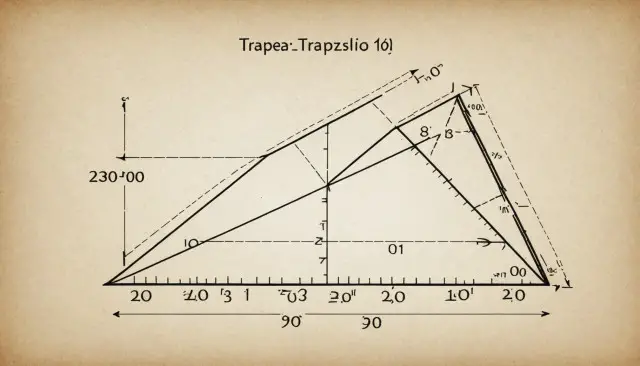
The mathematical formula to find the area of a trapezoid is straightforward once you identify the key components. The area is determined by taking the average of the two bases and multiplying that sum by the height. The standard formula is expressed as:
Area = ((a + b) / 2) * hIn this formula:
- a represents the length of the first base (the top parallel side).
- b represents the length of the second base (the bottom parallel side).
- h represents the height (the vertical distance between the bases).
It is crucial to remember that the height must be a perpendicular line connecting the two bases. You cannot use the length of the slanted legs as the height unless the shape is a right trapezoid where one leg is perpendicular to the bases.
How to Calculate the Area of a Trapezoid Manually
Performing this calculation manually requires a few simple steps. Following a systematic approach helps prevent common arithmetic errors.
Step 1: Measure the Bases
Identify the two parallel sides of the trapezoid. Measure their lengths using the same unit of measurement (inches, centimeters, meters, etc.). Let’s call the shorter parallel side 'a' and the longer parallel side 'b'.
Step 2: Measure the Height
Find the vertical distance between the two bases. This is not the length of the side walls unless they are perfectly vertical. If you are working with a physical object, use a square tool to ensure your height measurement is at a 90-degree angle to the bases.
Step 3: Add the Bases Together
Sum the lengths of base 'a' and base 'b'. For example, if base 'a' is 5 cm and base 'b' is 9 cm, the sum is 14 cm.
Step 4: Divide the Sum by Two
Divide the result from Step 3 by 2 to find the average length of the bases. Using our example, 14 divided by 2 equals 7 cm.
Step 5: Multiply by the Height
Finally, multiply the average base length by the height 'h'. If the height is 4 cm, then 7 cm multiplied by 4 cm results in an area of 28 square centimeters (cm²).[IMAGE SUGGESTION: A diagram showing a trapezoid with bases 'a' and 'b' and a dotted line for height 'h'. Alt text: Diagram illustrating the components of the trapezoid area formula.]
Practical Examples of Trapezoid Area Calculations
To better understand how this applies in the real world, let's look at two distinct scenarios.
Example 1: Calculating a Garden Plot
Imagine you are designing a flower bed that is shaped like a trapezoid. The side against the house (base a) is 10 feet long. The parallel side facing the lawn (base b) is 14 feet long. The distance from the house to the edge of the lawn (height h) is 6 feet.
- Add the bases: 10 + 14 = 24 feet.
- Divide by 2: 24 / 2 = 12 feet.
- Multiply by height: 12 * 6 = 72 square feet.
The total area of the garden plot is 72 square feet. This information is vital for determining how much mulch or soil you need to purchase.
Example 2: Architectural Window Design
An architect is designing a trapezoidal window for a modern home. The top width is 1.2 meters, the bottom width is 1.8 meters, and the height is 2.5 meters.
- Add the bases: 1.2 + 1.8 = 3.0 meters.
- Divide by 2: 3.0 / 2 = 1.5 meters.
- Multiply by height: 1.5 * 2.5 = 3.75 square meters.
The glass required for this window is 3.75 square meters. Knowing this helps in calculating the weight of the glass and the cost of the materials.[IMAGE SUGGESTION: A photo of a modern building with trapezoidal windows. Alt text: Real-world application of trapezoid area calculation in architecture.]
Common Mistakes When Calculating Trapezoid Area
Even with a simple formula, errors can occur. One of the most frequent mistakes is using the 'slant height' instead of the 'vertical height'. The slant height is the length of the non-parallel sides. Unless the side is perfectly vertical, using it in the formula will result in an area that is larger than the actual value. Always ensure you are measuring the shortest distance between the parallel lines.Another error involves inconsistent units. If base 'a' is measured in inches and base 'b' is measured in feet, the calculation will be incorrect. Always convert all measurements to the same unit before starting the formula. For complex conversions, you can visit https://calculatorr.com/ to ensure your initial data is accurate. Finally, forgeting to divide the sum of the bases by two is a common oversight that doubles the actual area. Always double-check your arithmetic steps.
Using an Online Trapezoid Area Calculator
While manual calculation is a great skill, using an online tool like the ones provided at https://calculatorr.com/ offers several advantages. Digital calculators eliminate human error in basic arithmetic and provide instant results, which is especially helpful when dealing with large numbers or decimals.To use an online trapezoid calculator, you simply need to input the values for the two bases and the height. Most tools also allow you to select different units of measurement, automatically handling the conversion for you. This is particularly useful for professional projects where precision is non-negotiable. If you are a student, using a calculator to verify your manual work is an excellent way to learn and build confidence in your mathematical abilities.
Real-World Applications of Trapezoid Area
The utility of the trapezoid area formula extends far beyond the classroom. In civil engineering, the cross-sections of dams, bridges, and canals are often trapezoidal to provide structural stability against water pressure or soil weight. Engineers must calculate these areas to determine the volume of concrete or earth required for construction.In the world of fashion and textiles, skirt patterns (especially A-line skirts) are often drafted as trapezoids. Tailors calculate the area to determine the amount of fabric needed for a specific garment size. Similarly, in the automotive industry, many components like windshields or certain engine parts have trapezoidal profiles. Understanding how to calculate the area of these shapes allows for efficient manufacturing and material usage. By mastering this simple geometric calculation, you equip yourself with a tool that is applicable in almost every physical industry in 2026.