Understanding the Parallelogram and Its Geometric Properties
A parallelogram is a unique four-sided polygon, or quadrilateral, where opposite sides are parallel and equal in length. In the world of geometry, understanding how to calculate the area of a parallelogram is a fundamental skill that serves as a building block for more complex spatial calculations. Unlike a simple rectangle, a parallelogram can be 'tilted,' which often confuses students and professionals alike when they try to determine the total space contained within its boundaries.
The defining characteristics of a parallelogram include opposite angles being equal and consecutive angles being supplementary (adding up to 180 degrees). When you are tasked with finding the area, you are essentially measuring the two-dimensional space occupied by this shape. This calculation is vital in fields ranging from architecture and civil engineering to graphic design and carpentry. Whether you are measuring a plot of land or designing a logo, knowing the precise area of a parallelogram ensures accuracy in your project.
The Fundamental Formula for the Area of a Parallelogram
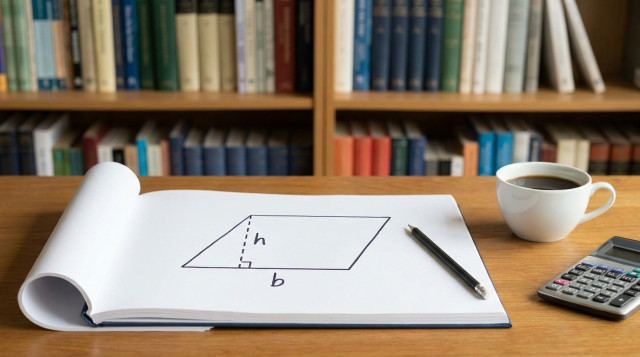
The most common and straightforward way to find the area is by using the base and the perpendicular height. The parallelogram area formula is expressed as:
Area = b × h
In this equation, 'b' represents the length of the base, and 'h' represents the perpendicular height. It is crucial to distinguish the height from the slanted side of the shape. The height must be a straight line that forms a 90-degree angle (perpendicular) with the base. If you use the length of the slanted side instead of the vertical height, your result will be incorrect.
This formula is derived from the fact that any parallelogram can be transformed into a rectangle of the same base and height. If you were to cut a right-angled triangle from one side of the parallelogram and move it to the opposite side, you would form a perfect rectangle. This is why the calculation is so similar to finding the area of a rectangle, despite the difference in visual appearance.
How to Calculate the Area of a Parallelogram Step by Step
Performing this calculation manually is simple once you have the correct measurements. Follow these steps to ensure you arrive at the right answer every time:
Step 1: Identify and Measure the Base
Choose one of the parallel sides to be your base. In most textbook problems, this is the side at the bottom. Measure the length of this side using your preferred units (inches, centimeters, meters, etc.). Let us assume for this example that the base is 12 centimeters.
Step 2: Determine the Perpendicular Height
Locate the height of the parallelogram. Remember, this is not the length of the slanted side. The height is the shortest distance between the base and the opposite parallel side. It must be measured at a right angle to the base. If the height is not provided, you may need to use a protractor or trigonometric functions to find it. For our example, let us say the height is 7 centimeters.
Step 3: Multiply the Base by the Height
Apply the formula by multiplying the two values you have identified. Using our example measurements: 12 cm (base) × 7 cm (height) = 84. The result is the area of the shape.
Step 4: State the Units Correctly
Area is always measured in square units. Since our measurements were in centimeters, the final result is 84 square centimeters (cm²). Failing to include the 'square' designation is a common error in academic and professional reporting.
Calculating Area Using Trigonometry
Sometimes, you may not have the perpendicular height readily available, but you do know the lengths of the two adjacent sides and the angle between them. In such cases, you can use trigonometry to find the area. This is often referred to as the Side-Angle-Side (SAS) method.
The formula using trigonometry is:
Area = a × b × sin(θ)
Where 'a' and 'b' are the lengths of the adjacent sides and 'θ' (theta) is the angle between those two sides. This method is incredibly useful in advanced surveying or when dealing with architectural blueprints where only side lengths and angles are specified. For instance, if you have a parallelogram with sides of 10 meters and 8 meters, and an internal angle of 60 degrees, the calculation would be: 10 × 8 × sin(60°). Since sin(60°) is approximately 0.866, the area would be roughly 69.28 square meters.
Advanced Methods: Using Diagonals or Coordinates
In more complex scenarios, such as coordinate geometry or advanced physics, you might need alternative methods to find the area.
Area Using Diagonals
If you know the lengths of the two diagonals (d1 and d2) and the angle (α) at which they intersect, you can use the following formula:
Area = ½ × d1 × d2 × sin(α)
This is less common in basic geometry but essential when the exterior sides are difficult to measure directly.
Area on a Coordinate Plane
If the parallelogram is plotted on a graph with coordinates (x, y), you can use the determinant of a matrix or the shoelace formula. If the vertices are known, the area can be calculated by finding the absolute value of the cross product of the vectors representing two adjacent sides. This is a standard approach in computer graphics and digital mapping software.
Practical Examples of Parallelogram Area Calculations
To master how to calculate the area of a parallelogram, it helps to look at real-world scenarios. Let's examine two distinct examples.
Example 1: Landscaping and Tiling
Imagine you are designing a patio with pavers shaped like parallelograms. Each paver has a base of 0.5 meters and a perpendicular height of 0.3 meters. To find the area of one paver: 0.5 m × 0.3 m = 0.15 m². If your patio is 15 square meters, you can then calculate exactly how many pavers you need by dividing the total area by the area of one paver.
Example 2: Structural Engineering
A support beam in a bridge has a cross-section in the shape of a parallelogram. The side lengths are 15 inches and 12 inches, and the angle between them is 45 degrees. Using the trigonometric formula: Area = 15 × 12 × sin(45°). Since sin(45°) is approximately 0.707, the area is 15 × 12 × 0.707 = 127.26 square inches. This precision is vital for calculating the load-bearing capacity of the beam.
Common Mistakes When Calculating Parallelogram Area
Even though the formula is simple, many people make avoidable errors. Being aware of these can save you from significant mistakes in your work:
- Confusing Slant Height with Perpendicular Height: This is the most frequent error. Always ensure the height is measured at a 90-degree angle to the base. If the line is tilted, it is a side, not the height.
- Inconsistent Units: Ensure both the base and height are in the same units before multiplying. If the base is in inches and the height is in feet, convert one so they match.
- Forgetting to Square the Units: Always report the final answer in square units (e.g., ft², m², cm²).
- Misidentifying the Shape: Ensure the shape is actually a parallelogram. If only one pair of sides is parallel, it is a trapezoid, which requires a different formula.
How to Use an Online Parallelogram Area Calculator
While manual calculation is a great way to understand the logic, using a digital tool can provide speed and eliminate human error, especially with large numbers or trigonometric functions. When you need to solve complex geometry problems quickly, using a dedicated tool at https://calculatorr.com/ can save time and ensure accuracy.
To use an online calculator, you typically only need to input the base and the height. The system instantly processes the multiplication and provides the result. If you are working with angles, look for a calculator that allows for 'Side-Angle-Side' inputs. These tools are particularly helpful for students checking their homework or professionals who need to perform multiple calculations in a short period.
Real-World Applications of This Calculation
The ability to calculate the area of a parallelogram is not just an academic exercise; it has practical applications in various industries:
- Architecture: Designing modern buildings often involves non-rectangular shapes. Calculating the surface area of parallelogram-shaped glass panels or walls is essential for material procurement.
- Textile Industry: Fabric patterns often use repeating parallelogram shapes. Calculating the area helps manufacturers determine how much dye or material is required for a specific run.
- Solar Energy: Solar panels are sometimes arranged in parallelogram configurations to maximize space on a roof. Calculating the total area helps estimate the potential energy output.
- Navigation: In vector physics, which is used in aviation and maritime navigation, the area of a parallelogram formed by two vectors represents the magnitude of their cross product.
By mastering these formulas and understanding the relationship between base, height, and angles, you gain a powerful tool for solving spatial problems in everyday life and professional environments. Whether you do it by hand or use the efficient tools at Calculatorr, accuracy in geometry is just a few steps away.