Understanding Blood Alcohol Content (BAC)
Blood Alcohol Content, commonly referred to as BAC, is a metric used to measure the amount of alcohol present in a person's bloodstream. It is expressed as a percentage, representing the mass of alcohol per volume of blood. For instance, a BAC of 0.08% means that there are 0.08 grams of alcohol for every 100 milliliters of blood. Understanding how to calculate this value is essential for personal safety, legal compliance, and health awareness.
When you consume alcohol, it is absorbed through the stomach and small intestine into the bloodstream. The liver then works to metabolize the alcohol, but it can only process a limited amount per hour. If you consume alcohol faster than your liver can process it, your BAC rises. Knowing your levels helps in making informed decisions about driving, health, and general well-being. Using tools like those found at Calculatorr.com can simplify this complex physiological process into understandable data.
The Widmark Formula for BAC Calculation
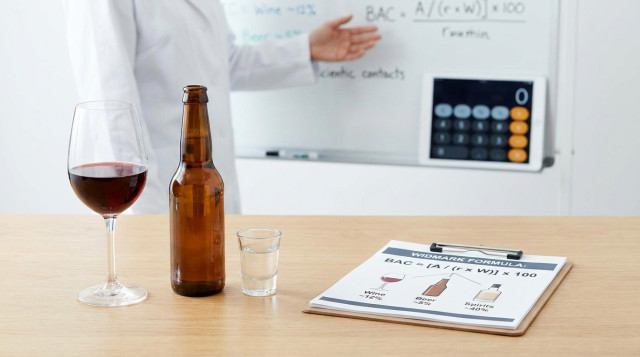
The most widely recognized mathematical method for estimating blood alcohol levels is the Widmark Formula, developed by Swedish physician Erik M. P. Widmark. This formula takes into account the amount of alcohol consumed, body weight, and a gender-specific distribution ratio. While it provides a solid estimate, it is important to remember that individual metabolism varies.
The Basic Widmark Equation
The formula is typically expressed as follows:
BAC = [Alcohol consumed in grams / (Body weight in grams * r)] * 100 - (Elapsed time in hours * β)
In this equation, the variables represent:
- Alcohol consumed: The total mass of pure ethanol ingested.
- Body weight: The weight of the individual in grams.
- r (Distribution Ratio): A constant that accounts for the percentage of water in the body. For men, the average is 0.68. For women, the average is 0.55.
- β (Elimination Rate): The rate at which alcohol is metabolized. The average rate is approximately 0.015% per hour.
How to Calculate BAC Manually Step by Step
Calculating your BAC manually requires converting standard drink measurements into grams of pure alcohol and ensuring all units of measurement are consistent. Follow these steps to perform the calculation.
Step 1: Determine the Amount of Pure Alcohol
First, you must identify how many grams of alcohol you have consumed. A 'standard drink' usually contains about 14 grams of pure alcohol. To calculate this for any specific beverage, use the following formula:
Grams of Alcohol = Volume (ml) * Alcohol by Volume (ABV) * 0.789
The number 0.789 is the density of ethanol. For example, a 355 ml (12 oz) beer with 5% ABV contains: 355 * 0.05 * 0.789 = 14.0 grams of alcohol.
Step 2: Convert Body Weight to Grams
Since the formula uses grams for both alcohol and body weight, you must convert your weight. If you weigh 180 pounds, first convert to kilograms (180 / 2.2046 = 81.65 kg) and then to grams (81,650 grams).
Step 3: Apply the Distribution Ratio
Multiply your weight in grams by the distribution ratio (0.68 for men or 0.55 for women). This represents the volume of the body where alcohol can be distributed.
Step 4: Calculate the Raw BAC and Subtract Metabolism
Divide the grams of alcohol by the result from Step 3, then multiply by 100 to get the percentage. Finally, subtract the amount of alcohol your body has already processed. Multiply the number of hours since your first drink by the elimination rate (0.015).
Practical Examples of BAC Calculation
To better understand how these variables interact, let's look at two different scenarios involving the same amount of alcohol consumption over the same period.
Example 1: A 180-pound Man
Suppose a 180-pound (81,650g) man consumes three standard beers (42g of alcohol) over two hours.
- Raw Calculation: 42 / (81,650 * 0.68) = 42 / 55,522 = 0.000756
- Percentage: 0.000756 * 100 = 0.0756%
- Metabolism: 2 hours * 0.015 = 0.03%
- Final BAC: 0.0756% - 0.03% = 0.0456%
Example 2: A 140-pound Woman
Now, consider a 140-pound (63,500g) woman who consumes the same three standard beers (42g of alcohol) over two hours.
- Raw Calculation: 42 / (63,500 * 0.55) = 42 / 34,925 = 0.001202
- Percentage: 0.001202 * 100 = 0.1202%
- Metabolism: 2 hours * 0.015 = 0.03%
- Final BAC: 0.1202% - 0.03% = 0.0902%
In this comparison, the woman would be over the legal driving limit (typically 0.08%), while the man would be below it, illustrating how weight and gender significantly impact alcohol concentration.
Factors That Affect Your BAC Levels
While the Widmark formula provides a mathematical baseline, several biological and environmental factors can influence how your body handles alcohol. These factors explain why two people of the same weight might react differently to the same number of drinks.
Rate of Consumption
The faster you drink, the more quickly your BAC rises. Because the liver can only metabolize a set amount of alcohol per hour, 'chugging' or rapid consumption creates a backlog in the bloodstream, leading to a higher peak BAC.
Food Intake
Drinking on an empty stomach allows alcohol to pass almost immediately into the small intestine, where it is absorbed rapidly. Eating a meal, especially one high in protein and healthy fats, before or during drinking slows the absorption rate, resulting in a lower peak BAC.
Body Composition
Alcohol is water-soluble, not fat-soluble. This means that individuals with a higher percentage of muscle (which contains more water) will generally have a lower BAC than individuals with a higher percentage of body fat, even if they weigh the same. This is one reason why the distribution ratio (r) differs between men and women.
Hydration and Medications
Dehydration can lead to a higher concentration of alcohol in the blood. Additionally, many medications—including common over-the-counter pain relievers and prescription drugs—can interfere with how the liver processes alcohol or intensify its effects on the central nervous system.
Interpreting Your BAC Results
Understanding what the numbers mean is crucial for safety. BAC levels correlate with specific physical and mental impairments. Below is a general guide to how different BAC levels typically affect the human body.
| BAC Percentage | Typical Effects and Impairments |
|---|---|
| 0.02% - 0.03% | Slight mood elevation, relaxation, and warmth. Minimal impairment. |
| 0.05% - 0.06% | Feeling of well-being, lowered inhibitions, and minor impairment of reasoning and memory. |
| 0.08% | Legal limit for driving in many regions. Impairment of balance, speech, reaction time, and hearing. |
| 0.10% - 0.12% | Significant impairment of motor coordination and loss of good judgment. Slurred speech. |
| 0.15% - 0.20% | Severe intoxication. Major loss of balance and motor control. Nausea and vomiting may occur. |
| 0.30% and above | Potential loss of consciousness. Severe central nervous system depression. Risk of alcohol poisoning. |
Using an Online BAC Calculator
While manual calculations are educational, they are prone to human error, especially when converting units or estimating metabolism. Using a digital tool on Calculatorr.com provides a faster and more reliable way to estimate your levels. These tools allow you to input your weight, gender, the number of drinks, and the time elapsed to get an instant result.
Digital calculators are particularly useful because they often include presets for different types of alcohol (wine, beer, spirits), saving you the trouble of calculating the grams of ethanol manually. However, always remember that these tools provide estimates and should never be used to determine if you are 'safe' to drive. If you have been drinking, the safest choice is always to avoid operating a vehicle.
Common Mistakes in BAC Estimation
Many people rely on 'rules of thumb' that can be dangerously inaccurate. Avoiding these common pitfalls can help you maintain a more realistic understanding of your sobriety.
Underestimating Drink Size
A common error is assuming every glass of wine or bottle of beer is one 'standard drink.' In reality, many craft beers have double the alcohol content of a standard lager, and many restaurant pours of wine are significantly larger than the standard 5 ounces. Always check the ABV and the volume of what you are consuming.
Ignoring the Time Factor
People often forget that the 'clock' starts from the first sip, not the last. If you had three drinks over five hours, your BAC will be much lower than if you had three drinks in one hour. Conversely, some believe that drinking coffee or taking a cold shower speeds up the metabolism of alcohol. This is a myth; only time can lower your BAC as the liver processes the ethanol at a constant rate.
Relying on Physical Feelings
Tolerance is not the same as BAC. A person who drinks frequently may feel 'sober' at a BAC of 0.08% due to functional tolerance, but their blood alcohol level remains the same as an occasional drinker, and their reaction times are still impaired. Never use your 'feeling' of sobriety as a metric for legal or safety decisions.
The Importance of Accuracy in Health Calculations
Calculating BAC is just one aspect of monitoring your health and safety. Whether you are tracking your fitness, managing your finances, or calculating physiological metrics, precision is key. By understanding the math behind the Widmark formula and the biological factors at play, you can better navigate social situations and prioritize your long-term health. For more practical tools and educational guides on various calculations, visit Calculatorr.com to explore our comprehensive range of online calculators.