
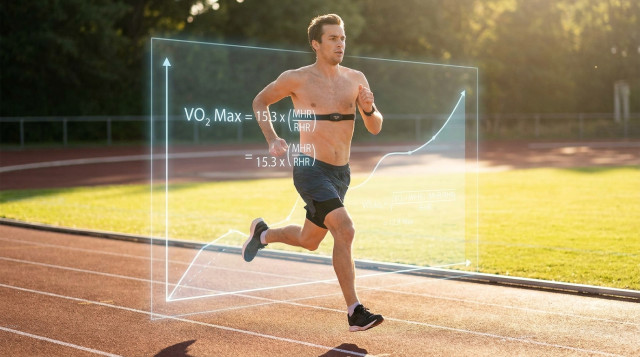
Understanding VO2 Max and Its Importance in 2026
VO2 max is widely considered the gold standard for measuring cardiovascular fitness and aerobic endurance. It represents the maximum amount of oxygen an individual can utilize during intense or maximal exercise. The 'V' stands for volume, 'O2' for oxygen, and 'max' for maximum. As we navigate fitness trends in 2026, understanding this metric is more relevant than ever for anyone looking to optimize their health, from professional athletes to weekend warriors.
When you exercise, your muscles require oxygen to produce energy. The more oxygen your body can use, the more energy you can generate, allowing you to run faster, cycle longer, or perform any aerobic activity with greater efficiency. Calculating your VO2 max provides a baseline for your current fitness level and helps you track progress over time. While laboratory testing with a metabolic cart is the most accurate method, several scientifically validated formulas allow you to estimate this value with high precision using simple tools and calculators available at https://calculatorr.com/.
The Science of Oxygen Consumption
Oxygen consumption is a complex process involving the respiratory, circulatory, and muscular systems. It begins with the lungs inhaling oxygen, which is then transferred to the blood. The heart pumps this oxygenated blood to the working muscles, where mitochondria use the oxygen to create adenosine triphosphate (ATP), the primary energy currency of cells. Your VO2 max is limited by how quickly your heart can pump blood and how efficiently your muscles can extract oxygen from that blood.
VO2 max is typically expressed in milliliters of oxygen consumed per kilogram of body weight per minute (ml/kg/min). This relative measurement allows for a fair comparison between individuals of different sizes. For example, a larger person might consume more total oxygen, but a smaller, more fit person might have a higher relative VO2 max, indicating superior cardiovascular efficiency.
How to Calculate VO2 Max Using the Cooper Test
The Cooper Test is one of the most popular and easiest ways to estimate aerobic capacity. Developed by Dr. Kenneth Cooper in 1968 for military use, it requires the participant to run or walk as far as possible in 12 minutes. This test is highly correlated with actual laboratory VO2 max results.
The Cooper Test Formula
To calculate your VO2 max using this method, you first need to measure the total distance covered in 12 minutes in meters. The formula is as follows:
VO2 Max = (Distance in meters - 504.9) / 44.73
Step-by-Step Instructions for the 12-Minute Run
1. Find a flat, measured track (a standard 400m track is ideal).
2. Warm up for 10 to 15 minutes with light jogging and dynamic stretching.
3. Set a timer for 12 minutes.
4. Run at a steady, maximal pace that you can maintain for the entire duration.
5. Record the total distance covered to the nearest meter.
6. Apply the formula or use a specialized tool on https://calculatorr.com/ to get your result.
How to Calculate VO2 Max Using the Rockport Fitness Walking Test
If running is not suitable for your current fitness level, the Rockport Fitness Walking Test is an excellent alternative. This test is designed for individuals who prefer walking or are just starting their fitness journey. It relies on your heart rate and the time it takes to walk one mile.
The Rockport Formula
This calculation is more detailed as it accounts for weight, age, gender, and heart rate. The formula is:
VO2 Max = 132.853 - (0.0769 × Weight in lbs) - (0.3877 × Age) + (6.315 × Gender) - (3.2649 × Time in minutes) - (0.1565 × Heart Rate)
For the gender variable, use 1 for males and 0 for females. The time must be expressed in minutes and decimals (e.g., 15 minutes and 30 seconds is 15.5 minutes).
Variables You Need to Measure
To ensure accuracy, you must measure your weight on the day of the test and use a heart rate monitor or manually count your pulse for 15 seconds immediately after finishing the mile (then multiply by 4). The walk must be brisk and performed on a flat surface.
Using the Uth-Sørensen-Overgaard-Pedersen Formula
Another quick way to estimate VO2 max is based on the ratio between your maximum heart rate and your resting heart rate. This method, often called the 'Heart Rate Ratio Method,' is useful because it doesn't require a specific physical test, though it assumes you know your true maximum heart rate.
VO2 Max = 15.3 × (HRmax / HRrest)
For example, if a 30-year-old has a resting heart rate of 60 bpm and a maximum heart rate of 190 bpm, the calculation would be: 15.3 × (190 / 60) = 48.45 ml/kg/min.
Practical Examples of VO2 Max Calculations
Let's look at a practical example using the Cooper Test. Suppose a 25-year-old athlete runs 2,800 meters in 12 minutes. Using the formula:
VO2 Max = (2800 - 504.9) / 44.73
VO2 Max = 2295.1 / 44.73
VO2 Max = 51.31 ml/kg/min.
Now, let's consider a 45-year-old woman weighing 150 lbs who completes the Rockport Walking Test in 14 minutes and 20 seconds (14.33 minutes) with a finishing heart rate of 140 bpm:
VO2 Max = 132.853 - (0.0769 × 150) - (0.3877 × 45) + (6.315 × 0) - (3.2649 × 14.33) - (0.1565 × 140)
VO2 Max = 132.853 - 11.535 - 17.446 + 0 - 46.786 - 21.91
VO2 Max = 35.17 ml/kg/min.
Interpreting Your VO2 Max Results
Once you have calculated your number, it is essential to understand what it means relative to your age and gender. Generally, higher numbers indicate better cardiovascular health. Below is a general guide for interpreting results in adults:
| Fitness Level | Men (Age 30-39) | Women (Age 30-39) |
|---|---|---|
| Superior | > 53.9 | > 46.9 |
| Excellent | 49.0 - 53.9 | 41.0 - 46.9 |
| Good | 44.0 - 48.9 | 36.0 - 40.9 |
| Fair | 39.0 - 43.9 | 31.0 - 35.9 |
| Poor | < 39.0 | < 31.0 |
A 'Superior' rating suggests that your heart and lungs are highly efficient, often seen in competitive endurance athletes. A 'Poor' rating may indicate a sedentary lifestyle and a higher risk for cardiovascular issues, suggesting that increasing aerobic activity could provide significant health benefits.
Common Mistakes When Measuring Aerobic Capacity
One of the most frequent errors is improper pacing during the Cooper Test. Many people start too fast and burn out, or start too slow and finish with excess energy. Both scenarios lead to an underestimation of VO2 max. It is recommended to practice the 12-minute run at least once before recording a final score.
Another mistake involves inaccurate heart rate measurement. Using a chest strap monitor is significantly more accurate than wrist-based optical sensors, especially during high-intensity exercise. If measuring manually, ensure you find your pulse immediately after stopping, as heart rate drops quickly once exercise ceases.
Finally, environmental factors like high heat, humidity, or altitude can negatively impact your performance. For the most consistent results, perform your tests under similar conditions and on the same surface each time.
How to Improve Your VO2 Max Over Time
The good news is that VO2 max is not a fixed number; it can be improved with consistent training. High-Intensity Interval Training (HIIT) is one of the most effective ways to boost oxygen consumption. By pushing your heart rate to 90-95% of its maximum for short bursts, you force your cardiovascular system to adapt and become more efficient.
Long, slow distance training also plays a role by increasing the capillary density in your muscles and improving mitochondrial function. A balanced program that includes both high-intensity intervals and steady-state cardio will yield the best results. As you train, revisit the calculators at https://calculatorr.com/ every 8 to 12 weeks to track your improvements and adjust your training zones accordingly.
Using an Online VO2 Max Calculator
While manual calculations are helpful for understanding the underlying math, using an online VO2 max calculator is the fastest way to get accurate results without the risk of arithmetic errors. These tools allow you to toggle between metric and imperial units and provide instant interpretations based on the latest fitness data. By inputting your test results into a digital interface, you can maintain a digital log of your fitness journey throughout 2026 and beyond, ensuring that your training remains data-driven and effective.