
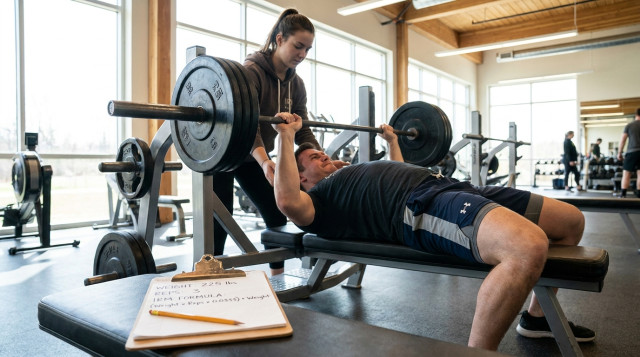
Knowing how to calculate your one-rep max (1RM) lets you pick the right weights, track strength progress and plan your training without ever testing a dangerous maximal lift. Instead of loading the bar until it breaks you, you lift a lighter weight for several reps and use a formula to estimate the heaviest single repetition you could complete with good form.
This guide explains the main 1RM formulas, shows how to apply them by hand, and covers how to turn the result into training loads you can use in your next session.
What is one-rep max (1RM) and why calculate it?
Your one-rep max is the maximum weight you can lift for a single repetition of a given exercise with correct technique. It is specific to each lift: your squat 1RM, bench press 1RM and deadlift 1RM will all be different numbers.
Calculating it is useful because most strength programs prescribe loads as a percentage of 1RM. A routine might ask for 5 sets of 5 reps at 80%, which only makes sense if you know your maximum.
Main uses of a 1RM estimate
- Setting training weights for strength, hypertrophy or power phases.
- Tracking progress over weeks and months using the same exercise and rep range.
- Comparing strength between lifts or between training cycles.
- Reducing injury risk by avoiding true maximal attempts when you are tired or training alone.
Direct test vs. estimated 1RM
A direct test means working up to a true single. It is accurate but demands warm-up, rest, a spotter and a high level of technical skill. An estimated 1RM uses a submaximal set (usually between 2 and 10 reps) and a formula. It is faster, safer and good enough for most people.
One-rep max formula: Epley, Brzycki and other equations
Several equations estimate 1RM from the weight lifted (w) and the number of repetitions completed (r). They give similar results at low reps and drift apart as reps increase.
| Formula | Equation | Best used for |
|---|---|---|
| Epley | 1RM = w × (1 + r / 30) | General use, 2 to 10 reps |
| Brzycki | 1RM = w × 36 / (37 − r) | Low to moderate reps, up to about 10 |
| Lombardi | 1RM = w × r^0.10 | Moderate reps |
| O'Conner | 1RM = w × (1 + 0.025 × r) | Quick mental estimate |
The Epley and Brzycki formulas are the most widely used. If you want a single, consistent method, pick one and stick with it so your numbers stay comparable over time.
Why Brzycki cannot handle high reps
In the Brzycki equation, the denominator is 37 minus the reps. At 37 reps the denominator would be zero, and well before that the estimate becomes unrealistic. Keep sets at 10 reps or fewer for reliable results with any formula.
How to calculate your 1RM step by step
You only need a barbell or machine, a safe setup and a basic calculator. Follow these steps.
- Warm up properly. Do several progressively heavier sets of the exercise, ending with a weight you can control.
- Choose a challenging weight. Pick a load you can lift for roughly 3 to 8 reps with good form.
- Perform one all-out set. Stop when your technique starts to break down or you could not complete another clean rep. Count only the reps done with full range of motion.
- Record weight and reps. Write both down, using the same unit (kg or lb) throughout.
- Apply a formula. Substitute the numbers into Epley, Brzycki or another equation.
- Round the result. Round to the nearest plate increment you actually have, such as 2.5 kg or 5 lb.
Example 1: 100 kg for 5 reps
Suppose you complete 5 clean reps on the squat with 100 kg.
- Epley: 100 × (1 + 5/30) = 100 × 1.1667 = 116.7 kg
- Brzycki: 100 × 36 / (37 − 5) = 100 × 36 / 32 = 112.5 kg
- Lombardi: 100 × 5^0.10 = 100 × 1.1746 = 117.5 kg
- O'Conner: 100 × (1 + 0.025 × 5) = 100 × 1.125 = 112.5 kg
The estimates range from 112.5 to 117.5 kg. A practical working figure is about 115 kg.
Example 2: 185 lb for 8 reps
Now imagine a bench press set of 8 reps with 185 lb.
- Epley: 185 × (1 + 8/30) = 185 × 1.2667 = 234.3 lb
- Brzycki: 185 × 36 / (37 − 8) = 185 × 36 / 29 = 229.7 lb
Your estimated 1RM is roughly 230 to 235 lb. With 8 reps, the gap between formulas is already wider than at 5 reps, which is one more reason to prefer lower rep sets when you can.
One-rep max calculator: how to use it
A calculator removes arithmetic mistakes and lets you compare formulas instantly. You can find related tools for training, health and everyday math on Calculatorr.
What to enter
- The weight you lifted in your best set.
- The number of repetitions you completed with good form.
- The unit (kg or lb), if the tool asks for it.
What to check in the result
Look at the estimated 1RM and, if available, the percentage table that comes with it. If the calculator shows several formulas, treat the average as your working number. Always verify that the weight and reps you typed match your actual set, since a single wrong digit changes everything.
1RM percentage chart: how many reps at each percentage
Once you know your 1RM, you can convert it into training loads. The table below shows typical relationships between percentage of 1RM, approximate reps to failure and the weight for someone with a 115 kg 1RM.
| % of 1RM | Approx. max reps | Weight (1RM = 115 kg) |
|---|---|---|
| 95% | 2 | 109.3 kg |
| 90% | 4 | 103.5 kg |
| 85% | 6 | 97.8 kg |
| 80% | 8 | 92.0 kg |
| 75% | 10 | 86.3 kg |
| 70% | 12 | 80.5 kg |
These rep numbers are averages. Some people get more reps at a given percentage on certain lifts, especially on leg exercises, and fewer on others.
How to match percentages to your goal
- Maximal strength: roughly 85% to 95% of 1RM, low reps, long rests.
- Muscle growth: roughly 65% to 85% of 1RM, moderate reps, sets taken close to failure.
- Muscular endurance: roughly 50% to 65% of 1RM, higher reps, shorter rests.
How to calculate working weight from your 1RM
You can also reverse the process. If your program calls for a specific number of reps, rearrange the Epley formula to find the load.
Working weight = 1RM / (1 + r / 30)
Example: target of 8 reps
With a 1RM of 115 kg and a target of 8 reps:
115 / (1 + 8/30) = 115 / 1.2667 = 90.8 kg. Rounded to available plates, that is about 90 kg.
If your program uses percentages instead, multiply your 1RM by the percentage. For 80%: 115 × 0.80 = 92 kg.
How to interpret your one-rep max result
An estimated 1RM is a guide, not a guarantee. It tells you the approximate ceiling of your strength on that day, with that exercise and technique.
- If your estimate rises over time using the same rep range and exercise, your strength is improving.
- If it stays flat for several weeks, review sleep, nutrition, volume and progression.
- If it drops suddenly, fatigue, stress or illness is a likely cause. Retest after a lighter week before changing your program.
Many lifters also compare 1RM with body weight. A bench press of 1.0 times body weight is a common early milestone, while squats and deadlifts tend to be significantly higher relative to body weight. For another way to compare strength across body sizes, you can explore other fitness tools at Calculatorr.
Common mistakes when calculating 1RM
Using sets with too many reps
Formulas lose accuracy beyond about 10 reps. A set of 20 will produce an unreliable estimate because endurance, not maximal strength, becomes the limiting factor.
Counting sloppy reps
Half squats, bounced bench reps and bent-back deadlifts inflate your numbers. Count only reps you would accept in a real max attempt.
Mixing formulas
Calculating one session with Epley and the next with Brzycki makes progress look better or worse than it is. Pick one formula for tracking.
Testing while fatigued
Estimating 1RM at the end of a hard workout will understate your strength. Test at the start of a session, after warming up.
Ignoring exercise differences
Your bench press 1RM does not predict your overhead press or row. Calculate each lift separately.
Mixing units
Entering kilograms in a calculator set to pounds, or the reverse, produces a result that looks plausible but is wrong. Confirm the unit before you calculate.
Is it safe to estimate 1RM? Practical tips
Estimating 1RM from a submaximal set is much safer than testing a true single, but a few precautions still matter.
- Use safety pins or a spotter on squats and bench presses.
- Stop the set when form breaks down, not when the bar stops moving.
- Retest every 4 to 8 weeks rather than every session.
- Use the same exercise variation, tempo and rest times so results are comparable.
- Beginners should focus on technique first and use the estimate only as a rough guide, since early strength gains are fast and the number will change quickly.
If you have a heart condition, joint problems or an injury, check with a qualified professional before doing any near-maximal work.
Quick reference: 1RM formula cheat sheet
- Epley: w × (1 + r / 30)
- Brzycki: w × 36 / (37 − r)
- Lombardi: w × r^0.10
- O'Conner: w × (1 + 0.025 × r)
- Weight for a target rep count (Epley): 1RM / (1 + r / 30)
- Training load at a given percentage: 1RM × percentage
Keep the set between 2 and 10 reps, use strict form, apply one formula consistently and retest at regular intervals. With those habits, your 1RM estimate becomes a reliable compass for planning every training cycle.