
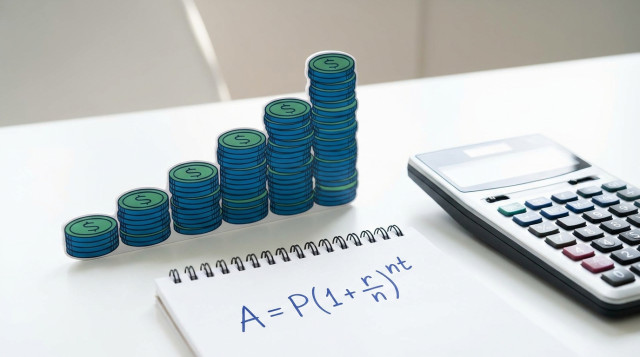
Knowing how to calculate compound interest is one of the most useful financial skills you can learn. It explains why savings grow faster over time, why debt gets expensive when left alone, and why starting early matters more than investing a large amount later. This guide shows the formula, the manual steps, worked examples with real numbers and the mistakes that most often distort the result.
What is compound interest and why does it matter?
Compound interest is interest calculated on the original amount plus all the interest already earned. Each period, your balance grows, and the next interest payment is based on that larger balance.
Simple interest works differently. It is calculated only on the initial amount, so the growth is a straight line. Compound interest produces a curve that gets steeper over time.
You will run into it in many places:
- Savings accounts and certificates of deposit
- Retirement and investment accounts
- Credit cards and personal loans
- Student loans with capitalized interest
- Bonds and reinvested dividends
When interest works for you, compounding builds wealth. When you are the borrower, the same mechanism increases what you owe.
Compound interest formula: what each variable means
The standard formula for the final amount is:
A = P × (1 + r/n)n×t
| Symbol | Meaning | Example |
|---|---|---|
| A | Final amount (principal plus interest) | 13,488.50 |
| P | Initial principal | 10,000 |
| r | Annual interest rate as a decimal | 0.06 (6%) |
| n | Compounding periods per year | 12 (monthly) |
| t | Time in years | 5 |
To find only the interest earned, subtract the principal: Interest = A − P.
Common compounding frequencies
- Annually: n = 1
- Semiannually: n = 2
- Quarterly: n = 4
- Monthly: n = 12
- Daily: n = 365
How to calculate compound interest step by step
Follow the same sequence every time and the calculation stays simple, even without a calculator that has a dedicated function.
- Convert the rate to a decimal. Divide the percentage by 100. A rate of 6% becomes 0.06.
- Divide the rate by the number of periods per year. For monthly compounding, 0.06 ÷ 12 = 0.005.
- Add 1. This gives the growth factor for one period: 1.005.
- Multiply n by t. This is the total number of periods. For 12 periods a year over 5 years, that is 60.
- Raise the growth factor to that power. 1.00560 ≈ 1.34885.
- Multiply by the principal. 10,000 × 1.34885 = 13,488.50.
The interest earned is 13,488.50 − 10,000 = 3,488.50.
Compound interest example with a lump sum
Suppose you deposit 10,000 at a 6% annual rate for 5 years. The table shows how the compounding frequency changes the outcome.
| Compounding | Periods (n×t) | Final amount | Interest earned |
|---|---|---|---|
| Annually | 5 | 13,382.26 | 3,382.26 |
| Quarterly | 20 | 13,468.55 | 3,468.55 |
| Monthly | 60 | 13,488.50 | 3,488.50 |
| Daily | 1,825 | 13,498.27 | 3,498.27 |
More frequent compounding always yields more, but the gain shrinks quickly. Going from annual to monthly adds about 106 here. Going from monthly to daily adds only about 10. The rate and the time matter far more than the frequency.
How to calculate compound interest with regular monthly contributions
Most people do not deposit a single amount. They add money every month. In that case, use the future value formula with periodic contributions:
FV = P × (1 + i)N + PMT × [((1 + i)N − 1) / i]
Here, i is the rate per period (annual rate ÷ n), N is the total number of periods and PMT is the contribution made at the end of each period. This version assumes contributions match the compounding frequency.
Worked example
You start with 5,000, add 200 per month and earn 7% annually, compounded monthly, for 10 years.
- Monthly rate: i = 0.07 ÷ 12 = 0.0058333
- Total periods: N = 12 × 10 = 120
- Growth factor: (1.0058333)120 ≈ 2.00966
- Initial deposit growth: 5,000 × 2.00966 ≈ 10,048.31
- Contribution growth: 200 × [(2.00966 − 1) / 0.0058333] ≈ 200 × 173.085 ≈ 34,616.98
- Total: 10,048.31 + 34,616.98 ≈ 44,665.29
You contributed 5,000 + (200 × 120) = 29,000 in total. The remaining 15,665 or so is interest. More than a third of the final balance came from compounding rather than from your own deposits.
Compound interest calculator: how to use it correctly
Doing the math by hand is useful for understanding the logic, but a compound interest calculator is faster and avoids rounding errors, especially with many periods. You can find this and other financial tools at Calculatorr.
To get a reliable result, enter these inputs:
- Initial amount: the money you have today, which can be zero.
- Contribution amount and frequency: how much you add and how often.
- Annual interest rate: the nominal rate quoted by the bank or the expected return of the investment.
- Compounding frequency: how often interest is added to the balance.
- Time horizon: total years or months.
Use the manual formula to check one scenario. If the calculator matches your hand result, you can trust it for comparisons with different rates and deadlines.
Calculating compound interest in a spreadsheet
In Excel or Google Sheets, the function FV does the work. For the earlier contribution example, use =FV(0.07/12, 120, -200, -5000). The negative signs represent money you pay in, and the result is a positive future value of about 44,665.
How to find the interest rate or time needed to reach a goal
Sometimes you know the target and need to work backward.
Time needed to reach a target amount
For a single deposit, rearrange the formula:
t = ln(A / P) / (n × ln(1 + r/n))
Example: you want 10,000 to become 15,000 at 5% compounded annually. Then t = ln(1.5) / ln(1.05) = 0.405465 / 0.048790 ≈ 8.31 years.
Rate needed to reach a target amount
For annual compounding, the required rate is:
r = (A / P)1/t − 1
Example: to turn 10,000 into 15,000 in 8 years, r = 1.51/8 − 1 ≈ 0.0521, or about 5.21% per year.
The rule of 72 for a quick estimate
To estimate how long it takes to double your money, divide 72 by the annual rate in percent. At 8%, 72 ÷ 8 = 9 years. The exact calculation, ln(2) / ln(1.08), gives 9.006 years, so the shortcut is very close for common rates.
Nominal rate vs. APY: how to compare accounts fairly
A bank may advertise a nominal rate of 6% compounded monthly. The rate you actually earn over a year is higher because of compounding. This is called the annual percentage yield (APY) or effective annual rate:
APY = (1 + r/n)n − 1
For 6% compounded monthly: (1.005)12 − 1 ≈ 0.06168, or 6.17%. When comparing two savings products, always compare APY to APY. A 6.00% account compounded annually is slightly worse than a 5.95% account compounded daily once you look at the effective yield.
How to interpret your compound interest results
The final number is only useful if you read it in context. Keep these points in mind:
- Compare interest to contributions. If interest is a small share of the total, time or rate is too low to make compounding visible.
- Check the growth curve. In early years, most growth comes from your deposits. In later years, interest takes over.
- Consider inflation. A 6% nominal return with 3% inflation is roughly a 3% real return. Your purchasing power grows more slowly than the balance suggests.
- Remember taxes and fees. Account fees and taxes on interest reduce the effective rate. Use the net rate in the formula for a realistic projection.
For debts, apply the same logic in reverse. A credit card balance of 3,000 at 24% compounded monthly grows by a factor of (1.02)12 ≈ 1.268 in a year if left untouched. That adds roughly 804 in interest, which is why paying down high-rate balances is often the best guaranteed return available.
Common mistakes when calculating compound interest
- Using the percentage instead of the decimal. Entering 6 instead of 0.06 produces absurd results.
- Forgetting to divide the rate by n. With monthly compounding, the rate per period is the annual rate divided by 12, not the full annual rate.
- Mixing years and months. If t is in years, multiply by n. If you work with months, make sure the rate per period matches.
- Ignoring the timing of contributions. Deposits made at the start of each period earn slightly more than those made at the end. Multiply the annuity part by (1 + i) for that case.
- Rounding too early. Keep at least five or six decimals in the growth factor until the final step, since small differences multiply over many periods.
- Assuming a constant rate. Variable-rate accounts and market investments change over time. Treat the result as a projection, not a guarantee.
Practical ways to use compound interest in your decisions
Once you can calculate compound interest, you can answer real questions quickly:
- How much will my monthly savings be worth in 15 years?
- How much more would I have by starting five years earlier?
- Is a slightly higher rate worth a longer lock-in period?
- How fast does my debt grow if I only make minimum payments?
Try running the same scenario with different starting dates. Investing 200 per month at 7% for 30 years gives about 243,994, while waiting 10 years and investing for 20 years gives about 104,185. The extra decade of compounding is worth more than twice as much, even though the total contributions differ by only 24,000.
To test your own numbers, open the tools on Calculatorr, enter your deposit, rate and time horizon, and compare scenarios side by side. Combine the result with other calculators for loans, savings goals and returns to build a clear picture of where your money is heading.