
What is Lean Body Mass and why is it important?
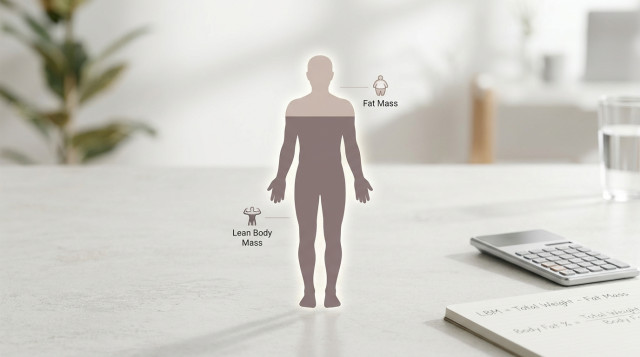
Lean Body Mass (LBM) represents the total weight of your body minus all the weight due to fat mass. It includes the weight of your organs, skin, bones, water, and muscles. Understanding how to calculate lean body mass is essential for anyone serious about fitness, nutrition, or general health monitoring because it provides a much more accurate picture of body composition than total body weight alone.
When you step on a traditional scale, the number you see doesn't distinguish between muscle, fat, or water. This can be misleading, especially for athletes or individuals undergoing body recomposition. By focusing on LBM, you can ensure that weight loss comes from fat stores rather than vital muscle tissue. Maintaining or increasing your lean mass is also crucial for metabolic health, as lean tissue is more metabolically active than fat, meaning it burns more calories even at rest.
Tracking this metric allows for better precision in nutritional planning. Most professional dietary guidelines for protein intake are based on lean mass rather than total weight. For instance, a person with high muscle mass requires more protein to maintain their physique than someone of the same weight with a higher body fat percentage. Using tools at Calculatorr can help you keep track of these variables efficiently.
Difference between Lean Body Mass and Muscle Mass
It is a common mistake to use the terms lean body mass and muscle mass interchangeably. While they are related, they are not the same thing. Muscle mass refers specifically to the weight of your muscles (skeletal, cardiac, and smooth muscles). Lean body mass, on the other hand, is an all-encompassing category that includes muscle mass plus the weight of your bones, internal organs, and body water.
If you gain muscle, your LBM will increase. However, if you are severely dehydrated, your LBM might decrease because water is a significant component of lean tissue. This distinction is vital when interpreting results from formulas or digital scales. When you calculate lean body mass, you are looking at the 'functional' part of your body that drives movement and metabolism, excluding the energy storage (fat).
How to calculate lean body mass using standard formulas
Since directly measuring LBM requires expensive medical equipment like DEXA scans or underwater weighing, researchers have developed mathematical models to estimate it based on height, weight, and gender. These formulas are highly effective for the general population and provide a reliable baseline for tracking progress.
The Boer Formula
Developed in 1984, the Boer formula is one of the most widely used methods in clinical settings. It is particularly useful for estimating lean mass in individuals who do not have extreme body compositions (neither very obese nor extremely muscular).
For Men: LBM = (0.407 * weight in kg) + (0.267 * height in cm) - 19.2
For Women: LBM = (0.252 * weight in kg) + (0.473 * height in cm) - 48.3
The James Formula
The James formula was introduced in 1976 and is often used to calculate the initial dosage of certain medications. It tends to be more accurate for people with average body fat levels but can sometimes underestimate lean mass in individuals with high levels of obesity.
For Men: LBM = 1.1 * weight - 128 * (weight / height)^2
For Women: LBM = 1.07 * weight - 148 * (weight / height)^2
The Hume Formula
The Hume formula, established in 1966, is another reliable alternative often used in academic research. It provides a slightly different perspective by adjusting the coefficients for height and weight.
For Men: LBM = (0.32810 * weight) + (0.33929 * height) - 29.5336
For Women: LBM = (0.29569 * weight) + (0.41813 * height) - 43.2933
Step-by-step guide to calculating lean body mass manually
To perform a manual calculation, you first need accurate measurements of your height and weight. Ensure you are using metric units (kilograms and centimeters) as most scientific formulas are designed for these. If you have your weight in pounds, divide it by 2.205. If you have your height in inches, multiply it by 2.54.
Follow these steps using the Boer Formula as an example for a male subject:
- Step 1: Measure your weight. Let's say 85 kg.
- Step 2: Measure your height. Let's say 180 cm.
- Step 3: Multiply weight by 0.407 (85 * 0.407 = 34.595).
- Step 4: Multiply height by 0.267 (180 * 0.267 = 48.06).
- Step 5: Add the results of Step 3 and Step 4 (34.595 + 48.06 = 82.655).
- Step 6: Subtract 19.2 from the total (82.655 - 19.2 = 63.455).
In this example, the estimated lean body mass is approximately 63.46 kg. To find the fat mass, simply subtract this number from the total weight (85 - 63.46 = 21.54 kg of fat).
Practical examples of lean body mass calculation
Let's look at how different body types yield different results using the Hume formula. This helps illustrate why height plays such a significant role in the calculation.
| Profile | Weight (kg) | Height (cm) | Formula Used | Estimated LBM (kg) |
|---|---|---|---|---|
| Average Male | 75 | 175 | Hume | 54.45 |
| Tall Male | 75 | 190 | Hume | 59.54 |
| Average Female | 60 | 165 | Hume | 43.44 |
| Athletic Female | 70 | 170 | Hume | 48.48 |
As shown in the table, two men weighing the same (75 kg) have different lean mass estimates because the taller individual likely has a larger skeletal structure and more connective tissue, which contributes to LBM. This is why height is a critical variable in every major lean body mass formula.
How to use a lean body mass calculator online
While manual calculations are great for understanding the math, using an online tool at Calculatorr is much faster and reduces the risk of human error. Most digital calculators will allow you to toggle between different formulas or provide an average of all three (Boer, James, and Hume).
To use an online calculator effectively, follow these tips:
- Use consistent measurements: Always weigh yourself at the same time of day, preferably in the morning before eating.
- Check the units: Ensure the calculator is set to the units you are familiar with (Metric vs. Imperial).
- Input gender correctly: Biological sex significantly impacts fat distribution and bone density, which the formulas account for.
- Review the output: Most calculators will provide your LBM, your body fat percentage, and your total fat mass.
Using a digital tool allows you to perform these calculations weekly or monthly, making it easier to graph your progress over time. If your LBM is increasing while your total weight stays the same, you are successfully gaining muscle and losing fat.
Interpreting your lean body mass results
Once you have your LBM figure, what does it actually mean? The primary use of this number is to determine your body fat percentage. If you know your LBM is 60 kg and your total weight is 80 kg, your fat mass is 20 kg. Dividing 20 by 80 gives you a body fat percentage of 25%.
For health and fitness goals, the objective is usually to maintain or increase LBM while reducing fat mass. A drop in LBM during a diet often indicates that the calorie deficit is too aggressive, causing the body to burn muscle for energy. Conversely, a steady LBM with a decreasing total weight is the 'gold standard' for healthy weight loss.
In 2026, fitness professionals emphasize that LBM is a better predictor of longevity and physical function than BMI (Body Mass Index). A high LBM relative to your height suggests better bone density and a more robust immune system, as muscle tissue plays a role in protein signaling and metabolic regulation.
Common mistakes when measuring and calculating LBM
One of the biggest errors is relying on a single measurement. Body weight can fluctuate by 1-2 kg daily due to water retention, sodium intake, and glycogen storage. Since LBM includes water, these fluctuations will show up as changes in your lean mass, even though you haven't actually gained or lost muscle.
Another mistake is using these formulas if you have an extreme body type. For example, professional bodybuilders have much more muscle than the average person the Boer or James formulas were designed for. In such cases, the formulas will significantly underestimate LBM. For these individuals, skinfold calipers or bioelectrical impedance analysis (BIA) might provide a better estimate, though even those have margins of error.
Finally, do not confuse LBM with 'dry' lean mass. Some advanced medical tests can separate water weight from the rest of the lean mass. Standard formulas include water. If you are taking supplements like creatine, which increases water retention in the muscles, your calculated LBM will go up. This is a real increase in lean mass, but it is not an increase in contractile muscle fiber.