
Understanding Temperature Scales: Celsius, Fahrenheit, and Kelvin
Temperature is one of the most frequently measured physical quantities in daily life. Whether you are checking the weather forecast, following a recipe from another country, or conducting a scientific experiment, understanding how to convert between different temperature scales is essential. The three most common scales used globally are Celsius, Fahrenheit, and Kelvin. Each has its own origin, purpose, and mathematical relationship with the others.
The Celsius scale, also known as centigrade, is the standard for most of the world. It is based on the freezing point of water at 0 degrees and the boiling point at 100 degrees under standard atmospheric pressure. The Fahrenheit scale is primarily used in the United States and a few other territories. It sets the freezing point of water at 32 degrees and the boiling point at 212 degrees. Finally, the Kelvin scale is the primary unit of temperature in the physical sciences. It is an absolute scale, meaning it starts at absolute zero, the point where all molecular motion ceases.
Navigating these different systems requires precise formulas. While many people rely on a digital tool like the ones found at Calculatorr.com, knowing the manual calculation process helps you understand the logic behind the numbers and allows you to make quick estimates when a device is not available.
How to Convert Celsius to Fahrenheit
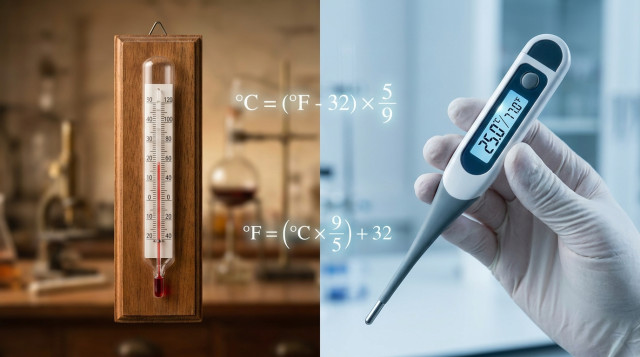
Converting Celsius to Fahrenheit is perhaps the most common conversion for travelers and international students. Because the Fahrenheit scale has 180 degrees between the freezing and boiling points of water, while the Celsius scale has only 100, the ratio between the two is 1.8 (or 9/5). Additionally, because Fahrenheit starts its freezing point at 32, we must add this constant to our calculation.
The Celsius to Fahrenheit Formula
To find the temperature in Fahrenheit (F) when you know the temperature in Celsius (C), use the following formula:
F = (C × 9/5) + 32
Alternatively, you can use the decimal version for faster mental math:
F = (C × 1.8) + 32
Step-by-Step Example: Converting 25 Degrees Celsius
Let us calculate what 25°C (a pleasant room temperature) is in Fahrenheit:
- Step 1: Multiply the Celsius temperature by 1.8. (25 × 1.8 = 45)
- Step 2: Add 32 to the result. (45 + 32 = 77)
- Result: 25°C is equal to 77°F.
How to Convert Fahrenheit to Celsius
If you are looking at a weather app or an oven setting in Fahrenheit and need to know the Celsius equivalent, you must reverse the previous process. This involves subtracting the 32-degree offset first and then dividing by the 1.8 ratio.
The Fahrenheit to Celsius Formula
To find the temperature in Celsius (C) from Fahrenheit (F), use this formula:
C = (F - 32) × 5/9
Or using decimals:
C = (F - 32) / 1.8
Step-by-Step Example: Converting 98.6 Degrees Fahrenheit
Let us convert the average human body temperature (98.6°F) into Celsius:
- Step 1: Subtract 32 from the Fahrenheit temperature. (98.6 - 32 = 66.6)
- Step 2: Divide the result by 1.8. (66.6 / 1.8 = 37)
- Result: 98.6°F is equal to 37°C.
The Kelvin Scale and Absolute Zero
In scientific contexts, particularly in physics and chemistry, the Kelvin scale is the standard. Unlike Celsius and Fahrenheit, Kelvin does not use the term 'degrees'; temperatures are simply expressed as Kelvins (K). The most significant feature of this scale is that it starts at 0 K, which is absolute zero. This is the theoretical temperature where particles have minimum thermal motion.
The relationship between Celsius and Kelvin is linear and straightforward because the size of one unit is exactly the same in both scales. The only difference is the starting point. Absolute zero is equivalent to -273.15°C.
How to Convert Celsius to Kelvin and Vice Versa
Since the increments are identical, you only need to account for the 273.15 difference between the two scales. This makes these calculations the easiest to perform manually.
Formula for Celsius to Kelvin
K = C + 273.15
Example: If a laboratory experiment requires a temperature of 20°C, what is that in Kelvin? (20 + 273.15 = 293.15 K).
Formula for Kelvin to Celsius
C = K - 273.15
Example: If a gas is cooled to 100 K, what is its temperature in Celsius? (100 - 273.15 = -173.15°C).
Converting Fahrenheit to Kelvin: The Two-Step Process
There is no direct, simple ratio between Fahrenheit and Kelvin that is easy to memorize. The most reliable way to perform this conversion manually is to first convert Fahrenheit to Celsius, and then add 273.15 to the result.
The Combined Formula
K = (F - 32) × 5/9 + 273.15
Practical Example: Converting 50 Degrees Fahrenheit
- Step 1: Convert 50°F to Celsius. (50 - 32 = 18; 18 / 1.8 = 10°C)
- Step 2: Add 273.15 to the Celsius result. (10 + 273.15 = 283.15 K)
- Result: 50°F is equal to 283.15 K.
Temperature Conversion Table for Quick Reference
For those who need immediate answers without performing the math, this table provides common temperature benchmarks across all three scales.
| Description | Celsius (°C) | Fahrenheit (°F) | Kelvin (K) |
|---|---|---|---|
| Absolute Zero | -273.15 | -459.67 | 0 |
| Freezing Point of Water | 0 | 32 | 273.15 |
| Room Temperature | 20 | 68 | 293.15 |
| Average Body Temp | 37 | 98.6 | 310.15 |
| Boiling Point of Water | 100 | 212 | 373.15 |
Practical Applications of Temperature Conversion
Why do we need to master these conversions? The reasons vary from daily chores to high-level professional requirements. In the culinary world, many classic recipes are written in Celsius if they originate in Europe or Fahrenheit if they come from the United States. Setting your oven to 200°C when the recipe calls for 200°F would result in a burnt meal, as 200°C is actually 392°F.
In the aviation and maritime industries, temperature affects air density and engine performance. Pilots often have to convert ambient temperatures to ensure safe takeoff distances. Similarly, in global logistics, sensitive cargo like pharmaceuticals or fresh produce must be kept within strict temperature ranges. If a shipping container's monitor is set to the wrong scale, the entire shipment could be compromised.
Common Mistakes in Temperature Calculations
One of the most frequent errors occurs when people forget the order of operations. In the Fahrenheit to Celsius conversion, you must perform the subtraction (F - 32) before multiplying or dividing. If you divide 32 by 1.8 first and then subtract, your result will be completely wrong.
Another common mistake is confusing the freezing points. It is easy to remember that 0°C is freezing, but many people mistakenly think 0°F is also freezing. Remembering that 32°F is the magic number for ice is crucial for safety, especially when driving in winter conditions.
Using an Online Temperature Converter for Accuracy
While manual formulas are excellent for understanding the relationship between units, human error is always a possibility, especially with complex decimals. Using a dedicated tool on Calculatorr.com ensures that your conversions are precise and instantaneous. This is particularly important in scientific or medical fields where a fraction of a degree can make a significant difference.
Online converters also allow for rapid switching between multiple units, which is helpful when comparing data from different international sources. Instead of performing three separate manual calculations to compare a weather report from London, New York, and a scientific paper using Kelvin, you can simply input the values and get immediate results.
Interpreting Your Results
When you obtain a result from a temperature conversion, it is important to place it in context. For example, if you convert a weather forecast and get a result of 40°C, you should recognize that this is extremely hot (104°F). If you are calculating a chemical reaction and get a result below 0 K, you know there is an error in your math, as temperatures below absolute zero are physically impossible in standard classical physics.
Understanding these scales allows you to communicate more effectively in a globalized world. Whether you are discussing climate change, which is usually measured in Celsius anomalies, or high-temperature engineering involving Kelvin, being fluent in temperature units is a valuable practical skill.