Understanding the conversion between square feet and square meters
Converting square feet to square meters is a fundamental task in various fields, including real estate, interior design, construction, and international travel. While the United States and a few other countries primarily use the imperial system, most of the world relies on the metric system. This discrepancy often leads to confusion when comparing property sizes or purchasing materials like flooring and paint. Understanding how to navigate these two units of measurement ensures accuracy in your projects and financial transactions.
Square feet (sq ft) measure area in the imperial system, while square meters (sq m) are the standard metric unit for area. Because a meter is longer than a foot, a square meter is significantly larger than a square foot. Specifically, one square meter is roughly equivalent to 10.76 square feet. When you are looking at international real estate listings or architectural plans from different regions, being able to perform this conversion quickly is an essential skill. You can always rely on a specialized tool at https://calculatorr.com/ to get instant results, but knowing the underlying math is vital for verifying data on the go.
The formula to convert square feet to square meters
To perform the conversion manually, you need a specific conversion factor. The most accurate factor used by professionals is 0.09290304. However, for most everyday applications, rounding this to 0.0929 is sufficient.
The mathematical formula is as follows:
Square Meters = Square Feet × 0.09290304
Alternatively, if you prefer division, you can divide the number of square feet by 10.7639:
Square Meters = Square Feet / 10.7639
Both formulas will yield the same result. The choice depends on whether you find multiplication or division easier to handle with your calculator or mental math. Using the multiplication method is generally faster when dealing with multiple measurements. For those who need to perform these calculations frequently, bookmarking a reliable resource like https://calculatorr.com/ can save significant time and reduce the risk of manual errors.
Step-by-step manual calculation guide
If you find yourself without a digital tool, you can follow these steps to determine the area in square meters manually:
- Step 1: Measure the dimensions. If you haven't calculated the square footage yet, measure the length and width of the space in feet.
- Step 2: Calculate square feet. Multiply the length by the width (Length in feet × Width in feet = Total Square Feet).
- Step 3: Apply the conversion factor. Multiply your total square footage by 0.0929.
- Step 4: Round the result. Depending on the required precision, round your final answer to two decimal places.
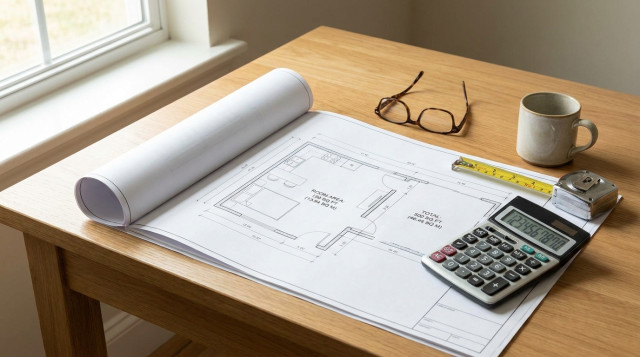
For example, if you have a room that is 15 feet long and 12 feet wide, the area is 180 square feet. To find the square meters: 180 × 0.0929 = 16.722 square meters.
Practical examples of area conversion
To better understand how these units relate in real-world scenarios, let's look at some common examples. These comparisons help visualize the scale of the metric system versus the imperial system.
Converting a standard bedroom size
A typical medium-sized bedroom in many modern homes is approximately 120 square feet. To convert this to the metric system for a furniture layout or international rental listing, we apply the formula:
120 sq ft × 0.0929 = 11.148 sq m
In this case, you would likely describe the room as being roughly 11 square meters. Knowing this helps when shopping for rugs or flooring in regions where metric measurements are the standard.
Converting a large residential property
Imagine you are looking at a house listed at 2,500 square feet. If you are comparing this to a property in Europe or South America, you need the metric equivalent:
2,500 sq ft × 0.0929 = 232.25 sq m
This conversion is crucial for understanding the true scale of the property. A 232-square-meter home is considered quite spacious in many parts of the world, and having the exact figure allows for better comparison across different markets.
Converting a small commercial office
For a small office space of 500 square feet, the calculation would be:
500 sq ft × 0.0929 = 46.45 sq m
This information is vital for commercial leases, where price per square meter is a common metric for determining monthly rent and utility costs.
Quick reference conversion table
The following table provides a quick look at common square feet measurements and their metric equivalents. This can serve as a handy cheat sheet for quick estimates.
| Square Feet (sq ft) | Square Meters (sq m) |
|---|---|
| 10 | 0.93 |
| 50 | 4.65 |
| 100 | 9.29 |
| 250 | 23.23 |
| 500 | 46.45 |
| 750 | 69.68 |
| 1,000 | 92.90 |
| 1,500 | 139.35 |
| 2,000 | 185.81 |
| 5,000 | 464.52 |
While this table is useful for estimates, always use a precise tool like the one found at https://calculatorr.com/ for official documentation or construction orders.
Why accuracy matters in real estate and construction
Precision in area conversion is not just a matter of academic interest; it has significant financial implications. In real estate, property value is often calculated based on the price per unit of area. A small error in conversion can lead to a discrepancy of thousands of dollars in the valuation of a home or commercial building.
In construction and renovation, accuracy is even more critical. If you are ordering expensive Italian marble or high-end hardwood flooring that is sold by the square meter, but your measurements are in square feet, a rounding error could result in you ordering too much or, worse, too little material. Ordering too little can lead to project delays and color mismatches if the next batch comes from a different production lot. Conversely, over-ordering leads to unnecessary waste and increased costs.
How to use an online area converter
Using a digital tool is the most reliable way to ensure your conversions are perfect. The interface at https://calculatorr.com/ is designed for simplicity and speed. To use it, follow these steps:
- Locate the area conversion section on the website.
- Select 'Square Feet' as your input unit.
- Enter the numerical value you wish to convert.
- Select 'Square Meters' as your output unit.
- The result will appear instantly, often with high decimal precision.
This method eliminates the risk of typos on a handheld calculator and ensures that the most up-to-date conversion factors are being applied. It is especially useful when dealing with complex numbers or large datasets.
Common mistakes when measuring area
One of the most frequent errors is confusing linear feet with square feet. A linear foot measures length, while a square foot measures area. You cannot convert linear feet directly to square meters; you must first calculate the total area in square feet.
Another common mistake is using an oversimplified conversion factor. Some people use 0.1 as a rough estimate (10 square feet = 1 square meter). While this is fine for a very quick mental guess, it represents a 7% error margin. On a 2,000 sq ft house, using 0.1 would give you 200 sq m, while the actual figure is approximately 186 sq m. That 14-square-meter difference is the size of a large bedroom!
Finally, always double-check if the 'square' has already been applied. If someone says a space is '10 feet square', they mean it is a square with 10-foot sides (100 square feet). If they say '10 square feet', they are describing the total area. Misinterpreting this terminology can lead to massive errors in your final metric conversion.
Practical tips for international projects
When working on projects that span different measurement systems, it is best practice to maintain a dual-unit spreadsheet. Record every measurement in both square feet and square meters from the beginning. This prevents the 'conversion fatigue' that leads to mistakes late in a project. Additionally, always verify which standard is legally binding in the jurisdiction where the property or project is located. In many countries, even if imperial units are used colloquially, the metric figure is the only one that holds weight in legal contracts and building permits.
For those moving abroad or buying property overseas, familiarize yourself with the 'feel' of a square meter. A square meter is roughly the size of a large card table. Visualizing the units helps you spot obvious errors in listings or documents before they become problematic. When in doubt, always return to https://calculatorr.com/ to verify your figures and ensure your planning is based on solid data.