
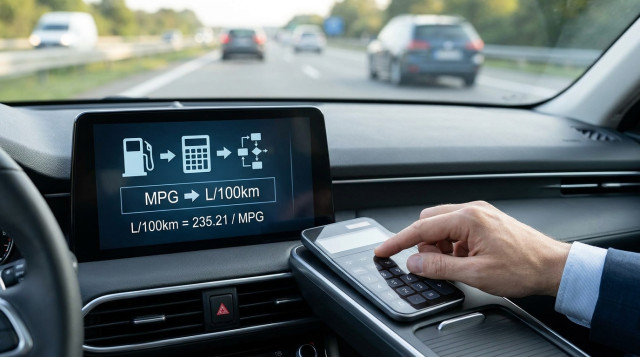
Understanding Fuel Efficiency Units
Fuel efficiency is a critical metric for vehicle owners, environmentalists, and budget-conscious drivers. However, the way this efficiency is measured varies significantly depending on where you are in the world. In the United States and the United Kingdom, the standard unit is Miles Per Gallon (MPG). In contrast, most other countries, particularly those using the metric system like Canada, Australia, and members of the European Union, use Liters per 100 Kilometers (L/100km).
The primary challenge when comparing these units is that they represent two different concepts. MPG is a measure of distance per unit of fuel (efficiency), meaning a higher number is better. L/100km is a measure of fuel consumed per unit of distance (consumption), meaning a lower number is better. Understanding how to convert between these two is essential for anyone looking to buy a car internationally or for travelers navigating different fuel standards. To make these transitions easier, tools available at Calculatorr provide instant results, but knowing the underlying math is invaluable.
The Difference Between US MPG and UK MPG
Before diving into the formulas, it is vital to distinguish between the two types of MPG. A gallon in the United States is not the same as a gallon in the United Kingdom. The US liquid gallon is approximately 3.785 liters, while the UK (Imperial) gallon is approximately 4.546 liters. Because the UK gallon is larger, a car will naturally achieve a higher MPG rating in the UK than it would in the US for the exact same fuel consumption.
When you are performing a conversion, you must first identify which gallon unit you are starting with. Using the wrong constant will result in a significant error in your final L/100km figure. This distinction is one of the most common mistakes made when comparing vehicle specifications across international markets.
The Formula to Convert US MPG to L/100km
To convert US Miles Per Gallon to Liters per 100 Kilometers, you use a specific mathematical constant. The relationship is inverse, meaning you divide the constant by the MPG value. The constant used for US MPG is 235.215.
The Formula:
L/100km = 235.215 / US MPG
This formula is derived from the conversion of miles to kilometers (1 mile = 1.609344 km) and US gallons to liters (1 gallon = 3.785411784 liters). By combining these factors into a single step, you can quickly determine how many liters of fuel a vehicle will consume over a 100-kilometer journey.
Step-by-Step Manual Calculation for US Units
If you want to perform this calculation manually without a digital tool, follow these steps:
- Identify the US MPG rating of the vehicle (e.g., 25 MPG).
- Take the constant 235.215.
- Divide 235.215 by your MPG value (235.215 / 25).
- The result is your fuel consumption in L/100km (9.41 L/100km).
[IMAGE SUGGESTION: A side-by-side comparison chart showing common US MPG values (20, 30, 40) and their corresponding L/100km values. Alt text: Comparison table of US MPG to L/100km fuel efficiency conversion]
The Formula to Convert UK MPG to L/100km
For those dealing with Imperial units, the constant changes because the gallon is larger. The constant for UK MPG is 282.481.
The Formula:
L/100km = 282.481 / UK MPG
Just like the US version, this is an inverse relationship. If a car is rated at 50 MPG in the UK, it does not mean it is more efficient than a 45 MPG car in the US without first normalizing the units to a common standard like L/100km.
Step-by-Step Manual Calculation for Imperial Units
To calculate the metric consumption from a UK MPG rating:
- Determine the UK MPG (e.g., 40 MPG).
- Use the constant 282.481.
- Divide 282.481 by 40.
- The result is 7.06 L/100km.
Practical Examples for Real-World Scenarios
Let’s look at how these conversions apply to real vehicles. Suppose you are looking at a compact car that advertises 35 US MPG. To find out how that translates to the metric system used in Europe, you would calculate: 235.215 / 35 = 6.72 L/100km. This tells you that for every 100 kilometers driven, the car uses roughly 6.7 liters of gasoline.
Now, consider a heavy-duty truck that gets 15 US MPG. The calculation would be: 235.215 / 15 = 15.68 L/100km. Notice how the L/100km number increases as the MPG decreases. This inverse relationship is why many people find the metric system more intuitive for calculating costs; it directly tells you how much fuel you are buying for a set distance.
[IMAGE SUGGESTION: A photo of a person holding a smartphone displaying a fuel conversion result next to a car's window sticker. Alt text: Using a fuel conversion calculator to check MPG to L/100km on a car window sticker]
Why Converting Fuel Economy is Essential for International Travelers
If you are planning a road trip in a foreign country, understanding these conversions helps you estimate your fuel budget. In countries like Germany or France, gas prices are listed per liter, and distances are in kilometers. If you are used to thinking in MPG, you might struggle to estimate how much a 500km trip will cost.
By converting your vehicle's known efficiency into L/100km, you can simply multiply the result by the distance (divided by 100) and then by the price per liter. For example, if your car consumes 8 L/100km and you are traveling 300km, you will need 24 liters of fuel (8 * 3). If fuel costs 1.50 per liter, your total cost is 36. This level of clarity is much harder to achieve using MPG alone.
How to Use the Calculatorr.com Conversion Tool
While manual calculations are useful for understanding the logic, using an online tool at Calculatorr is the fastest way to get accurate results without the risk of mathematical errors. To use a fuel conversion calculator, follow these steps:
- Select the input unit (US MPG or UK MPG).
- Enter the numerical value of your fuel efficiency.
- The tool will automatically apply the correct constant (235.215 or 282.481).
- View the instant conversion to L/100km.
This is particularly helpful when comparing multiple vehicles side-by-side during a car-buying process. You can quickly convert all options to L/100km to see which one truly offers the best fuel economy regardless of the region it was manufactured for.
Factors That Influence Your Actual Fuel Consumption
It is important to remember that the MPG or L/100km rating provided by manufacturers is often based on controlled laboratory tests. Your real-world results may vary based on several factors:
- Driving Style: Rapid acceleration and heavy braking significantly increase fuel consumption.
- Vehicle Load: Carrying extra weight or using roof racks increases drag and reduces efficiency.
- Tire Pressure: Under-inflated tires create more rolling resistance, requiring more energy to move the vehicle.
- Terrain: Driving in hilly or mountainous areas will always result in higher L/100km figures than flat highway driving.
- Weather: Cold temperatures and high winds can negatively impact how efficiently your engine operates.
Interpreting Your Results: What is a Good L/100km Rating?
Once you have converted your MPG to L/100km, you need to know what the numbers mean in a global context. Generally, for a standard passenger car:
- Under 5 L/100km: Excellent efficiency (typical of hybrids and very small diesel cars).
- 5 to 8 L/100km: Good efficiency (standard for modern compact and mid-size sedans).
- 8 to 12 L/100km: Average efficiency (common for crossovers and larger sedans).
- Over 12 L/100km: Poor efficiency (typical of large SUVs, trucks, and performance sports cars).
By understanding these brackets, you can better evaluate the environmental and financial impact of your vehicle choice. A shift from 10 L/100km to 5 L/100km literally halves your fuel bill and your carbon emissions for every mile driven.
Common Pitfalls in Fuel Efficiency Comparisons
One of the biggest traps is the "MPG Illusion." Because MPG is a non-linear measure of fuel consumption, the benefit of improving from 10 to 20 MPG is much greater than improving from 30 to 40 MPG. Specifically, going from 10 to 20 MPG saves 5 gallons every 100 miles, while going from 30 to 40 MPG only saves 0.83 gallons every 100 miles.
When you convert these to L/100km, the relationship becomes linear and much easier to grasp. A reduction of 2 L/100km always represents the same amount of fuel saved, regardless of whether you are starting at 15 L/100km or 7 L/100km. This is why many experts prefer the L/100km metric for policy-making and environmental tracking. Using a reliable calculator ensures you are making decisions based on clear, linear data rather than the sometimes misleading MPG scale.