The ability to convert liters to gallons is a fundamental skill used in various industries, from automotive engineering to international trade and home improvement. As the world becomes increasingly interconnected in 2026, understanding the relationship between the metric system and the imperial or US customary systems is more relevant than ever. While most of the world utilizes liters for liquid measurement, the United States and a few other regions continue to rely on gallons, making accurate conversion essential for travel, commerce, and scientific accuracy.
The Importance of Knowing How to Convert Liters to Gallons
Volume conversion is not just a mathematical exercise; it has real-world implications for budgeting and safety. For instance, if you are traveling through Europe or Canada and renting a vehicle, fuel is sold in liters. However, if you are accustomed to calculating fuel economy in miles per gallon (MPG), you must be able to translate those liters into a familiar unit to understand your travel costs. Similarly, in the shipping industry, liquid cargo volumes must often be reported in both units to comply with international regulations. Using a reliable tool like Calculatorr.com ensures that these conversions are handled with precision, preventing costly errors in logistics and planning.
Understanding the Two Types of Gallons: US vs. UK
One of the most common sources of confusion in volume measurement is the existence of two different types of gallons. Before performing any calculation, it is vital to identify which gallon you are targeting. The US liquid gallon and the British Imperial gallon are not the same size, and using the wrong one can lead to a discrepancy of approximately 20% in your results.
The US Liquid Gallon
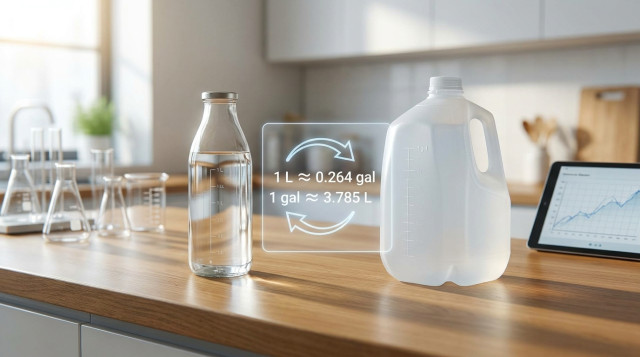
The US liquid gallon is the standard unit of liquid volume in the United States. It is defined as 231 cubic inches. In the metric system, one US liquid gallon is exactly 3.785411784 liters. For most practical and everyday purposes, this is rounded to 3.785 liters. This unit is used for gasoline, milk, and consumer beverages in the US market.
The Imperial (UK) Gallon
The Imperial gallon, also known as the UK gallon, is used primarily in the United Kingdom and some Commonwealth nations, though many of these countries have officially transitioned to the metric system. The Imperial gallon is larger than the US gallon, defined as the volume of 10 pounds of water at 62 degrees Fahrenheit. One Imperial gallon is equal to approximately 4.54609 liters. This significant difference means that a 'gallon' of fuel in London provides more volume than a 'gallon' of fuel in New York.
The Mathematical Formula for Liters to Gallons
To convert liters to gallons manually, you need to apply a specific division formula based on the type of gallon required. Mathematics provides the bridge between these two systems of measurement.
Converting to US Liquid Gallons
The formula to convert liters (L) to US gallons (gal) is: Gallons = Liters / 3.78541. If you have a volume in liters and want to know how many US gallons it represents, you divide the number of liters by the conversion factor of 3.78541.
Converting to Imperial Gallons
The formula to convert liters (L) to Imperial gallons (imp gal) is: Gallons = Liters / 4.54609. In this case, you divide the liter amount by 4.54609 to obtain the equivalent volume in UK units.
Step-by-Step Guide to Manual Conversion
Performing these calculations manually requires attention to detail, especially regarding decimal placement. Follow these steps for an accurate manual conversion:
- Identify the target unit: Determine if you need US liquid gallons or Imperial gallons.
- Locate the liter value: Start with the total number of liters you wish to convert.
- Apply the divisor: Use 3.785 for US gallons or 4.546 for UK gallons.
- Perform the division: Use a calculator or long division to find the quotient.
- Round the result: For most household or automotive tasks, rounding to two decimal places is sufficient. For scientific work, maintain at least four decimal places.
Practical Examples in Real-World Scenarios
To better understand how these formulas work, let us look at some common scenarios where you might need to convert liters to gallons.
Example 1: Fuel Tank Capacity
Imagine you are driving a car in Germany that has a fuel tank capacity of 50 liters. You want to know how many US gallons this is to compare it to your vehicle back home. Using the US formula: 50 / 3.78541 = 13.21 gallons. This tells you that the tank holds slightly over 13 gallons.
Example 2: Aquarium Volume
You purchase a large aquarium from a UK-based manufacturer that is rated at 200 liters. You need to know the Imperial gallon capacity for water treatment dosages. Using the Imperial formula: 200 / 4.54609 = 43.99 gallons. You can safely round this to 44 Imperial gallons for your calculations.
Example 3: Industrial Chemical Mixing
A factory requires 1,000 liters of a specific cleaning agent. The mixing instructions are provided in US gallons. To find the volume: 1,000 / 3.78541 = 264.17 US gallons. Accurate measurement here is crucial to ensure the chemical concentration is safe and effective.
Quick Reference Conversion Table
The following table provides a quick look at common liter-to-gallon conversions for both US and Imperial units. This is useful for rapid estimations without needing to perform the full math every time.
| Liters (L) | US Gallons (Approx.) | Imperial Gallons (Approx.) |
|---|---|---|
| 1 L | 0.26 gal | 0.22 gal |
| 5 L | 1.32 gal | 1.10 gal |
| 10 L | 2.64 gal | 2.20 gal |
| 20 L | 5.28 gal | 4.40 gal |
| 50 L | 13.21 gal | 11.00 gal |
| 100 L | 26.42 gal | 22.00 gal |
| 500 L | 132.09 gal | 109.98 gal |
Common Mistakes to Avoid in Volume Calculations
Errors in volume conversion can lead to engine damage, incorrect medication dosages, or financial loss. One of the most frequent mistakes is failing to distinguish between US and UK gallons. As shown in the examples above, the difference is nearly 20%, which is a massive margin of error in any technical field. Another common error is 'double rounding.' This happens when you round the conversion factor (e.g., using 3.7 instead of 3.785) and then round the final result. This compounds the inaccuracy. Always use the full conversion factor during the calculation and only round the final answer. Finally, ensure you are not confusing liquid gallons with 'dry gallons,' which are a separate unit used for grain and other dry commodities in the US, equal to approximately 4.405 liters.
How to Use an Online Volume Converter Effectively
While manual calculation is a great skill, using a digital tool like the ones found on Calculatorr.com is the most efficient way to ensure accuracy. To use an online converter, simply select the 'Volume' category, enter the number of liters in the input field, and choose 'Gallons' as the output. Most high-quality converters will allow you to toggle between US and Imperial gallons. This eliminates the risk of manual division errors and provides an instant result that is often more precise than what can be achieved with a handheld calculator. In 2026, these tools are optimized for mobile use, allowing you to perform conversions on the go, whether you are at a gas station or in a hardware store.
Why Precision Matters in Scientific and Industrial Contexts
In fields such as chemistry, pharmacology, and aerospace engineering, even a tiny deviation in volume can have catastrophic results. When converting liters to gallons for industrial purposes, professionals often use the most precise conversion factors available, extending to seven or more decimal places. For example, in the aviation industry, fuel weight is calculated based on volume and density. Since fuel expands and contracts with temperature, the conversion from liters to gallons must be exact to ensure the aircraft has enough energy for its flight path without carrying unnecessary weight. Understanding the math behind the conversion allows professionals to verify the results provided by automated systems, ensuring a double layer of safety and reliability in every calculation.