
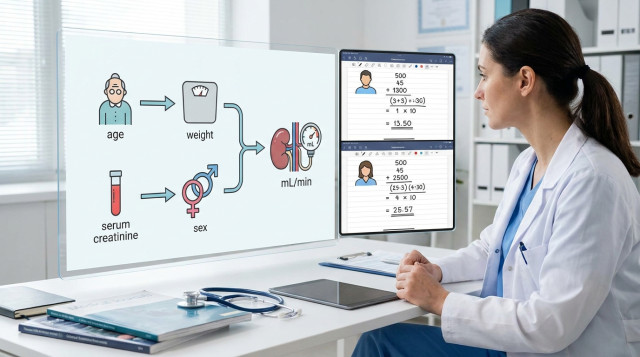
how to calculate creatinine clearance (Cockcroft‑Gault)
Creatinine clearance (CrCl) estimates how well the kidneys are filtering blood. The Cockcroft‑Gault formula is a common method to calculate CrCl for drug dosing and clinical decisions. Below you will find the formula, step‑by‑step manual calculations, practical examples, how to use an online calculator, and how to interpret results.
what is creatinine clearance and why it matters
Creatinine clearance approximates glomerular filtration rate (GFR) by relating serum creatinine to a patient’s age, weight and sex. It helps determine kidney function for medication dosing (especially renally cleared drugs), assessing progression of kidney disease, and guiding acute management. Remember that estimated CrCl is one piece of the clinical picture; use together with clinical findings and laboratory trends.
cockcroft‑gault formula
Main keyword: how to calculate creatinine clearance (Cockcroft‑Gault) — include this phrase in searches and internal links.
Standard Cockcroft‑Gault formula:
CrCl (mL/min) = ((140 − age) × weight (kg)) / (72 × SCr (mg/dL))
For females, multiply the result by 0.85:
CrClfemale = CrClmale × 0.85
which weight to use: total, ideal or adjusted?
Choice of weight affects the CrCl result, especially in underweight or obese patients.
- Total body weight (TBW): used for most patients with normal body composition.
- Ideal body weight (IBW): consider when patient is underweight. IBW (male) = 50 kg + 2.3 kg × (height in inches − 60). IBW (female) = 45.5 kg + 2.3 kg × (height in inches − 60).
- Adjusted body weight (AdjBW): used for obese patients (BMI ≥30). AdjBW = IBW + 0.4 × (TBW − IBW).
Clinical tip: for obese patients use Adjusted BW; for most others use TBW. Document which weight you used.
step-by-step calculation method
- Collect values: age (years), sex, serum creatinine (SCr in mg/dL), weight (kg), height (for IBW if needed).
- Decide which weight to use (TBW, IBW, or AdjBW).
- Plug values into the Cockcroft‑Gault formula.
- If female, multiply the result by 0.85.
- Round sensibly (typically to 1 decimal) and interpret against clinical thresholds for drug dosing or staging kidney disease.
example 1 — adult male with normal weight
Patient: 60 years, male, weight 80 kg, SCr 1.2 mg/dL.
Step 1: (140 − age) = 140 − 60 = 80.
Step 2: Multiply by weight: 80 × 80 = 6,400.
Step 3: Denominator: 72 × SCr = 72 × 1.2 = 86.4.
Step 4: CrCl = 6,400 / 86.4 = 74.07 mL/min.
Interpretation: CrCl ≈ 74 mL/min — generally sufficient for many medications, but check specific drug dosing guidelines.
example 2 — elderly female, low muscle mass
Patient: 78 years, female, weight 60 kg, SCr 1.0 mg/dL.
Step 1: (140 − 78) = 62.
Step 2: 62 × 60 = 3,720.
Step 3: 72 × 1.0 = 72.
Step 4: CrClmale = 3,720 / 72 = 51.67 mL/min.
Step 5: Adjust for female: 51.67 × 0.85 = 43.92 mL/min.
Interpretation: CrCl ≈ 44 mL/min — reduced renal clearance; many drugs require dose adjustment or increased monitoring.
example 3 — obese patient using adjusted body weight
Patient: 55 years, male, height 170 cm (66.9 in), TBW 110 kg, SCr 1.1 mg/dL.
Step 1: Calculate IBW (male) = 50 + 2.3 × (height in inches − 60) = 50 + 2.3 × (66.9 − 60) = 50 + 2.3 × 6.9 = 50 + 15.87 = 65.87 kg.
Step 2: AdjBW = IBW + 0.4 × (TBW − IBW) = 65.87 + 0.4 × (110 − 65.87) = 65.87 + 0.4 × 44.13 = 65.87 + 17.65 = 83.52 kg.
Step 3: (140 − 55) = 85. Multiply by weight: 85 × 83.52 = 7,098.2.
Step 4: Denominator: 72 × 1.1 = 79.2. CrCl = 7,098.2 / 79.2 = 89.65 mL/min.
Interpretation: CrCl ≈ 90 mL/min using adjusted weight — higher than if IBW used; choose method consistently and note limitations.
how to use an online creatinine clearance calculator
Online calculators speed the process and reduce transcription errors. To use one:
- Open a trusted medical calculator or a clinical tools section on sites such as https://calculatorr.com/ and find the Cockcroft‑Gault calculator.
- Enter age, sex, serum creatinine (mg/dL), weight (select TBW/IBW/AdjBW or enter height for automatic IBW calculation), and units.
- Review the output: many calculators will show both CrCl and suggested weight used. Some provide drug dosing recommendations—verify against local guidelines.
Tip: double‑check units (SCr in mg/dL vs μmol/L) — many calculators allow switching units and will convert automatically.
interpretation of results
Common CrCl ranges and implications:
- >90 mL/min: normal or high clearance — no renal dose adjustment typically required.
- 60–90 mL/min: mild reduction — check specific drug guidance.
- 30–59 mL/min: moderate reduction — many drugs require dose adjustment or longer dosing intervals.
- 15–29 mL/min: severe reduction — substantial dose changes likely; avoid some drugs.
- <15 mL/min: kidney failure range — individualized therapy and often dialysis considerations.
Always correlate CrCl with trends in serum creatinine, urine output, and clinical status. For acute kidney injury, formulas may not accurately reflect rapidly changing renal function.
common errors and limitations
- Relying solely on CrCl for patients with unstable renal function or rapidly changing SCr.
- Using TBW in extreme obesity without considering adjusted weight, which can overestimate CrCl.
- Using Cockcroft‑Gault in children — it is intended for adults; use pediatric equations for children.
- Interpretation without accounting for differences between CrCl and measured GFR (CrCl often overestimates GFR because creatinine is secreted by renal tubules).
- Not converting serum creatinine units correctly (μmol/L vs mg/dL). To convert μmol/L to mg/dL divide by 88.4.
when to use alternative formulas
Other eGFR formulas (CKD‑EPI, MDRD) are often preferred for staging chronic kidney disease because they are standardized to body surface area and may be more accurate across populations. However, Cockcroft‑Gault remains commonly used for drug dosing because many medication dosing recommendations were derived using CrCl values from Cockcroft‑Gault.
practical checklist before dosing based on CrCl
- Confirm units (SCr in mg/dL).
- Decide which weight to use and record it.
- Check for acute changes in creatinine or volume status that make estimates unreliable.
- Use a validated online calculator (for speed) and verify manual calculation for critical decisions.
- Document the CrCl value and any dose adjustments with rationale.
images suggested
Image 1 (placed near top of article): illustrative graphic of the Cockcroft‑Gault formula with labeled inputs (age, weight, SCr, sex). Alt text: 'Cockcroft‑Gault formula how to calculate creatinine clearance (Cockcroft‑Gault) with inputs age weight SCr sex'.
Image 2 (placed near examples section): side‑by‑side worked example calculations showing numeric steps and results. Alt text: 'worked examples showing how to calculate creatinine clearance Cockcroft‑Gault step by step'.
For more calculators related to kidney function and drug dosing see the calculators and clinical tools at https://calculatorr.com/ to speed calculations and avoid manual errors.