
Understanding the Wilks Score in Modern Powerlifting
In the world of strength sports, comparing the performance of a 150-pound lifter to a 300-pound lifter has always been a challenge. The Wilks Score was developed to solve this specific problem, providing a standardized way to measure relative strength across different body weights and genders. Whether you are competing in a local meet or tracking your progress in the gym in 2026, understanding your Wilks Score is essential for evaluating how strong you truly are relative to your size.
The score works by applying a specific coefficient to the total weight lifted in the three main powerlifting movements: the squat, bench press, and deadlift. This allows for a fair comparison between a lightweight athlete who might deadlift three times their body weight and a heavyweight athlete who lifts a massive absolute weight but a smaller multiple of their own mass. By using a tool like the ones available at Calculatorr, athletes can quickly see where they stand in the global hierarchy of strength.
The Mathematical Foundation of the Wilks Formula
The Wilks Formula is not a simple linear equation. It is a complex polynomial calculation that accounts for the fact that as body mass increases, the potential to lift more weight does not increase at the same rate. This concept, known as allometric scaling, is the reason why smaller athletes often appear stronger pound-for-pound. The formula uses different sets of coefficients for men and women to account for physiological differences in muscle distribution and bone density.
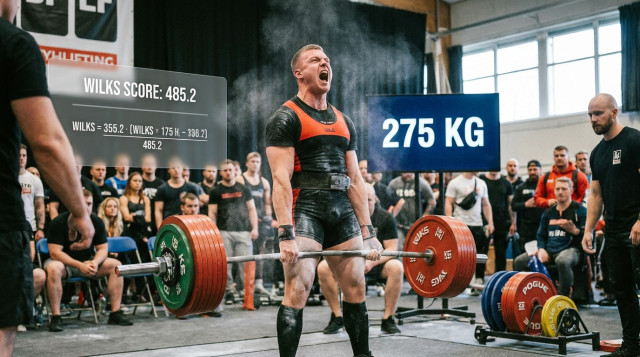
The standard formula is expressed as the total weight lifted multiplied by a coefficient (x). This coefficient is derived from a fifth-degree polynomial equation. While the math behind it is intricate, the goal is simple: to create a level playing field where a score of 400 means the same level of elite performance regardless of whether the lifter weighs 60kg or 120kg.
How to Determine Your Wilks Score Manually
To calculate your Wilks Score without an automated tool, you first need to know your exact body weight and your total weight lifted (the sum of your best successful attempts in squat, bench, and deadlift) in kilograms. If you use pounds, you must convert these values to kilograms first by dividing by 2.20462.
The coefficient is calculated using the following variables for men: a = -216.0475144, b = 16.2606339, c = -0.002388645, d = -0.00113732, e = 7.01863E-06, and f = -1.291E-08. The formula for the coefficient is: 500 divided by (a + bx + cx^2 + dx^3 + ex^4 + fx^5), where x is the lifter's body weight. Once you have this coefficient, you multiply it by your total lift weight to get your final Wilks Score.
Step-by-Step Calculation Example for a Male Lifter
Imagine a male lifter weighing 80kg with a total lift of 500kg. First, we calculate the denominator of the coefficient using the male variables and the body weight of 80. After performing the polynomial expansion (80 multiplied by b, 80 squared multiplied by c, and so on), we find the specific coefficient for an 80kg male. If the resulting coefficient is 0.6850, the calculation would be: 500kg x 0.6850 = 342.5 Wilks points. This score can then be compared against other lifters in different weight classes.
Interpreting Your Results: What is a Good Wilks Score?
Once you have obtained your score, the next step is understanding what that number signifies in terms of strength standards. While these standards can shift slightly over time, the general benchmarks for 2026 remain consistent with competitive powerlifting history. A score of 300 is generally considered a solid intermediate level for a drug-free lifter. Reaching 350 indicates a very strong regional competitor, while 400 is often the threshold for national-level performance.
Elite and world-class lifters typically boast scores exceeding 450 or even 500. It is important to note that these scores are often higher in 'equipped' powerlifting (where lifters use supportive suits) compared to 'raw' powerlifting. When comparing your results, ensure you are looking at the correct category to get an accurate sense of your standing. Using a dedicated strength metric helps you set realistic goals that focus on relative improvement rather than just chasing a higher absolute number on the bar.
Comparing Wilks with DOTS and IPF GL Points
While the Wilks Score was the undisputed king of strength metrics for decades, newer formulas like DOTS (Dynamic Objective Team Scoring) and IPF GL points have gained popularity in recent years. The DOTS formula was created to address some perceived biases in the Wilks Score, specifically that Wilks tended to favor very light and very heavy lifters while slightly disadvantaging those in the middle weight classes. The IPF GL formula is used specifically by the International Powerlifting Federation and scales differently based on the type of competition.
Despite these newer alternatives, the Wilks Score remains the most recognized metric in the global lifting community. Many lifters continue to use it because of the vast historical database of scores, allowing them to compare their current strength with legends of the sport from previous decades. If you are training for a specific federation, it is wise to check which formula they use for 'Best Lifter' awards, but for general progress tracking, Wilks remains a gold standard.
Common Errors When Measuring Relative Strength
One of the most frequent mistakes lifters make is using inconsistent units. The Wilks formula is strictly designed for kilograms. If you input your body weight in pounds but your total in kilograms, or vice versa, the resulting score will be completely inaccurate. Always ensure both values are in the same unit before starting the calculation. Another common error is using the wrong gender coefficients. Because the physiological potential for absolute strength differs between men and women, using the male formula for a female lifter will result in an unfairly low score.
Additionally, lifters often forget to use their 'meet day' body weight. In powerlifting, your weight at the time of the official weigh-in is what counts for the formula, not your average walking-around weight. If you are calculating your score at the gym, try to weigh yourself in the same state you would at a competition to ensure the data is meaningful for your training logs.
How to Use an Online Wilks Calculator Effectively
Manually calculating a fifth-degree polynomial is prone to human error. To get the most accurate results, using a digital tool is highly recommended. On platforms like Calculatorr, you simply enter your gender, body weight, and total lifted weight. The system instantly applies the correct coefficients and provides your score. This is particularly useful during a training session when you want to see how a new personal best (PR) affects your overall standing without breaking out a scientific calculator.
Beyond just getting a single number, you can use these tools to run 'what-if' scenarios. For example, you can determine if it is more beneficial for your score to lose 2kg of body weight or to add 10kg to your deadlift. This type of analysis is crucial for athletes who are considering moving up or down a weight class. By visualizing how weight fluctuations impact your relative strength, you can make more informed decisions about your nutrition and training programming.
Practical Applications for Your Training Program
The Wilks Score should be used as a long-term tracking metric rather than a daily obsession. Because strength gains take time, checking your score every week might lead to frustration. Instead, calculate your score at the end of every training cycle or after a mock meet. This provides a clear picture of your trajectory. If your absolute strength is going up but your Wilks Score is going down, it may indicate that you are gaining body mass faster than muscle, which could be a sign to adjust your caloric intake.
Furthermore, the score is a great motivational tool for those who may never be the heaviest lifter in the gym. It shifts the focus from 'who can lift the most' to 'who is the most efficient athlete.' This perspective is vital for smaller lifters and masters athletes who want to remain competitive and motivated. By focusing on increasing your Wilks points, you are prioritizing the quality of your strength and your body composition, leading to a more balanced and effective approach to the sport of powerlifting.