
What is Power-to-Weight Ratio in Cycling?
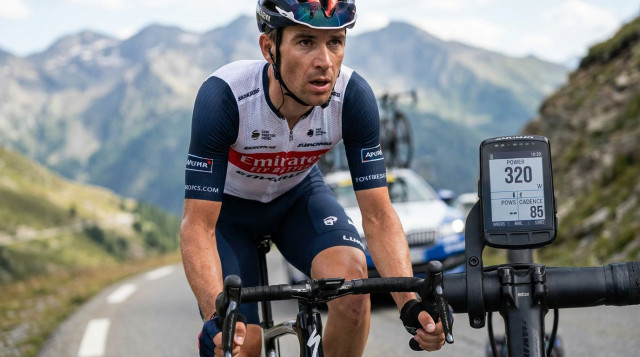
Power-to-weight ratio is a fundamental metric used by cyclists to measure their performance and efficiency, particularly when climbing. It represents the amount of power a rider can produce relative to their body mass. In the cycling world, this is expressed as watts per kilogram (W/kg). While absolute power is important for sprinting on flat roads, the power-to-weight ratio is the primary predictor of success when the road tilts upward and gravity becomes the main resistance.
Understanding this metric allows cyclists of all levels to compare their abilities fairly. A heavier rider might produce more total watts than a lighter rider, but if the lighter rider produces more watts for every kilogram of their body weight, they will likely reach the top of a mountain much faster. This is why professional climbers are often very lean; they aim to maximize their power output while minimizing the weight they have to carry uphill.
By focusing on this ratio, you can better understand your strengths and weaknesses as a cyclist. Whether you are training for a local gran fondo or looking to improve your times on a specific segment, knowing how to measure and improve your W/kg is essential for progress. You can find various tools to help with these measurements at Calculatorr.com, which simplifies the process of tracking your fitness evolution.
The Mathematical Formula for Watts per Kilogram
The calculation for power-to-weight ratio is one of the simplest formulas in sports science. To find your ratio, you divide your power output by your weight in kilograms. The standard power metric used for this calculation is your Functional Threshold Power (FTP), which is the maximum power you can theoretically maintain for one hour.
The formula is expressed as follows:
Power-to-Weight Ratio (W/kg) = Power (Watts) / Body Weight (Kilograms)
To use this formula accurately, you must ensure that both variables are measured correctly. If you measure your weight in pounds, you must first convert it to kilograms by dividing the weight in pounds by 2.20462. For example, a rider weighing 165 pounds would weigh approximately 74.84 kilograms.
How to Measure Your Functional Threshold Power (FTP)
Before you can calculate your ratio, you need an accurate measurement of your power. This requires a power meter installed on your bicycle or a smart indoor trainer. The most common way to determine your power for this calculation is through an FTP test. There are several protocols to choose from, depending on your experience level and equipment.
The 20-Minute FTP Test Protocol
The 20-minute test is the gold standard for most amateur and professional cyclists. It involves a thorough warm-up followed by a 20-minute all-out effort. Because a 20-minute effort is slightly higher than what you could maintain for a full hour, the standard practice is to take 95% of your average power during this interval to estimate your FTP.
For example, if your average power during the 20-minute test was 250 watts, your estimated FTP would be 237.5 watts (250 x 0.95). This figure is what you will use as the 'Power' variable in your W/kg formula.
The Ramp Test Method
The Ramp Test is a popular alternative, especially for those using indoor training platforms. It starts at a very low intensity and increases the power requirement every minute until the rider reaches exhaustion and can no longer turn the pedals. The FTP is then calculated as a percentage (usually 75%) of the highest power reached during the final minute of the test. This method is often preferred because it requires less pacing strategy than the 20-minute test.
Step-by-Step Guide to Calculating Your Ratio Manually
Once you have your FTP and your current body weight, you can perform the calculation manually. Follow these steps to ensure accuracy:
- Step 1: Weigh yourself. For the most accurate results, weigh yourself in the morning before eating, wearing only your cycling kit or undergarments.
- Step 2: Convert weight to kilograms. If your scale is in pounds, divide the number by 2.20462.
- Step 3: Identify your FTP. Use the result from your most recent 20-minute or Ramp test.
- Step 4: Divide Power by Weight. Divide your FTP (Watts) by your weight (kg).
For instance, if a cyclist has an FTP of 280 watts and weighs 70 kilograms, the calculation would be 280 / 70 = 4.0 W/kg. This rider produces 4 watts for every kilogram of body weight.
Practical Examples of Power-to-Weight Ratios
To put these numbers into perspective, let's look at how different profiles compare using the W/kg formula. These examples highlight how changes in either power or weight affect the final ratio.
| Rider Profile | FTP (Watts) | Weight (kg) | Power-to-Weight Ratio |
|---|---|---|---|
| Recreational Rider | 150 W | 85 kg | 1.76 W/kg |
| Intermediate Amateur | 220 W | 75 kg | 2.93 W/kg |
| Competitive Amateur | 300 W | 72 kg | 4.16 W/kg |
| Professional Climber | 380 W | 60 kg | 6.33 W/kg |
As seen in the table, the professional climber has a significantly higher ratio not just because of high power, but because that power is distributed over a very low body mass. An intermediate amateur might increase their ratio to 3.14 W/kg simply by losing 5 kilograms of body fat while maintaining the same 220-watt FTP.
Why Power-to-Weight Ratio Matters for Different Terrains
The importance of your W/kg ratio changes depending on the profile of the road. Understanding when this metric is the priority can help you choose the right races or training goals.
Climbing and Gravity
When you are riding up a steep incline (usually anything over a 5% grade), gravity is the primary force you are fighting. In this scenario, your power-to-weight ratio is the most critical factor. A rider with 5.0 W/kg will almost always outclimb a rider with 4.0 W/kg, regardless of their absolute power. This is why smaller, lighter riders often dominate mountain stages in professional racing.
Flat Roads and Aerodynamics
On flat roads, the primary resistance is air (aerodynamic drag). In this case, absolute power (total watts) and your aerodynamic profile (CdA) are more important than your power-to-weight ratio. A large rider producing 400 watts might have a lower W/kg than a small rider producing 250 watts, but the large rider will be much faster on the flats because they have more raw power to push through the air.
How to Use an Online Cycling Performance Calculator
While manual calculation is simple, using an online tool at Calculatorr.com can help you track changes over time and avoid mathematical errors. These tools often allow you to toggle between metric and imperial units instantly, which is helpful if you are used to tracking weight in pounds but need the result in W/kg.
To use a calculator, simply input your FTP and your weight. Many advanced calculators also allow you to input 'system weight' (rider + bike + gear). While the standard benchmark for fitness is based on body weight alone, calculating your system W/kg gives you a more realistic idea of your actual speed on a climb, as you must also move the weight of your bicycle and water bottles up the hill.
Interpreting Your W/kg Results
What does your result actually mean? Most cycling coaches use general categories to help riders understand where they stand compared to the broader cycling population. These categories are typically based on your FTP (60-minute sustainable power).
- Untrained: 1.0 - 2.0 W/kg. This is typical for beginners or recreational riders who cycle occasionally.
- Moderate: 2.0 - 3.0 W/kg. This range includes many club riders and consistent enthusiasts.
- Cat 3/4 Competitive: 3.0 - 4.0 W/kg. Riders in this range are often competitive in local races and fast group rides.
- Cat 1/2 Elite: 4.0 - 5.0 W/kg. These are high-level amateur racers who train systematically.
- Professional: 5.0 - 6.5+ W/kg. This is the territory of world-class athletes and World Tour professionals.
It is important to remember that these numbers are benchmarks. Your ratio can fluctuate throughout the season based on your training phase, diet, and overall health.
Common Errors in Power and Weight Measurement
To get a reliable power-to-weight ratio, you must avoid common pitfalls that can skew the data. One of the most frequent errors is using an outdated FTP. Power can change significantly in just a few weeks of training or detraining. If you use an FTP from six months ago, your current W/kg calculation will be inaccurate.
Another error is 'ego-weighting,' where a rider uses a weight they wish they were rather than their actual current weight. Even a 2-kilogram difference can change your ratio enough to move you into a different performance category. Additionally, ensure your power meter is calibrated (zero-offset) before every test to ensure the wattage readings are consistent and precise.
Tips to Improve Your Power-to-Weight Ratio
There are three ways to improve your ratio: increase your power, decrease your weight, or a combination of both. For most riders, the most sustainable approach is focusing on increasing power through structured training. This involves intervals at or above your threshold to force physiological adaptations.
Weight loss can also be effective, but it must be done carefully. Losing weight too quickly can lead to a loss of muscle mass, which often causes your absolute power to drop, potentially resulting in a lower W/kg than when you started. The goal should be to lose excess body fat while maintaining the lean muscle required to produce high wattage. Consistent training, proper recovery, and a balanced diet are the keys to optimizing this vital cycling metric.