Understanding the Relationship Between Square Meters and Acres
Land measurement is a fundamental aspect of real estate, agriculture, and urban planning. However, the units used to measure land vary significantly depending on the region and the specific industry. While the metric system, which uses square meters (m²), is the standard in most of the world, the acre remains the primary unit for land area in the United States, the United Kingdom, and several other countries. Understanding how to convert square meters to acres is essential for anyone dealing with international property listings, agricultural planning, or legal land documents.
A square meter is a SI unit of area defined as the area of a square with sides of one meter. It is a precise, scientific measurement used globally. On the other hand, the acre is a unit of area in the imperial and US customary systems. Historically, an acre was defined as the amount of land a yoke of oxen could plow in a single day. Today, it is standardized, but the transition between these two systems requires a specific mathematical conversion factor to ensure accuracy.
The Mathematical Formula for Square Meters to Acres
To perform an accurate conversion, you must use the established constant that relates these two units. The most commonly used conversion factor is based on the international acre. One international acre is exactly 4,046.8564224 square meters. For most practical purposes, this number is rounded to 4,046.86.
The formula to convert square meters to acres is:
Acres = Square Meters / 4,046.8564224
Conversely, if you need to find out how many square meters are in a specific number of acres, you would use the multiplication formula:
Square Meters = Acres × 4,046.8564224
Another useful constant to remember is the value of a single square meter in acres. One square meter is approximately 0.000247105 acres. This small decimal is often used when dealing with smaller plots of land or when high precision is required in scientific calculations.
[Image Suggestion 1: A high-resolution aerial photograph of a diverse landscape showing both urban plots and rural fields, with a subtle overlay of a grid representing square meters transitioning into a larger boundary representing an acre. Alt text: Aerial view of land plots illustrating the conversion of square meters to acres.]
Step-by-Step Guide to Manual Conversion
Performing the conversion manually is straightforward if you follow a consistent process. This is particularly useful when you are in the field or do not have immediate access to a digital tool. Follow these steps to ensure your results are reliable:
- Identify the total area in square meters: Ensure you have the exact figure from your land survey or deed.
- Apply the conversion factor: Divide your total square meters by 4,046.86.
- Determine the required precision: Depending on the purpose (e.g., a casual estimate vs. a legal document), decide how many decimal places you need to keep. For real estate, two or three decimal places are usually sufficient.
- Verify the result: Multiply your result back by 4,046.86 to see if you return to your original square meter figure.
For example, if you have a plot of land that is 20,000 square meters, the calculation would look like this: 20,000 / 4,046.86 = 4.942 acres. This simple division allows you to quickly translate metric data into a format that is more familiar in markets that use the imperial system.
Practical Examples for Real Estate and Agriculture
To better understand how these numbers translate to the real world, let’s look at some common scenarios where you might need to convert square meters to acres.
Example 1: Residential Development
Imagine a developer in Europe is selling a large parcel of land measuring 50,000 square meters to an American investment group. The investors need to know the size in acres to compare it with their domestic portfolio. Using the formula: 50,000 / 4,046.86 = 12.355 acres. This allows the investors to visualize the scale of the development based on their existing knowledge of land sizes.
Example 2: Small-Scale Farming
A farmer has a greenhouse area of 2,500 square meters and wants to know what fraction of an acre this represents for insurance purposes. The calculation would be: 2,500 / 4,046.86 = 0.617 acres. Knowing this helps the farmer fill out standardized forms that may only accept imperial units.
Example 3: Comparing Hectares and Acres
In many metric countries, the hectare is used for large land areas. One hectare is 10,000 square meters. To convert one hectare to acres: 10,000 / 4,046.86 = 2.471 acres. This is a very common conversion in international agriculture and environmental science.
| Square Meters (m²) | Approximate Acres | Common Context |
|---|---|---|
| 1,000 | 0.247 | Large residential lot |
| 4,047 | 1.000 | Standard 1-acre plot |
| 10,000 | 2.471 | One hectare |
| 40,468 | 10.000 | Small farm or estate |
| 100,000 | 24.710 | Industrial park or large farm |
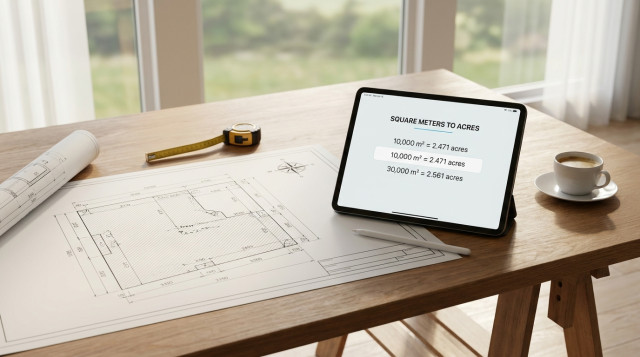
[Image Suggestion 2: A close-up of a professional land survey map with a compass and a calculator resting on top, showing handwritten notes of area conversions. Alt text: Land survey map with manual calculations for converting square meters to acres.]
Why Use an Online Area Converter
While manual calculations are effective, using a dedicated tool like Calculatorr provides several advantages, especially when dealing with complex figures or multiple conversions. Precision is the most significant benefit. Manual rounding at various steps can lead to cumulative errors, which might be costly in high-value real estate transactions.
Online converters use the full decimal string of the conversion factor (4,046.8564224), ensuring that the result is as accurate as possible. Furthermore, these tools often allow for instant switching between other units, such as square feet, square miles, or hectares, providing a comprehensive view of the land area in various systems. This speed and reliability make digital tools indispensable for professionals who need to process land data quickly and accurately.
Common Mistakes in Land Area Conversions
Errors in land measurement can lead to significant legal and financial complications. One of the most common mistakes is confusing the "International Acre" with the "US Survey Acre." While the difference is minute (about 2 parts per million), it can result in a discrepancy of several square feet over very large areas. For most commercial and residential purposes, the international acre is the standard.
Another frequent error is improper rounding. If you round the conversion factor to 4,000 instead of 4,046.86, you introduce a 1.1% error. On a 100-acre property, that is an error of over an acre, which could represent a massive difference in valuation. Always use at least two decimal places for the conversion factor (4,046.86) to maintain acceptable accuracy.
Finally, ensure that the original measurement is actually in square meters. Sometimes, measurements are provided in square yards or square feet. Converting from the wrong starting unit will obviously lead to an incorrect final acreage. Always verify your source units before applying the formula.
Interpreting Your Land Measurement Results
Once you have converted your square meters to acres, it is important to understand what that number actually represents. For many, an acre is a difficult size to visualize. A helpful rule of thumb is that an acre is approximately the size of an American football field, excluding the end zones. If your conversion results in 5 acres, you are looking at an area roughly equivalent to five football fields.
In a residential context, a standard suburban lot is often a quarter-acre (approx. 1,011 m²) or a third-acre (approx. 1,349 m²). If your calculation shows 0.5 acres, you have a substantial amount of space for a single-family home. In an agricultural context, the productivity of an acre varies wildly depending on the crop and soil quality, but having the accurate acreage is the first step in determining seed requirements, fertilizer application rates, and expected yield.
By mastering the conversion from square meters to acres, you gain the ability to navigate the global real estate market and agricultural sector with confidence. Whether you are using a manual formula or a digital tool on Calculatorr, the key is consistency, precision, and a clear understanding of the units involved.