
convert mph to m/s: what it means and when to use it
'Convert mph to m/s' refers to changing a speed value expressed in miles per hour (mph) into meters per second (m/s). This conversion is useful in physics, engineering, sports performance, and transportation when you need metric units for calculations, measurements, or displays.
Miles per hour is common in a few countries and in many legacy contexts; meters per second is the SI unit for speed and is required for scientific formulas, many simulation tools, and most engineering standards.
formula to convert mph to m/s
The conversion uses the relation between miles and meters and hours and seconds. One mile equals 1609.344 meters, and one hour equals 3600 seconds.
Formula:
m/s = mph × 1609.344 ÷ 3600
That simplifies to:
m/s = mph × 0.44704
why 0.44704?
- 1609.344 meters per mile divided by 3600 seconds per hour = 0.44704.
- Using the factor 0.44704 gives a direct and precise conversion without repeated division.
step-by-step manual conversion (three methods)
1. direct multiplication (fast and exact enough for most uses)
Multiply the speed in mph by 0.44704.
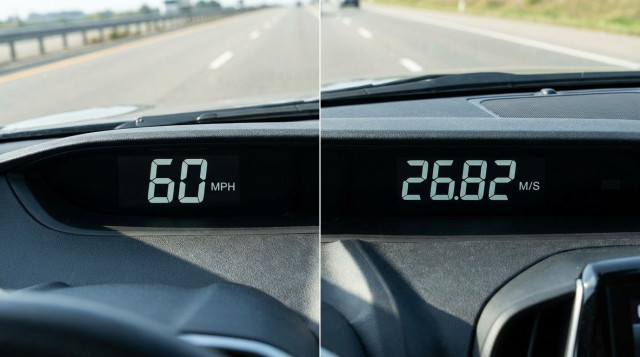
Example: 60 mph × 0.44704 = 26.8224 m/s.
2. convert via base units (explicit method)
- Take the value in mph. Example: 45 mph.
- Multiply by 1609.344 to get meters per hour: 45 × 1609.344 = 72,420.48 m/h.
- Divide by 3600 to get meters per second: 72,420.48 ÷ 3600 = 20.1168 m/s.
3. use fractions for mental math (approximate)
Since 0.44704 ≈ 0.447, a quick estimate is mph × 0.45 for conservative rounding or mph ÷ 2.24 for a simple mental shortcut (because 1 m/s ≈ 2.23694 mph).
Example: 10 mph ≈ 10 ÷ 2.24 ≈ 4.464 m/s (exact: 10 × 0.44704 = 4.4704 m/s).
practical examples with different speeds
| Speed (mph) | Exact m/s (mph × 0.44704) | Rounded m/s |
|---|---|---|
| 5 mph | 2.2352 | 2.24 m/s |
| 15 mph | 6.7056 | 6.71 m/s |
| 30 mph | 13.4112 | 13.41 m/s |
| 55 mph | 24.5872 | 24.59 m/s |
| 100 mph | 44.704 | 44.70 m/s |
how to reverse: convert m/s back to mph
To convert m/s to mph, use the reciprocal factor:
mph = m/s × 2.236936
Or divide by 0.44704. Example: 10 m/s × 2.236936 = 22.36936 mph.
using an online converter: quick and reliable
Online calculators speed up conversions and avoid transcription errors. Use a trusted speed conversion tool on Calculatorr to paste a value and get instant results in both units.
Steps to use an online converter:
- Open the speed conversion tool on https://calculatorr.com/ or the relevant conversion page.
- Select or enter the source unit (mph) and the target unit (m/s).
- Enter the numeric value and press convert; the tool returns the exact conversion and often offers rounding options.
how to interpret results and choose rounding
Interpretation depends on context:
- Engineering and scientific work: keep at least four to six significant digits or use the exact factor 0.44704 for internal calculations.
- Everyday context (running, driving estimates): one or two decimal places are enough (e.g., 13.4 m/s).
- Displays for dashboards or apps: choose rounding that matches the display precision and user expectations.
common mistakes and how to avoid them
- Mixing up units: confirm mph (miles per hour) vs kph (kilometers per hour). Converting kph to m/s uses a different factor (kph × 0.277777...).
- Using inaccurate conversion factors: use 0.44704 for mph→m/s and 2.236936 for m/s→mph for precision-sensitive tasks.
- Rounding too early: keep full precision while calculating multiple steps, then round for presentation.
- For small or very large speeds, watch significant figures to avoid misleading precision.
applications where mph to m/s conversion matters
- Physics problems and lab experiments that require SI units.
- Vehicle dynamics, braking distance, and crash analysis models often use m/s.
- Sports science and training analytics where velocity needs to feed into power or energy calculations.
- Simulations and control systems that expect metric inputs.
example: braking distance estimate using m/s
Some formulas for stopping distance use speed in m/s. Example: approximate braking distance under constant deceleration a is d = v^2 ÷ (2a).
If a car travels at 60 mph, first convert to m/s: 60 × 0.44704 = 26.8224 m/s.
Assuming deceleration a = 6 m/s², stopping distance d = (26.8224^2) ÷ (2 × 6) ≈ 359.6 ÷ 12 ≈ 29.97 m.
Without converting, plugging 60 into the formula would be invalid because units would mismatch.
extra tips and shortcuts
- Mental shortcut: divide mph by about 2.24 to estimate m/s quickly.
- For rounded everyday values: 10 mph ≈ 4.47 m/s, 20 mph ≈ 8.94 m/s, 30 mph ≈ 13.41 m/s.
- Create unit-aware spreadsheets that store the original mph and compute m/s with the exact factor to avoid repeated manual conversions.
internal resources and next steps
Use the conversion tools and related calculators on Calculatorr to convert speeds, check reverse conversions, or feed converted values into other calculators such as kinetic energy or travel time. For reference and quick access, visit the conversions section at https://calculatorr.com/.
final checklist before using converted values
- Confirm the source unit is mph (not kph or knots).
- Use 0.44704 as the conversion factor for precision.
- Keep full precision during calculations; round only for display.
- Validate converted values in an online tool if they feed safety-critical models.