
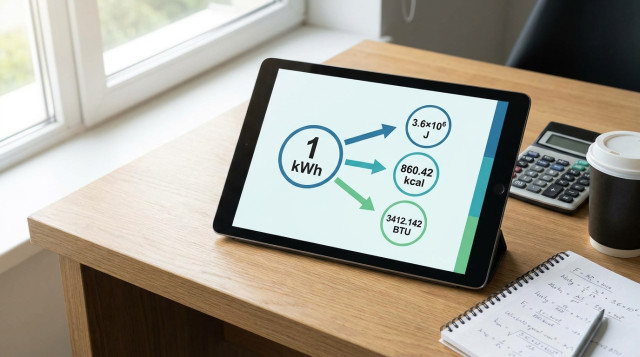
how to convert kilowatt-hours (kWh) to joules, calories and BTU explains the exact relationships between common energy units and shows step-by-step methods to perform conversions manually and with an online calculator. These conversions are useful for comparing electricity consumption, appliance energy use, food energy, and heating or cooling requirements.
what is a kilowatt-hour (kWh) and when to convert it
A kilowatt-hour (kWh) is a unit of energy equal to one kilowatt (1 kW) of power used for one hour. Utility bills, appliance energy ratings and simple energy estimates commonly use kWh. Converting kWh to other energy units like joules, calories and British Thermal Units (BTU) helps compare across disciplines: physics, nutrition and HVAC.
key conversion factors (kWh to joules, calories and BTU)
- 1 kWh = 3,600,000 joules (J). More compact: 1 kWh = 3.6 × 10^6 J.
- 1 kWh ≈ 860,420.65 calories (cal, small calorie). Often nutrition uses kilocalories (kcal): 1 kWh ≈ 860.42 kcal.
- 1 kWh ≈ 3,412.142 BTU (British Thermal Units).
why these factors matter
Joules are the SI energy unit used in physics and engineering. Calories (kcal) relate to food energy and metabolism. BTU is common in heating/cooling and HVAC calculations. Using precise factors avoids rounding errors when scaling or comparing values.
formulas to convert kWh to other units
Use these direct formulas.
To joules (J):
J = kWh × 3,600,000
To small calories (cal):
cal = kWh × 860,420.65
To kilocalories (kcal, food Calories):
kcal = kWh × 860.42
To BTU:
BTU = kWh × 3,412.142
step-by-step conversion method (manual)
Follow these steps to convert any kWh value to the desired unit.
- Identify the energy in kWh you want to convert.
- Choose the target unit (J, cal, kcal, BTU).
- Multiply the kWh value by the appropriate conversion factor from the table above.
- Adjust significant figures or rounding according to the required precision.
practical examples with numbers
example 1 — convert 2.5 kWh to joules
Step 1: value = 2.5 kWh.
Step 2: use factor 3,600,000 J per kWh.
J = 2.5 × 3,600,000 = 9,000,000 J.
Interpretation: 2.5 kWh equals 9 MJ (megajoules). This is useful when plugging into physics equations or energy budgets measured in joules.
example 2 — convert 0.75 kWh to kilocalories (kcal)
kcal = 0.75 × 860.42 ≈ 645.315 kcal.
Interpretation: If a process consumes 0.75 kWh, it releases about 645 kilocalories of energy—useful for comparing with food energy or body energy needs.
example 3 — convert 12 kWh to BTU
BTU = 12 × 3,412.142 ≈ 40,945.7 BTU.
Interpretation: 12 kWh is approximately 40.95 thousand BTU, a useful figure when sizing heaters or air conditioners that are rated in BTU/h.
reverse conversions: from joules, calories or BTU to kWh
Reverse formulas are the reciprocal of the forward factors.
- kWh = J / 3,600,000
- kWh = cal / 860,420.65
- kWh = kcal / 860.42
- kWh = BTU / 3,412.142
reverse example — how many kWh is 1.5 × 10^7 J?
kWh = 15,000,000 / 3,600,000 ≈ 4.1667 kWh.
Interpretation: 15 MJ corresponds to about 4.17 kWh—handy when converting measured energy in joules back to the electricity billing unit.
using an online kWh conversion calculator
A conversion calculator saves time and avoids manual errors. To use a kWh conversion tool:
- Enter the energy value in kWh (or the original unit if converting to kWh).
- Select the target unit (J, cal, kcal, BTU).
- Click convert to get instant results with the precise factor applied.
For quick conversions and comparatives, try the energy conversion tools available on https://calculatorr.com/ which show results in multiple units at once and let you copy values to spreadsheets.
rounding, significant figures and unit prefixes
When converting large or small values use prefixes to simplify presentation:
- 1 kJ = 1,000 J; 1 MJ = 1,000,000 J.
- 1 MWh = 1,000 kWh (useful for utility-scale calculations).
Keep consistent significant figures based on measurement precision. For appliance-level estimates, two or three significant digits are usually sufficient. For engineering work, follow project-specific tolerances.
common errors and how to avoid them
- Mixing calories (small cal) with food Calories (kcal). Always verify whether the source uses cal or kcal. Use 1 kcal = 1,000 cal.
- Confusing power (kW) with energy (kWh). kW is an instantaneous rate; kWh is an accumulated energy over time. To get energy, multiply power by time: Energy (kWh) = Power (kW) × Time (h).
- Rounding too early. Keep full precision during calculation and round final result.
- Wrong conversion factors. Use the exact numbers provided here for accurate results.
practical applications and interpretation of results
These conversions help in real situations:
- Comparing appliance energy use with food energy: e.g., a 1 kWh toaster equals ~860 kcal, showing relative energy magnitudes.
- Engineering calculations: convert measured joules from sensors into kWh for billing or reporting.
- HVAC sizing: convert kWh to BTU to match heating/cooling equipment specifications expressed in BTU/h or total BTU.
- Energy auditing and sustainability: express savings in kWh and translate to CO2 or caloric equivalents when communicating to nontechnical stakeholders.
conversion table: quick reference
| Energy (kWh) | Joules (J) | Kilocalories (kcal) | BTU |
|---|---|---|---|
| 0.1 | 360,000 | 86.042 | 341.214 |
| 1 | 3,600,000 | 860.42 | 3,412.142 |
| 5 | 18,000,000 | 4,302.1 | 17,060.71 |
| 10 | 36,000,000 | 8,604.2 | 34,121.42 |
final tips for accurate energy comparisons
- Always state units when sharing values (e.g., 3.5 kWh, not just 3.5).
- When comparing different energy forms, convert everything to the same unit first.
- Use an online converter for repetitive tasks to minimize human error—tools on calculatorr.com can speed conversions and export results.
- Document conversion factors used, especially in reports or shared spreadsheets, so others can reproduce your results.