
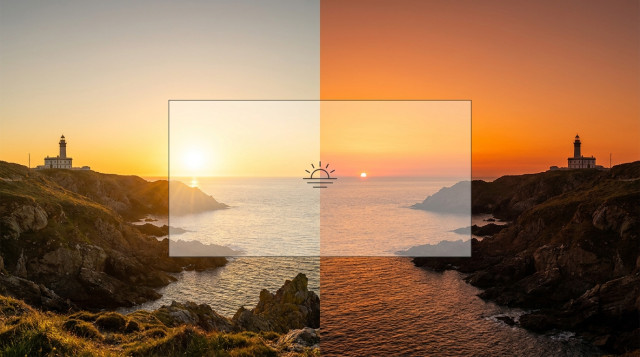
how to calculate sunrise and sunset times for any location
The sunrise and sunset times tell you when the Sun crosses the horizon at a given place. Calculating these times precisely requires astronomy concepts (solar declination, observer latitude, and solar hour angle) but you can follow a clear step-by-step method to compute them manually or verify online tools. This guide explains the formula, walks through calculations with real numbers, shows a shortcut for approximate results, and explains how to use an online calculator.
what the calculation is and why it matters
Sunrise and sunset times are the local clock times when the center of the Sun reaches the horizon, corrected for atmospheric refraction and the Sun's apparent radius. Applications include photography planning, solar energy estimates, prayer times, outdoor scheduling, and navigation.
key concepts and terms
- Latitude (φ): observer’s geographic latitude (degrees, positive north).
- Longitude (λ): observer’s geographic longitude (degrees, positive east).
- Julian day (JD): continuous count of days used in astronomy.
- Solar declination (δ): Sun’s angular position north/south of the celestial equator (degrees).
- Hour angle (H): angular distance the Earth must rotate to bring the Sun to the local meridian (degrees).
- Solar zenith angle (θ0): angle between local vertical and the Sun’s center at rise/set. For rise/set θ0 ≈ 90.833° (this includes refraction and Sun radius).
main formula to calculate sunrise and sunset
The core relation to compute the hour angle H0 at sunrise/set is:
cos H0 = (cos θ0 - sin φ · sin δ) / (cos φ · cos δ)
Where H0 is in degrees. Once H0 is known, the local solar time of sunrise and sunset is:
- Sunrise (local solar time) = 12:00 - H0/15
- Sunset (local solar time) = 12:00 + H0/15
To convert local solar time to clock time, apply the equation of time (EoT) and longitude-based time-zone offset.
step-by-step manual calculation
1) compute Julian day (JD) for the date
Convert the calendar date to Julian day number at 0h UT. Use standard algorithms (Fliegel-Van Flandern) or an online JD converter. For manual work use a reliable reference; the JD is needed to compute the Sun's mean longitude and mean anomaly.
2) calculate the Sun’s mean longitude and anomaly
Compute the number of days since J2000.0: n = JD - 2451545.0. Then approximate:
- L = 280.46° + 0.9856474° × n (mean longitude)
- g = 357.528° + 0.9856003° × n (mean anomaly)
Reduce L and g to the range 0–360° (subtract multiples of 360°).
3) compute ecliptic longitude and solar declination
Approximate the Sun’s ecliptic longitude λs:
λs = L + 1.915° sin g + 0.020° sin 2g
Then the obliquity of the ecliptic ε ≈ 23.439° (use small corrections if high precision needed). Compute declination δ:
sin δ = sin ε · sin λs → δ = arcsin(sin δ)
4) compute hour angle H0 for rise/set
Use θ0 = 90.833° (this standard value includes atmospheric refraction and Sun radius). Then calculate:
cos H0 = (cos θ0 - sin φ · sin δ) / (cos φ · cos δ)
If |cos H0| > 1, the Sun does not rise or set on that date at that latitude (polar day/night).
Compute H0 = arccos(cos H0) in degrees.
5) convert hour angle to local solar time
Local solar noon occurs when the Sun crosses the local meridian. The sunrise and sunset times in local solar time are:
Sunrise = 12:00 - H0/15, Sunset = 12:00 + H0/15
6) apply equation of time (EoT) and timezone correction
The equation of time (in minutes) corrects the difference between apparent solar time and mean solar time (clock). Approximate EoT with:
EoT ≈ 9.87 sin(2B) - 7.53 cos B - 1.5 sin B, where B = 360°(N - 81)/365
Here N is the day of year. Convert EoT minutes to hours and add to local solar time. Then adjust for longitude: local civil time = local solar time + (longitude_ref - λ) / 15 + timezone_offset, where longitude_ref is the standard meridian of the time zone (e.g., for UTC+2 it's 30°E) and timezone_offset is the time zone in hours from UTC.
example: calculate sunrise and sunset for Madrid (approx) on day 172
Use example values to illustrate the method with rounded approximations. Madrid approximate coordinates: φ = 40.4°N, λ = -3.7° (west). Use N = 172 (June 21-ish). The following steps use simplified approximations for clarity.
- Approximate solar declination δ on summer solstice ≈ +23.44°.
- θ0 = 90.833°.
- Compute cos H0 = (cos 90.833° - sin 40.4° · sin 23.44°) / (cos 40.4° · cos 23.44°).
Numerical values:
- cos 90.833° ≈ -0.01454
- sin 40.4° ≈ 0.649
- sin 23.44° ≈ 0.398
- cos 40.4° ≈ 0.761
- cos 23.44° ≈ 0.917
So numerator = -0.01454 - (0.649 × 0.398) = -0.01454 - 0.258 ≈ -0.273
Denominator = 0.761 × 0.917 ≈ 0.698
cos H0 ≈ -0.273 / 0.698 ≈ -0.391
H0 = arccos(-0.391) ≈ 112.99° → H0/15 ≈ 7.533 hours.
Local solar sunrise ≈ 12:00 - 7.533 = 4:28, sunset ≈ 19:32 (local solar time).
Apply EoT for N=172: B ≈ 360(172-81)/365 ≈ 88.9°. EoT ≈ 9.87 sin(177.8°) - 7.53 cos 88.9° - 1.5 sin 88.9° ≈ small value ≈ -1.4 minutes (approx). Madrid longitude is -3.7°; Standard meridian for CET (UTC+1) is 15°E (difference = 18.7°). Longitude correction = (15 - (-3.7))/15 = 18.7/15 ≈ +1.247 h. If using UTC+2 (DST) the standard meridian is 30°E; adjust accordingly. After applying corrections the clock times are roughly sunrise 6:45 and sunset 21:37 during long summer days (this example shows the process; use exact JD/EoT routines for precise results).
quick approximate method for daily use
For many practical purposes a simpler approximation is enough:
day length ≈ 2 × (1/15) × arccos( -tan φ × tan δ)
Then sunrise = 12:00 - day_length/2, sunset = 12:00 + day_length/2 (before applying EoT and longitude/timezone corrections). This ignores refraction and Sun radius but gives a quick estimate.
how to use an online calculator
Using an online sunrise/sunset calculator saves the heavy astronomy steps. Enter date and coordinates or city. A good workflow:
- Find latitude/longitude of the location (search or use GPS).
- Enter date and coordinates into the calculator.
- Check if the tool returns times in local civil time and whether it accounts for DST.
- Compare the calculator results with manual estimates to learn where approximations differ.
Calculatorr offers relevant conversion and date/time tools; include links internally for coordinate lookup and time zone conversion on https://calculatorr.com/ to streamline inputs and verify results.
interpreting results and common pitfalls
- If cos H0 > 1 or < -1: no sunrise/sunset on that date at that latitude (polar day/night).
- Remember to include atmospheric refraction and the Sun’s apparent radius — the standard θ0 = 90.833° accounts for both.
- Equation of time can shift apparent times by up to about ±16 minutes annually; ignore it only for rough estimates.
- Longitude and time zone mismatches cause systematic shifts—use the time zone standard meridian or convert via UTC to avoid errors.
- Daylight saving time: online tools usually apply local DST rules; manual methods need explicit adjustment.
example: full worked calculation for New York City (approx)
Coordinates: φ = 40.7128°N, λ = -74.0060°. Date: equinox (δ ≈ 0°). Using θ0 = 90.833°:
cos H0 = (cos 90.833° - sin 40.713° × sin 0°) / (cos 40.713° × cos 0°) = cos 90.833° / cos 40.713° ≈ -0.01454 / 0.757 ≈ -0.0192
H0 = arccos(-0.0192) ≈ 91.10° → H0/15 ≈ 6.073 h.
Local solar sunrise ≈ 12:00 - 6.073 = 5:55, sunset ≈ 18:04 (local solar time). Apply EoT ~ 0 min around equinox and longitude correction: NYC standard meridian for EST (UTC-5) is -75°; longitude is -74°, correction = (-75 - (-74))/15 = -1/15 h ≈ -0.0667 h (~ -4 min). Civil times are about sunrise 6:51 and sunset 18:54 around equinox after applying time zone and DST variations—use exact JD/EoT for precise clock times.
recommended checks and tools
- Use precise JD and EoT formulas (or reliable libraries) for high accuracy.
- Cross-check with an online sunrise/sunset calculator and a time zone converter on https://calculatorr.com/.
- Validate results against trusted observatory data for mission-critical needs (solar installations, navigation).
errors users commonly make
- Forgetting to convert degrees to radians when using trigonometric functions in calculators or spreadsheets.
- Ignoring atmospheric refraction and the Sun’s radius (use θ0 = 90.833° for standard rise/set).
- Applying wrong sign conventions for longitude (east positive vs west positive).
- Mixing local solar time with civil clock time without applying EoT and timezone corrections.
With the formulas and steps above you can compute sunrise and sunset times manually and understand the corrections an online calculator performs. For quick, accurate results use an astronomy-capable calculator and verify inputs for coordinates, date, and time zone. Check related tools on Calculatorr to convert coordinates, compute Julian day, and adjust time zones.