
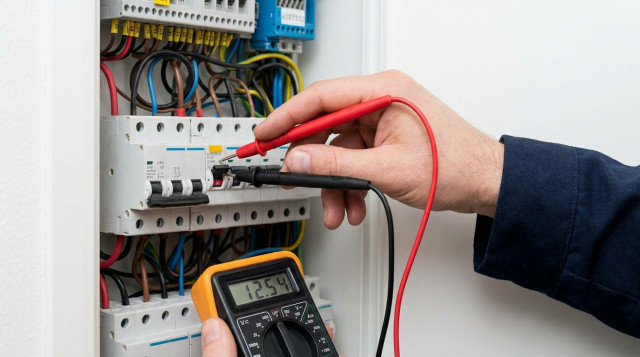
The Relationship Between Watts, Volts, and Amps
Understanding how to convert watts to amps is a fundamental skill for anyone dealing with electrical systems, whether you are a DIY enthusiast, a homeowner planning a renovation, or someone setting up a solar power system. To perform this conversion accurately, you must first understand the three core components of electricity: wattage, voltage, and amperage. These three elements work together to power everything from the smallest LED bulb to the largest industrial machinery.
Wattage (W) represents the total power consumed or produced by an electrical device. It is the rate at which energy is transferred. Amperage (A), or current, measures the flow of electricity through a conductor, such as a wire. Voltage (V) is the electrical pressure that pushes the current through the circuit. A common way to visualize this is the water pipe analogy: voltage is the water pressure, amperage is the flow rate of the water, and wattage is the total amount of work the water can do, such as turning a water wheel.
When you need to know how many amps a device draws, you are essentially asking how much current is flowing through the wires. This is critical because every wire and circuit breaker has a maximum amperage limit. Exceeding this limit can lead to overheating, melted insulation, and even electrical fires. By learning to calculate amps from watts, you can ensure your electrical setups remain safe and efficient in 2026 and beyond.
The Fundamental Watts to Amps Formula
The basic formula for converting watts to amps is derived from Ohm's Law and the Power Law. In its simplest form, for Direct Current (DC) circuits, the formula is:
I = P / V
Where:
I is the current in Amps (A)
P is the power in Watts (W)
V is the voltage in Volts (V)
This formula tells us that to find the amperage, you simply divide the total wattage by the voltage of the system. However, the calculation becomes slightly more complex when dealing with Alternating Current (AC), which is the type of electricity found in most homes and businesses. For AC circuits, factors such as the power factor and the number of phases (single-phase vs. three-phase) must be considered to get an accurate result.
Calculating Amps in DC Circuits
Direct Current is commonly found in battery-powered devices, automotive systems, and solar panel installations. In these systems, the flow of electricity is unidirectional, making the calculation straightforward. If you have a 120-watt solar panel running on a 12-volt system, the calculation would be:
120 Watts / 12 Volts = 10 Amps
This simple division is highly reliable for DC applications. It is essential for sizing fuses and wiring in vehicles or off-grid power setups where 12V or 24V systems are standard.
Calculating Amps in AC Single-Phase Circuits
Most residential wall outlets provide single-phase AC power. In the United States, the standard voltage is typically 120V or 240V, while in many other parts of the world, it is 230V. When calculating amps for AC, we introduce the 'Power Factor' (PF). The power factor is a decimal between 0 and 1 that represents how efficiently the device uses electricity. For purely resistive loads like a standard electric heater, the PF is 1.0. For devices with motors or compressors, the PF might be lower, such as 0.8.
The formula for AC single-phase is:
I = P / (V × PF)
If you are using a 1500-watt space heater on a 120V circuit with a power factor of 1.0, the calculation is:
1500 / (120 × 1.0) = 12.5 Amps.
Calculating Amps in AC Three-Phase Circuits
Three-phase power is primarily used in industrial and commercial settings to run heavy machinery. There are two main types of three-phase configurations: Line-to-Line (L-L) and Line-to-Neutral (L-N). The formula for Line-to-Line voltage is:
I = P / (V × 1.732 × PF)
The number 1.732 is the square root of 3, a constant used in three-phase calculations. If an industrial motor is rated at 10,000 watts, operates at 480V, and has a power factor of 0.85, the amperage would be:
10,000 / (480 × 1.732 × 0.85) ≈ 14.17 Amps.
Step-by-Step Guide to Manual Calculation
Performing these calculations manually ensures you understand the load you are placing on your electrical system. Follow these steps to convert watts to amps for any device:
- Identify the Wattage: Look for the 'W' or 'Watts' rating on the device's label. If only kilowatts (kW) are listed, multiply by 1,000 (e.g., 1.5 kW = 1,500 W).
- Determine the Voltage: Check your power source. Standard US household outlets are 120V. Large appliances like dryers or ovens often use 240V.
- Check the Power Factor: For most household calculations, using a PF of 1.0 is a safe starting point for resistive loads. For electronics or motors, use 0.8 or 0.9 if the specific PF isn't listed.
- Apply the Formula: Divide the wattage by the voltage (and the PF if applicable).
- Verify the Result: Compare the calculated amperage to the rating of your circuit breaker to ensure it won't trip.
Practical Examples for Everyday Use
To better understand how these conversions apply to real life, let's look at some common household scenarios. These examples assume standard US 120V or 240V circuits.
| Appliance | Wattage | Voltage | Calculated Amps |
|---|---|---|---|
| LED Light Bulb | 10W | 120V | 0.08A |
| Coffee Maker | 1000W | 120V | 8.33A |
| Microwave | 1200W | 120V | 10.00A |
| Electric Clothes Dryer | 5000W | 240V | 20.83A |
| Gaming PC | 600W | 120V | 5.00A |
In these examples, you can see why certain appliances require dedicated circuits. A microwave drawing 10 amps and a coffee maker drawing 8.33 amps cannot run simultaneously on a standard 15-amp kitchen circuit without tripping the breaker, as their combined draw would be 18.33 amps.
Understanding Power Factor and Efficiency
The power factor is often overlooked, but it is vital for professional-grade calculations. It represents the ratio of 'real power' (used to do work) to 'apparent power' (the total power flowing through the circuit). In 2026, as more energy-efficient appliances enter the market, understanding PF becomes even more relevant. A low power factor means the circuit is carrying more current than is strictly necessary to perform the work, which can lead to energy waste and higher utility costs in commercial environments.
When you use a calculatorr.com tool for electrical conversions, you will often see an option to input the power factor. For most modern switching power supplies (like those in laptops), the PF is quite high (0.95+). However, older induction motors might have a PF as low as 0.7. Always check the manufacturer's specifications if precision is required for safety or billing purposes.
Why Amperage Matters for Electrical Safety
The primary reason to convert watts to amps is safety. Electrical wires are rated by their 'ampacity,' which is the maximum amount of current they can carry before they start to heat up excessively. For example, a standard 14-gauge copper wire is typically rated for 15 amps, while a thicker 12-gauge wire is rated for 20 amps.
If you plug a high-wattage appliance into an undersized extension cord, the cord will draw more amps than it can handle. This causes the cord to become hot to the touch and can eventually melt the plastic casing. Similarly, circuit breakers are designed to 'trip' or shut off the flow of electricity when the amperage exceeds a certain threshold (usually 15A or 20A for home outlets). Knowing how to calculate the amperage of your devices allows you to distribute the load across different circuits, preventing annoying power outages and dangerous electrical hazards.
How to Use an Online Watts to Amps Calculator
While manual calculations are great for understanding the theory, using an online tool at calculatorr.com is the fastest way to get accurate results, especially for complex AC or three-phase conversions. Here is how to use one effectively:
- Select the current type (DC, AC Single Phase, or AC Three Phase).
- Enter the power in watts.
- Enter the voltage of your system.
- If you are calculating for AC, enter the power factor (default is usually 1.0).
- Click calculate to see the amperage instantly.
Using a digital tool reduces the risk of mathematical errors and allows you to quickly toggle between different voltages to see how they affect the current. For instance, you can see how switching from a 120V to a 240V system for a high-power appliance cuts the amperage in half, which is why heavy appliances use higher voltages.
Common Mistakes in Electrical Conversions
One of the most frequent errors is forgetting to account for the difference between starting watts and running watts. Many devices with motors, such as refrigerators or air conditioners, require a 'surge' of power to start up. This surge can be two to three times higher than the running wattage. If you only calculate amps based on the running wattage, you might find that your circuit breaker trips every time the compressor kicks in.
Another mistake is ignoring the voltage drop. In very long runs of wire (such as an extension cord reaching the back of a large property), the voltage can drop significantly by the time it reaches the device. Since Amps = Watts / Volts, a lower voltage actually forces the amperage to increase to provide the same amount of power, which can lead to overheating. Always ensure you are using the actual voltage at the device for the most accurate safety calculations.